KKR vs SRH IPL Match Analysis: Key Takeaways and Future Impact
Two of the most unpredictable teams in the Indian Premier League (IPL) collided once again as Kolkata Knight Riders (KKR) faced Sunrisers Hyderabad (SRH) in a match that could reshape the tournament’s narrative. The outcome hinged on moments of brilliance, tactical missteps, and the sheer unpredictability that defines T20 cricket.
The Context: Why This Match Matters
Coming into this fixture, both teams stood at different crossroads. KKR, despite boasting a star-studded lineup, had struggled with consistency, particularly in close contests. Their middle order had shown flashes of potential but lacked the finishing power required in crunch situations. SRH, on the other hand, had defied early-season expectations. Under the leadership of Aiden Markram, the team had rediscovered its aggressive brand of cricket, blending youth with experience in ways that had revitalized their campaign.
The stakes were higher than just two points. With the IPL’s playoff spots tightening, this match offered both teams a chance to assert their dominance in a league where momentum often shifts as quickly as the dew factor on a Kolkata evening. For KKR, a win would have been a statement of intent; for SRH, it would have reinforced their status as serious contenders rather than pretenders.
Key Storylines Before the Toss
- KKR’s Batting Depth: Could Shreyas Iyer’s line-up handle the pressure of a high-scoring game, or would they once again falter against quality spin?
- SRH’s Death Bowling: Bhuvneshwar Kumar and T Natarajan had the task of defending totals in the final overs, a challenge they had met with mixed success.
- Varun Chakravarthy’s Spin: The mystery spinner had been KKR’s X-factor, but could he replicate his earlier performances against a batting unit brimming with right-handers?
- Nitish Rana’s Role: The opener had been in sublime form, but his ability to anchor the innings would be crucial in a match where the pitch could favor spinners.
Match Highlights: A Game of Margins
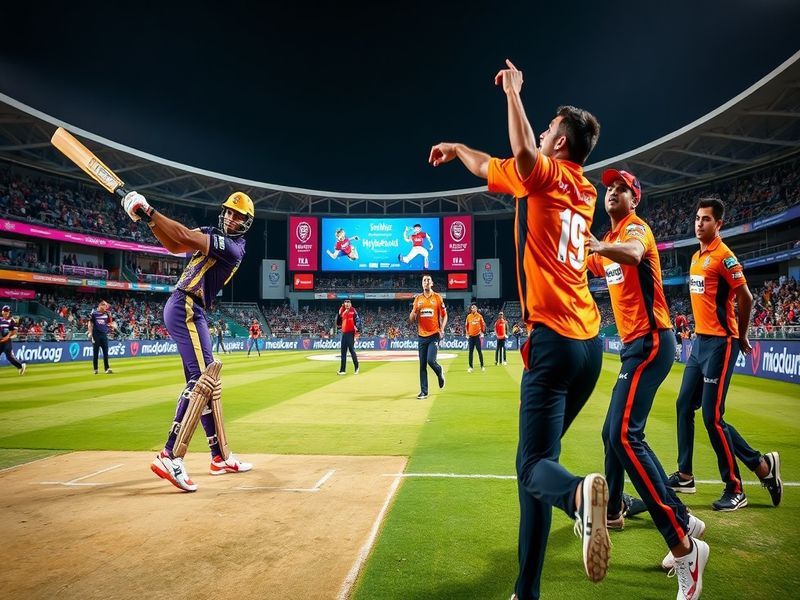
The game began with SRH winning the toss and opting to bowl first—a decision that would prove pivotal. The Kolkata pitch, traditionally slow and low, offered little to the pacers, and SRH’s spinners were tasked with stemming the flow of runs early. However, KKR’s top order, led by Nitish Rana and Rahmanullah Gurbaz, attacked from the outset. Rana’s fluid strokeplay and Gurbaz’s aggression set the tone, as KKR raced to 50 in the powerplay.
SRH’s bowling coach Muttiah Muralitharan, watching from the dugout, must have grimaced as the boundaries kept coming. Bhuvneshwar Kumar’s first spell was torn apart, with Rana and Gurbaz treating his variations with disdain. The introduction of Washington Sundar and Abhishek Sharma brought a semblance of control, but by then, KKR had already laid a foundation that looked unassailable.
The middle overs saw KKR’s middle order struggle slightly. Shreyas Iyer, promoted to accelerate, found the pitch slow, and his dismissal triggered a mini-collapse. Andre Russell, the big-hitting all-rounder, tried to steady the ship, but his dismissal brought KKR to a total that, while competitive, was far from intimidating. When SRH’s innings began, the dew had already started to play its part, making the Kolkata surface slower and heavier.
SRH’s chase got off to a shaky start, with Marcus Stoinis and Rahul Tripathi falling early. Markram and Glenn Phillips steadied the ship, but the required rate kept climbing. A brief flurry from Abhishek Sharma in the death overs brought SRH close, but KKR’s bowlers held their nerve. The final over, bowled by Lockie Ferguson, saw SRH require 12 runs. A six and a four from Phillips kept the game alive, but a brilliant last-ball yorker sealed the victory for KKR by a margin of 2 runs.
Broader Implications: What This Result Means for the IPL
This victory was more than just three points in the standings. For KKR, it was a much-needed confidence boost ahead of their upcoming fixtures. The team had been criticized for their inability to close out games, and this win, though narrow, demonstrated that they possess the tools to grind out results when it matters most. Shreyas Iyer’s captaincy, often questioned for its tactical acumen, received a rare endorsement from the performance of his team. His decision to bowl first, despite the dew factor, was vindicated by the end result.
For SRH, the loss was a setback but not a catastrophe. The team had shown resilience in chases all season, and this defeat, while disappointing, highlighted areas for improvement rather than fundamental flaws. Their batting lineup, stacked with power hitters, remains one of the most feared in the league. However, the inability to defend a modest total in Kolkata will raise questions about their bowling depth and adaptability to different conditions.
The broader implications of this match extend beyond the two teams involved. In a league where every run and every wicket counts, such high-stakes encounters often become turning points for multiple franchises. A win for KKR keeps them in the playoff conversation, while SRH’s loss shifts the focus to their next challenge. The IPL, as always, thrives on unpredictability, and this match was a perfect example of why the tournament remains the most watched cricket league in the world.
Lessons from the Game
- Death Bowling is a Premium: SRH’s inability to defend their total underscored the importance of specialist death bowlers. While Bhuvneshwar and Natarajan are experienced, the lack of a third option in the slog overs proved costly.
- Top-Order Consistency: KKR’s victory was built on the back of Rana and Gurbaz’s starts. In T20 cricket, where games are decided in bursts, having openers who can capitalize on powerplays is non-negotiable.
- Captaincy Decisions: Iyer’s choice to bowl first was a masterclass in reading the conditions. Dew, often a decisive factor in night matches, played a minimal role here, allowing KKR’s spinners to exploit the surface.
- Middle-Order Fragility: Both teams struggled to post or chase substantial totals in the middle overs. For KKR, the reliance on Russell and Iyer to accelerate was evident, while SRH’s middle order failed to capitalize on a solid platform.
Looking Ahead: What’s Next for KKR and SRH?
For KKR, this win should serve as a catalyst. The team now has a psychological edge over SRH, a team they have historically dominated. Their next few matches will be crucial in determining whether they can sustain this momentum and climb the table. The return of Sunil Narine, the team’s premier all-rounder, adds another dimension to their bowling attack. If Narine can replicate his past performances, KKR could become an even more formidable unit.
SRH, meanwhile, will need to regroup quickly. Their upcoming fixtures against the league leaders will test their mettle, and a similar collapse in those games could derail their playoff hopes. The team’s management may look to bolster their bowling unit in the upcoming auction, with a focus on death-overs specialists and spin backups.
The IPL is a league of fine margins, where a single game can swing fortunes. For KKR, this victory is a step in the right direction. For SRH, it’s a reminder that even the best-laid plans can unravel in the blink of an eye. As the tournament progresses, both teams will look to learn from this encounter and refine their strategies for the challenges ahead.
One thing is certain: the rivalry between KKR and SRH is far from over. Fans can expect more fireworks in their next encounter, whether it’s in the league stage or, if fate allows, in the playoffs. Until then, the IPL continues to deliver drama, suspense, and the kind of cricket that keeps fans on the edge of their seats.
For more cricket analysis and updates, check out our Sports section. Don’t miss our in-depth previews and post-match breakdowns of the IPL and other major tournaments.