Roots of Conflict: Colonialism and Cold War Tensions
The Vietnam War (1955–1975) did not emerge in a vacuum. Its origins trace back to French colonial rule in Indochina, which began in the late 19th century and lasted until World War II. The Vietnamese people, led by Ho Chi Minh, fought for independence during this period, forming the Viet Minh—a coalition of nationalist groups with communist leanings. When Japan occupied Vietnam during World War II, the Viet Minh gained further traction by resisting foreign control.
After Japan’s surrender in 1945, Ho Chi Minh declared Vietnam’s independence, quoting the U.S. Declaration of Independence in his speech. However, France, seeking to reclaim its colonial empire, reasserted control. The First Indochina War (1946–1954) followed, culminating in the decisive Battle of Dien Bien Phu, where Vietnamese forces defeated the French. The 1954 Geneva Accords temporarily divided Vietnam at the 17th parallel, with Ho Chi Minh’s communist government in the North and a U.S.-backed regime in the South.
This division was never intended to be permanent, but Cold War tensions ensured it became a flashpoint. The U.S., fearing communist expansion (the “domino theory”), poured resources into propping up South Vietnam. By the early 1960s, American military advisors were on the ground, and by 1965, full-scale combat operations had begun.
Escalation and Attrition: The American Experience
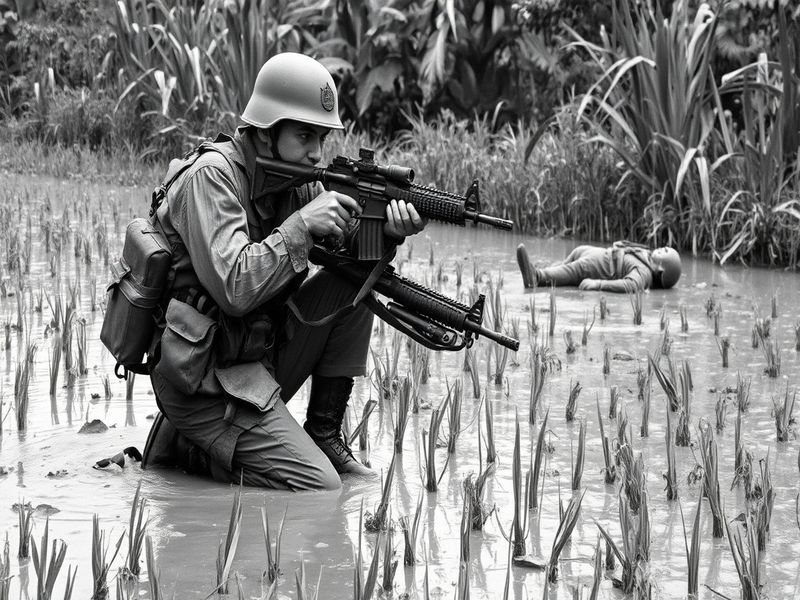
What started as a limited advisory mission under President Kennedy escalated dramatically under Lyndon B. Johnson. The Gulf of Tonkin incident in 1964—a disputed naval clash—provided the pretext for the Gulf of Tonkin Resolution, granting Johnson broad powers to deploy troops. By 1968, over half a million U.S. service members were stationed in Vietnam, fighting a guerrilla war against the North Vietnamese Army (NVA) and the Viet Cong.
American tactics relied heavily on air power and search-and-destroy missions, but the Viet Cong’s intimate knowledge of the terrain and use of underground tunnels made progress slow. The Tet Offensive in January 1968 shattered U.S. public confidence. Though a military defeat for North Vietnam, the surprise attacks on cities and military bases exposed the war’s grim reality to American audiences. Walter Cronkite, the era’s most trusted news anchor, declared the conflict a stalemate, shifting public opinion irrevocably against the war.
As casualties mounted and protests spread, President Nixon initiated “Vietnamization”—a policy to withdraw U.S. troops while increasing South Vietnam’s combat role. The Paris Peace Accords in 1973 formally ended direct U.S. involvement, but fighting continued. In 1975, North Vietnam launched a full-scale invasion, capturing Saigon and reunifying the country under communist rule.
Key Turning Points of the War
- 1954: French defeat at Dien Bien Phu leads to partition of Vietnam.
- 1964: Gulf of Tonkin incident accelerates U.S. military involvement.
- 1968: Tet Offensive shifts U.S. public opinion against the war.
- 1973: Paris Peace Accords withdraw U.S. troops but fail to prevent final communist victory.
Human Cost and Cultural Impact
The Vietnam War left deep scars on all sides. An estimated 3 million Vietnamese civilians died, alongside 1.1 million North Vietnamese and Viet Cong fighters and 250,000 South Vietnamese soldiers. The U.S. lost nearly 58,000 troops, with many more physically and psychologically scarred. Agent Orange, a toxic herbicide used to defoliate jungles, caused long-term health issues and birth defects in subsequent generations.
Veterans returned home to a divided nation. Protests, often led by students and anti-war activists, clashed with pro-military counter-demonstrations. The war also reshaped American foreign policy, fostering a reluctance to intervene militarily abroad—a sentiment that lasted for decades. Meanwhile, in Vietnam, the postwar period brought economic hardship and political repression under the communist regime.
The war’s cultural legacy endures in literature, film, and music. Works like Apocalypse Now and The Things They Carried grapple with its moral ambiguities. Protest songs by artists such as Bob Dylan and John Lennon became anthems of dissent, while memorials like the Vietnam Veterans Memorial in Washington, D.C., underscore the human cost.
Broader Implications: Lessons and Legacies
The Vietnam War exposed the limits of military power in counterinsurgency conflicts. Unlike conventional wars, Vietnam demonstrated that superior firepower and technology could not guarantee victory against a determined, politically motivated enemy. This lesson would later influence U.S. strategy in Afghanistan and Iraq, where asymmetric warfare posed similar challenges.
Diplomatically, the war accelerated decolonization in Southeast Asia. Countries like Cambodia and Laos, drawn into the conflict, suffered devastating civil wars in its aftermath. Globally, it intensified Cold War rivalries, pushing the Soviet Union and China to support North Vietnam more aggressively. The war also marked a turning point in media coverage of conflicts, as television brought the brutality of war directly into living rooms, shaping public perception in real time.
Today, Vietnam and the U.S. maintain a complex but improving relationship. Economic ties have flourished, with trade agreements and tourism bridging decades of hostility. However, the war remains a sensitive topic in Vietnam, where the government tightly controls historical narratives. For Americans, it serves as a cautionary tale about the perils of interventionism and the importance of clear objectives in foreign policy.
As new generations grapple with the lessons of Vietnam, the war’s legacy offers a reminder of the human cost of geopolitical ambitions. It challenges us to question not just the strategies of the past, but the ethical dimensions of war itself.
For further reading on conflicts with lasting global effects, explore our Politics and History sections, where we analyze the ripple effects of pivotal events.