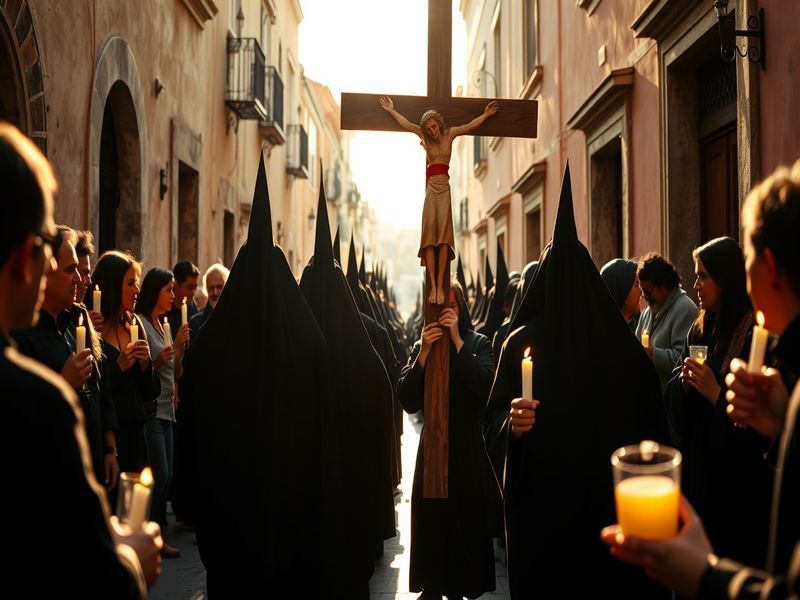
Viernes Santo, or Good Friday, stands as one of the most solemn days in the Christian liturgical calendar. It marks the crucifixion of Jesus Christ and is observed with deep reverence across continents, cultures, and denominations. While rooted in religious tradition, the observance of Viernes Santo has evolved into a tapestry of cultural expressions, from silent processions in Spain to vibrant street theater in the Philippines.
The date of Viernes Santo shifts annually, aligning with the first full moon after the spring equinox. In 2024, it falls on March 29, a reminder of its ancient astronomical origins. This fluidity underscores the day’s global significance, as communities adapt centuries-old rituals to modern contexts while preserving their spiritual essence.
The Historical and Theological Foundations
At its core, Viernes Santo commemorates the crucifixion of Jesus in Jerusalem, an event documented in all four Gospels. According to Christian belief, this sacrifice represents the atonement for humanity’s sins, a cornerstone of salvation theology. The day’s liturgical color is black or red, symbolizing mourning and the blood of Christ.
Historically, the observance dates back to the early Church, though its formalization as Good Friday occurred during the Council of Nicaea in 325 AD. By the Middle Ages, elaborate rituals emerged, including the veneration of the Cross and the reading of the Passion narrative. These traditions were not merely religious acts but also political statements, reinforcing the authority of the Church in medieval Europe.
In Orthodox Christianity, the day is observed as Great Friday, with a distinct emphasis on the descent of Christ into Hades and the harrowing of hell. This theological distinction highlights the diversity within Christianity, where cultural expression often shapes ritual practice.
Cultural Variations Around the World
Viernes Santo’s observance varies dramatically across regions, reflecting local customs and historical influences. In Spain, particularly in Andalusia, the day is marked by cultural spectacles. The Procesiones de Semana Santa feature towering floats bearing statues of the Virgin Mary and Christ, accompanied by hooded penitents and haunting saetas, flamenco-style religious songs. These processions, some dating back to the 16th century, blend artistry with devotion, attracting millions of spectators.
In the Philippines, one of Asia’s most deeply Catholic countries, Viernes Santo takes on a visceral quality. Some devotees reenact the crucifixion, with participants nailed to wooden crosses in acts of penance. These extreme displays, while controversial, underscore the lengths to which believers go to express faith and solidarity with Christ’s suffering.
- Italy: In Rome, the Pope leads the Via Crucis at the Colosseum, a modern tradition revived by Pope John Paul II. The event draws global attention, blending antiquity with contemporary piety.
- Germany: The Karfreitagsprozessionen in Bavaria feature torchlit marches and the singing of medieval hymns, preserving a musical heritage tied to the day.
- Mexico: In Iztapalapa, a suburb of Mexico City, thousands participate in a dramatic reenactment of the Passion, complete with Roman soldiers and Judas’ betrayal.
- India: In Goa, Catholic communities hold processions with crosses adorned with flowers, reflecting Portuguese colonial influences.
These global variations reveal how Viernes Santo serves as both a unifying force and a canvas for local identity. The rituals may differ, but the underlying theme—sacrifice, redemption, and renewal—remains constant.
The Role of Silence and Reflection
In many traditions, Viernes Santo is a day of silence and fasting. Churches strip altars bare, bells fall silent, and organs remain unplayed, creating an atmosphere of austerity. This intentional pause allows worshippers to meditate on Christ’s suffering and its theological implications. In some denominations, even the Eucharist is withheld until Easter Sunday, emphasizing the day’s penitential nature.
Modern secular society often overlooks this aspect of Viernes Santo, yet its emphasis on silence offers a counterpoint to the noise of contemporary life. In a world inundated with stimuli, the day invites reflection on suffering, sacrifice, and the human condition. This introspective quality has even influenced non-religious circles, where mindfulness and meditation practices resonate with the day’s themes.
Viernes Santo in a Multicultural World
As globalization blurs cultural boundaries, Viernes Santo encounters new contexts. In countries like the United States, where Catholicism is a minority faith, immigrant communities preserve traditions like the Via Crucis processions in city streets. These events become bridges between cultures, introducing local populations to the depth of Holy Week observances.
Meanwhile, in secular societies, Viernes Santo has taken on new meanings. In some European countries, it is a public holiday with no religious connotations, simply marking a day of rest. In others, like the UK, commercial interests clash with tradition, as businesses debate whether to remain open on this sacred day.
This tension reflects broader societal debates about the role of religion in public life. For some, Viernes Santo remains a vital expression of faith; for others, it is a historical artifact. Yet, even in its secularized forms, the day retains a cultural footprint, reminding societies of their shared heritage.
A Day of Contrasts
Viernes Santo exists at the intersection of joy and sorrow, tradition and innovation. It is a day when ancient rituals meet modern sensibilities, when global faith encounters local expression. Whether through the silent streets of a European village or the crowded processions of Latin America, the day challenges believers and observers alike to confront profound questions about sacrifice and redemption.
As societies evolve, so too will the observance of Viernes Santo. Yet its core message endures: a reminder of the fragility of life, the power of sacrifice, and the hope of resurrection. In an era of rapid change, these timeless themes offer a grounding force, connecting generations across time and space.
For those who observe it, Viernes Santo is more than a date on the calendar. It is a lived experience, a moment of connection with the divine and with one another. And in that connection, there is hope—a quiet, enduring hope that transcends the darkness of the cross.