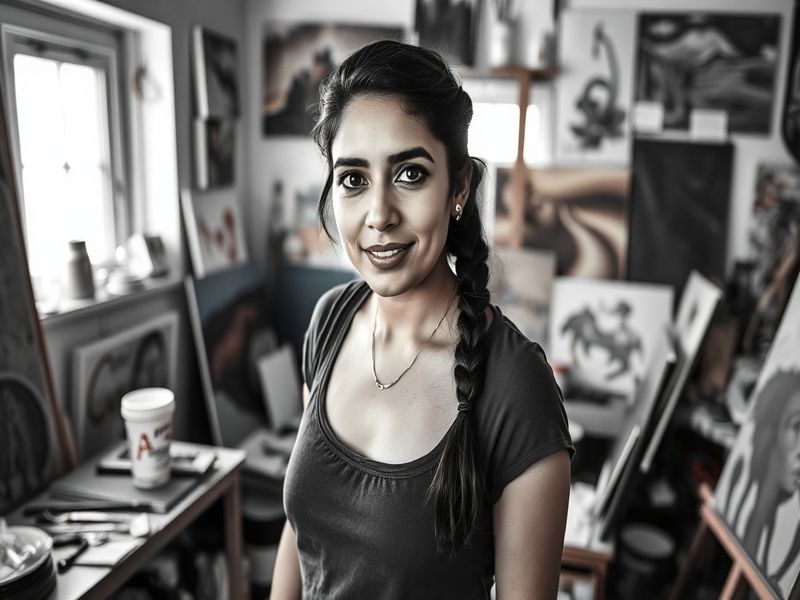
Blanca Quiñonez stands at the intersection of tradition and innovation, crafting a body of work that challenges preconceived notions about Latinx art while maintaining a distinct voice. Her paintings, installations, and public works have begun to redefine how cultural identity is expressed in contemporary visual arts. Through a meticulous blend of symbolism and modern technique, Quiñonez invites viewers into a world where heritage is not just preserved but actively reinterpreted.
Born in Oaxaca, Mexico, and later relocating to Los Angeles, Quiñonez draws deeply from her Indigenous Zapotec roots while engaging with the urban landscapes of her adopted city. This duality forms the foundation of her artistic practice, creating a dialogue between ancient storytelling and modern experience. Her exhibitions are not merely displays of art; they are immersive experiences that demand participation and reflection.
Early Influences and Artistic Evolution
Quiñonez’s journey began in the weaving communities of Oaxaca, where she apprenticed under local artisans. These early years instilled in her an appreciation for texture, pattern, and the tactile quality of materials—elements that continue to define her work today. However, her artistic evolution took a decisive turn when she moved to California, where she encountered the vibrant street art and mural traditions of East LA.
The contrast between rural Oaxaca and urban Los Angeles became a catalyst for her creativity. She began experimenting with mixed media, combining traditional weaving techniques with spray paint and digital collage. This fusion allowed her to explore themes of migration, displacement, and cultural resilience in ways that felt both personal and universally resonant.
By the mid-2010s, Quiñonez had developed a signature style characterized by bold colors, intricate patterns, and layered narratives. Her breakthrough came with the 2018 solo exhibition Raíces en Movimiento (Roots in Motion), which toured galleries in both Mexico and the United States. The show was celebrated for its ability to bridge cultural divides without diluting its message, earning her critical acclaim and a growing international following.
Key Themes in Quiñonez’s Work
Quiñonez’s art is deeply rooted in storytelling, but her narratives are not linear. Instead, they unfold like tapestries, with each thread representing a different aspect of identity, history, or social commentary. Below are some of the recurring themes that define her practice:
- Cultural Memory: Quiñonez often incorporates pre-Columbian symbols and motifs into her work, recontextualizing them within modern frameworks. Her use of Zapotec iconography, for example, serves as both a homage and a challenge to colonial narratives.
- Migration and Belonging: Many of her pieces explore the emotional and physical journeys of Latinx communities. She uses fragmented imagery to represent the disjointed experiences of those who straddle multiple cultures.
- Environmental and Social Justice: Quiñonez frequently addresses issues such as land displacement and resource exploitation, particularly in her public murals. These works serve as both aesthetic interventions and calls to action.
- Intergenerational Dialogue: Her art often features overlapping generations, symbolizing the passing down of knowledge, language, and traditions. This theme is particularly evident in her large-scale textile pieces, which resemble family heirlooms.
One of her most acclaimed works, The Weaver’s Hands, is a multimedia installation that combines woven tapestries with projected animations. The piece depicts the hands of women from three generations—her grandmother, mother, and herself—creating a visual narrative of labor, time, and legacy. The installation has been exhibited in venues from San Francisco to Mexico City, sparking conversations about the role of women in preserving cultural heritage.
Impact and Broader Implications
Quiñonez’s influence extends beyond the art world. She has become a vocal advocate for Latinx artists, particularly women, who are often underrepresented in mainstream galleries and museums. In 2022, she co-founded Raíz Collective, a nonprofit organization dedicated to supporting emerging Latinx artists through mentorship, exhibitions, and public art initiatives.
Her work has also contributed to a broader reevaluation of Latinx art as a category. While institutions have historically grouped Latinx artists under a single umbrella, Quiñonez’s practice highlights the diversity within this label. Her art refuses to be confined to a single narrative, instead embracing the complexity of Latinx identities across regions, generations, and disciplines.
Critics have noted that Quiñonez’s success reflects a growing appetite for art that engages with social and political realities. In an era where identity politics dominate public discourse, her work offers a nuanced perspective—one that is neither didactic nor sentimental but deeply human. This approach has resonated with younger audiences, particularly those who see their own experiences reflected in her art.
Moreover, Quiñonez’s public art projects have transformed urban spaces, turning walls and plazas into canvases for community storytelling. Her mural Sueños en el Asfalto (Dreams on Asphalt), painted on a busy street in Boyle Heights, Los Angeles, depicts a series of hands reaching upward, each holding an object symbolic of cultural heritage—a loom, a book, a seed. The mural has become a landmark, attracting visitors and sparking conversations about the role of art in urban renewal.
Looking Ahead: The Future of Quiñonez’s Art
As Quiñonez continues to evolve, she shows no signs of slowing down. Her current project, Voces del Futuro (Voices of the Future), is a collaborative effort with youth from Indigenous communities in both Mexico and the U.S. The project involves workshops where participants create art that envisions their future while honoring their past. The resulting pieces will be exhibited in 2025, with plans for a digital archive to preserve the participants’ stories.
Quiñonez’s work also signals a shift in how Latinx art is consumed globally. As museums and collectors increasingly seek diverse voices, artists like her are redefining the canon. Her success challenges the art world to move beyond tokenism and engage with Latinx artists on their own terms.
In an interview with ArtForum, Quiñonez stated, “Art is not just about beauty or technique. It’s about asking questions and creating spaces where those questions can be explored without judgment.” This philosophy underpins her practice and ensures that her work remains relevant and urgent.
For those interested in exploring Latinx art further, Dave’s Locker Culture features a curated selection of articles and resources. Additionally, her work aligns closely with the themes explored in Dave’s Locker News, particularly in discussions about cultural representation and public art.
Blanca Quiñonez’s art does more than adorn walls; it builds bridges. By weaving together the old and the new, the personal and the political, she invites us to reconsider what it means to belong—to a culture, a community, or a shared future. In doing so, she not only redefines Latinx art but also reminds us of the power of creativity to transcend boundaries.