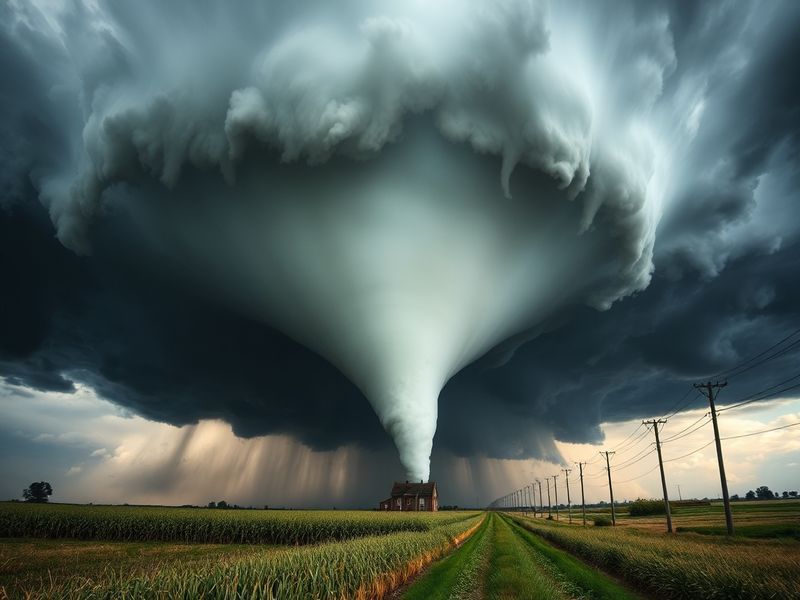
The calm afternoon shatters in an instant. One moment, the sky is a familiar shade of blue; the next, it darkens into an ominous green. A low rumble builds into a freight train’s roar. Before you can react, the National Weather Service issues a tornado warning for your area. For millions around the world, this isn’t just a hypothetical scenario—it’s a terrifying reality that unfolds with terrifying regularity.
Tornadoes are among nature’s most violent phenomena, capable of destroying entire neighborhoods in minutes. While the United States leads the world in tornado frequency—averaging over 1,200 per year—they occur on every continent except Antarctica. From the plains of Bangladesh to the steppes of Russia, from urban Japan to rural Argentina, communities face the sudden, unpredictable wrath of these spinning vortices.
The Science Behind the Swirl: How Tornadoes Form
Tornadoes develop from powerful thunderstorms known as supercells. These storms contain a rotating updraft called a mesocyclone. When wind shear—changes in wind speed and direction with altitude—tilts this rotating air vertically, it can tighten into a funnel cloud. If that funnel touches the ground, it becomes a tornado.
Most tornadoes last less than ten minutes and travel only a few miles. But the strongest—rated EF4 or EF5 on the Enhanced Fujita Scale—can persist for over an hour, carving paths more than a mile wide and 50 miles long. Wind speeds exceeding 200 mph make them capable of hurling cars like toys and tearing houses from their foundations.
While meteorologists have made significant advances in forecasting, the exact formation of a tornado remains one of nature’s most closely guarded secrets. Research continues at institutions like the NOAA National Severe Storms Laboratory and international centers in Europe and Asia, where scientists study Doppler radar data and storm chutes to improve early warning systems.
Where in the World Are Tornadoes Most Common?
Tornadoes thrive in regions where warm, moist air clashes with cold, dry fronts. While the U.S. “Tornado Alley” stretching from Texas to South Dakota remains the global hotspot, other areas face significant risk.
- Bangladesh and Eastern India: The most tornado-prone country outside the U.S., with an average of 5–10 tornadoes annually. Deadly storms in 1989 and 1996 killed hundreds. High population density and poor infrastructure amplify the risk.
- Europe: Especially in the UK, Germany, and northern Italy. The UK experiences around 30 tornadoes per year, though most are weak (EF0–EF1). The deadly 1999 tornado in Bognor Regis proved that even mild climates aren’t safe.
- South America: Argentina and Brazil experience frequent tornadoes, particularly in the Pampas region. The 2015 storm in Concepción del Uruguay killed 26 and injured hundreds.
- Australia and New Zealand: Eastern Australia sees 10–20 tornadoes yearly. The 1999 Sydney hailstorm, though technically a derecho, highlighted how urban areas can be hit without warning.
- Africa and the Middle East: South Africa reports several tornadoes annually, while rare but violent storms have struck Algeria, Oman, and even Dubai.
When the Warning Siren Screams: What to Do When a Tornado Is Near
Every second counts when a tornado approaches. Early warnings—often just 10–15 minutes—come from sirens, smartphone alerts, or emergency broadcasts. Knowing how to respond can mean the difference between life and death.
In the U.S., the National Weather Service uses a tiered system: a Tornado Watch means conditions are favorable; a Tornado Warning means a tornado has been spotted or indicated by radar. Other countries use similar systems, though names and protocols vary.
- Seek Shelter Immediately: If you’re indoors, go to a basement or an interior room on the lowest floor (bathroom, closet, hallway). Get under a sturdy table or cover yourself with a mattress or heavy blankets. Stay away from windows.
- Avoid Mobile Homes: Even tied down, they offer little protection. Leave immediately and seek a sturdy building or storm shelter.
- In a Vehicle: Do not try to outrun a tornado. If possible, drive at right angles to its path. If trapped, abandon the car and lie flat in a low ditch or culvert, protecting your head.
- Outdoors: Seek a sturdy building. If none exists, lie flat in a low-lying area and cover your head. Avoid highway overpasses—they can create wind tunnels.
- After the Storm: Stay indoors until authorities confirm it’s safe. Watch for downed power lines, gas leaks, and unstable structures. Use flashlights, not candles, to avoid fire risks.
Cultural attitudes toward tornado preparedness vary widely. In Japan, where tornadoes are rare but increasing due to climate change, public awareness campaigns emphasize drills in schools and offices. In Bangladesh, where early warning systems are less accessible, community radio and local leaders play a vital role in spreading alerts. In the U.S., social media and smartphone apps like NOAA Weather Radar and Storm Shield have revolutionized real-time communication.
From Kansas to Kathmandu: How Communities Rebuild and Remember
Tornadoes don’t just destroy buildings—they reshape lives, economies, and identities. In the American Midwest, towns like Joplin, Missouri (2011 EF5) and Moore, Oklahoma (2013 EF5) have become symbols of resilience. Memorials, community centers, and rebuilt schools stand as testaments to recovery. Yet, the emotional toll lingers. Survivors often describe a “before and after” life, where fear of storms becomes a permanent shadow.
In Bangladesh, tornadoes are woven into the fabric of rural life. Farmers know the signs: the air grows heavy, birds fall silent, and the horizon darkens. After a storm, neighbors share labor to rebuild homes from corrugated tin and bamboo. NGOs and government agencies have introduced low-cost early warning towers and cyclone shelters, saving thousands of lives since the 1970 Bhola cyclone.
In Europe, where tornadoes are less frequent but no less shocking, communities rely on cross-border cooperation. The European Severe Storms Laboratory (ESSL) in Germany coordinates data across nations, helping predict storms that might cross from France into Germany or Poland. Their work has reduced fatalities, though public skepticism remains a challenge in some regions.
Climate change is altering tornado patterns. While the total number of tornadoes may not be increasing, research suggests they are becoming more intense and shifting eastward in the U.S.—into more densely populated areas. In South Asia, warming oceans may fuel stronger cyclones that spawn tornadoes far from the coast. These changes demand global adaptation: stronger building codes, better early warning systems, and community-based education.
Building Resilience: Lessons from Around the World
Several nations have pioneered approaches to tornado safety that could inspire others:
- Canada: Uses a “community-based risk approach,” training volunteers to spot funnel clouds and relay warnings via text and social media.
- Turkey: After a deadly tornado in 2019, the government invested in mobile alert apps and retrofitted schools with reinforced shelters.
- South Africa: Local radio stations broadcast tornado warnings in multiple languages, reaching rural communities with limited internet access.
These examples highlight a crucial truth: technology alone cannot save lives. Culture, communication, and community engagement are just as vital. Whether it’s a rural village in Bangladesh or a suburb in Kansas, the most resilient places are those where neighbors look out for one another.
Staying Informed and Staying Safe
In an era of instant information, staying ahead of tornado threats is easier than ever—but only if you know where to look. The key is preparation before the sky turns green.
Start by identifying your local emergency management office and signing up for alerts. In the U.S., the Ready.gov website offers free guides on tornado safety, evacuation planning, and emergency kits. Internationally, organizations like the International Federation of Red Cross and Red Crescent Societies provide region-specific resources in multiple languages.
Keep an emergency kit ready: water, non-perishable food, a flashlight, batteries, a first-aid kit, a portable phone charger, and a whistle to signal for help. Include copies of important documents and a list of emergency contacts. Store it in your designated safe room.
Practice your tornado drill with your family or coworkers. Know where to go in different locations—home, work, school, or while traveling. Teach children how to recognize warning signs and respond calmly.
Finally, support local and global efforts to improve tornado forecasting and disaster response. From citizen science projects like Skywarn in the U.S. to crowdfunded shelters in Bangladesh, collective action saves lives.
Tornadoes may be unpredictable, but our response doesn’t have to be. With knowledge, preparation, and community, we can face the storm—not with fear, but with readiness.
Because when the sky turns ugly, it’s not the end of the story. It’s the beginning of resilience.