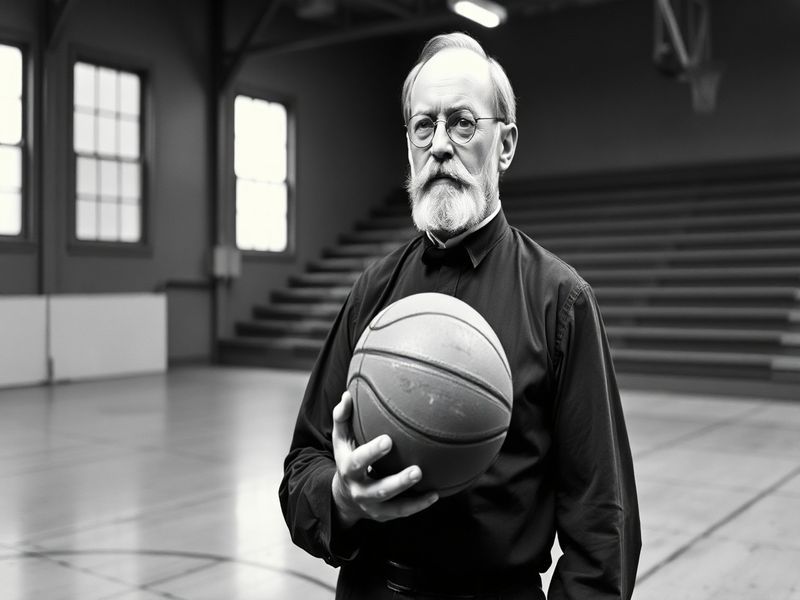
In the winter of 1891, a Canadian physical education instructor stood in a gymnasium at the International YMCA Training School in Springfield, Massachusetts. With two peach baskets, some twine, a soccer ball, and a group of restless students, James Naismith created a game that would evolve into one of the world’s most popular sports. Basketball, born from necessity and innovation, traces its origins to this unassuming moment.
Naismith wasn’t just inventing a game—he was responding to a challenge. The school’s director, Luther Gulick, tasked him with developing an indoor activity to keep students active during harsh New England winters. Within two weeks, Naismith had drafted 13 basic rules, nailed peach baskets to the gym’s balcony, and introduced a sport that emphasized skill over brute strength. His creation was an instant hit, spreading rapidly across colleges and YMCA branches before becoming a global phenomenon.
The Origins of a Legend
James Naismith was born on November 6, 1861, in Almonte, Ontario, Canada. Orphaned at age nine, he was raised by his aunt and uncle, who instilled in him a strong work ethic and a love for sports. Naismith studied at McGill University, where he excelled in rugby, lacrosse, and gymnastics. His academic and athletic achievements earned him a position at the YMCA Training School in Springfield, where his most enduring legacy would take shape.
The original game bore little resemblance to today’s high-flying, fast-paced version. Players couldn’t dribble—they could only pass the ball. The peach baskets, which lacked holes in the bottom, required someone to climb a ladder to retrieve the ball after each score. Despite these limitations, the game’s core principles—teamwork, strategy, and physical activity—were immediately apparent.
Naismith’s original 13 rules, written in pencil, outlined everything from the dimensions of the court to the prohibition of running with the ball. His emphasis on fairness and sportsmanship set the tone for the sport’s future. By 1893, the first public basketball game was played in Springfield, and the sport’s popularity exploded. Within a decade, it had spread to Europe, Asia, and beyond, thanks in large part to the YMCA’s global network.
The Rules That Shaped a Sport
Naismith’s 13 rules were not just guidelines—they were a blueprint for a new way to play. Here’s a breakdown of their key elements:
- The ball: A soccer ball was used initially, but Naismith quickly realized a larger, softer ball would be better suited for indoor play.
- No dribbling: Players could only move by passing the ball. Dribbling wasn’t introduced until later, revolutionizing the game.
- No tackling: Physical contact was discouraged, emphasizing skill and finesse over brute force.
- The goal: Peach baskets were mounted 10 feet high, a height that remains standard today. The bottoms were later removed to allow the ball to fall through.
- Scoring: Each successful shot earned one point, a stark contrast to today’s three-point line.
Naismith’s rules were designed to minimize injury and maximize participation. He wanted a game that could be played by anyone, regardless of size or strength. This inclusivity helped basketball spread rapidly, particularly in schools and community centers. By the early 1900s, the sport had evolved with the introduction of dribbling, the five-player team format, and the backboard, which was added to prevent spectators from interfering with shots.
The first official basketball game under Naismith’s rules took place on January 20, 1892, in Springfield. The score was 1-0, a far cry from the high-scoring contests of today. Yet, the game’s potential was undeniable. Within a few years, colleges began forming teams, and the first intercollegiate game was played in 1896 between the University of Chicago and the University of Iowa.
From Springfield to the Olympics
Basketball’s journey from a YMCA gym to the Olympic stage is a testament to Naismith’s vision. The sport made its Olympic debut at the 1904 Games in St. Louis as a demonstration event. It wasn’t until 1936 in Berlin that basketball became a full medal sport, with the United States winning the first gold medal.
Naismith, then 74 years old, attended the Berlin Olympics as an honored guest. Though he didn’t play a direct role in the competition, his presence underscored the sport’s global reach. By this time, basketball had become a symbol of international cooperation and athletic excellence. The game’s inclusion in the Olympics helped solidify its place in the pantheon of major sports.
Naismith’s contributions were recognized long after his death in 1939. In 1959, he was posthumously inducted into the Naismith Memorial Basketball Hall of Fame, named in his honor. The Hall of Fame, located in Springfield, Massachusetts—just miles from where basketball was born—serves as a shrine to the game’s history and its greatest players.
The Lasting Legacy of a Modest Genius
James Naismith’s impact extends far beyond the sport he invented. His emphasis on physical education laid the groundwork for modern fitness culture. As a physician and educator, he advocated for the integration of sports into daily life, believing it could improve both physical and mental health. His work with the YMCA and his later career as a professor at the University of Kansas further cemented his legacy as a pioneer in sports and education.
Naismith’s humility was as notable as his inventiveness. He never sought fame or fortune, preferring instead to let his creation speak for itself. In interviews, he often downplayed his role, crediting the students who played the game and the YMCA for its spread. His 1939 obituary in the New York Times described him as a man who “never sought the spotlight but whose work changed the way millions move and play.”
Today, basketball is a multi-billion-dollar industry, with professional leagues like the NBA attracting global audiences. Yet, its roots remain rooted in the simple act of throwing a ball into a basket. Naismith’s original vision—a game that was accessible, inclusive, and fun—endures in every pickup game played in parks and driveways around the world.
For those interested in exploring more about the evolution of sports, Dave’s Locker Sports offers a deep dive into how games like basketball have shaped culture and community. Similarly, Dave’s Locker History provides context on how Naismith’s invention fits into the broader narrative of 19th-century innovation.
James Naismith’s story is a reminder that great inventions often come from unexpected places. His creation of basketball was not the result of grand ambition but of practical necessity. In a world where sports are often defined by spectacle and commercialism, Naismith’s original vision—a game for everyone—remains as relevant as ever.