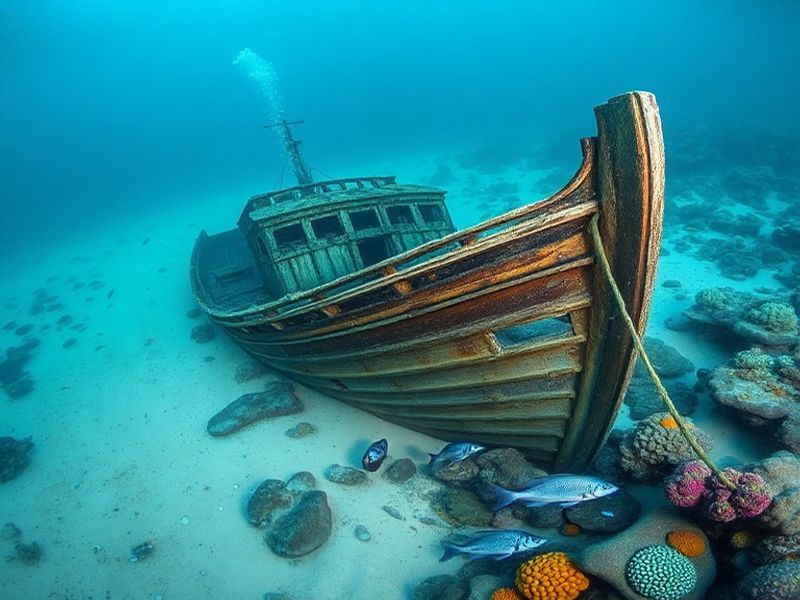
The ocean floor holds stories older than most written records. Among these submerged narratives are shipwrecks—silent witnesses to human ambition, tragedy, and discovery. Each wreck represents a frozen moment in time, offering archaeologists, historians, and divers a tangible connection to events long past. From ancient trading vessels to modern cruise liners, these underwater time capsules tell diverse tales of trade, war, exploration, and human error.
The Science of Shipwreck Discovery
Locating shipwrecks is no simple feat. Modern technology has transformed underwater exploration, with sonar, magnetometers, and autonomous underwater vehicles (AUVs) becoming essential tools. Side-scan sonar, for example, creates detailed images of the seafloor by bouncing sound waves off objects. When anomalies appear—unusual shapes or densities—teams investigate further. In 2015, researchers used this method to locate the San José, a Spanish galleon sunk in 1708, carrying a treasure estimated at $17 billion in today’s gold prices.
Beyond technology, luck still plays a role. In 2007, a fisherman off the coast of Israel hauled in a net tangled with ancient pottery. What he discovered was the Mazie shipwreck, a 2,400-year-old vessel carrying Greek wine jars and other artifacts. Such finds remind us that the sea still guards secrets waiting to be revealed.
Documenting wrecks requires precision. Underwater archaeologists create site maps using photogrammetry—combining multiple photographs into 3D models. These digital reconstructions allow researchers to study wrecks without disturbing fragile remains. The Science section of Dave’s Locker often features breakthroughs in marine archaeology, highlighting how technology deepens our understanding of these discoveries.
Famous Shipwrecks and Their Stories
The ocean is littered with wrecks that have shaped history. Some became legends long before their discovery:
- Titanic (1912) – Perhaps the most famous wreck, the Titanic struck an iceberg on its maiden voyage, killing over 1,500 people. Rediscovered in 1985, it lies 12,500 feet below the North Atlantic, slowly corroding. Recent expeditions have revealed new details, including the ship’s deteriorating state and the eerie silence of the deep.
- Mary Rose (1545) – King Henry VIII’s flagship sank during a battle with the French fleet. Raised in 1982 after 437 years underwater, the Mary Rose provided unprecedented insight into Tudor-era seafaring, including preserved weapons, tools, and even crew remains.
- Vasa (1628) – Sweden’s Vasa sank on its first voyage due to design flaws and excessive decoration. Salvaged in 1961, it remains one of the best-preserved 17th-century ships, now housed in Stockholm’s Vasa Museum.
- Bismarck (1941) – The German battleship’s final battle ended in its sinking by the British Royal Navy. In 1989, Robert Ballard located the wreck 15,700 feet deep in the Atlantic, its massive guns still pointing skyward.
These wrecks are more than relics—they are historical documents. The Titanic, for instance, is often called a “time capsule” because of the personal items preserved in its debris field. From shoes to champagne bottles, these objects humanize the tragedy. Similarly, the Mary Rose’s discovery of longbows and navigational tools reshaped historians’ understanding of naval warfare in the 16th century.
The Challenges of Preservation and Ethics
Preserving shipwrecks is a race against time. Saltwater accelerates corrosion, while deep-sea currents and marine life, such as shipworms and barnacles, consume wood and metal. The Vasa, for example, required decades of conservation work after its salvage, including spraying with polyethylene glycol to replace lost water in the wood.
Ethical dilemmas surround wrecks, especially those with human remains or cultural significance. The Titanic’s wreck lies within international waters, but salvage rights and memorialization spark debate. Should artifacts be displayed in museums, or left undisturbed as underwater memorials? The 2004 UNESCO Convention on Underwater Cultural Heritage aims to protect these sites, but enforcement remains inconsistent.
Another challenge is the commercialization of wrecks. Companies like Odyssey Marine Exploration have recovered artifacts from ships such as the SS Republic (1865) and the Black Swan (a 2007 find later identified as part of the Nuestra Señora de las Mercedes). While some argue that salvaging funds further exploration, critics contend that profit motives overshadow historical preservation. The Culture section of Dave’s Locker frequently explores these ethical debates, particularly in articles about artifact repatriation and museum ethics.
The Future of Shipwreck Exploration
The next frontier in shipwreck discovery lies in deep-sea and polar regions. Climate change is melting Arctic ice, revealing new areas for exploration. In 2019, researchers located the wreck of the HMS Terror, part of Sir John Franklin’s ill-fated 1845 Arctic expedition. The ship’s remarkably intact condition—including intact windows and cabins—has provided fresh insights into 19th-century naval life.
Advancements in robotics and artificial intelligence are also revolutionizing the field. Autonomous underwater vehicles (AUVs) like the REMUS 6000 can operate at depths of 6,000 meters, mapping and photographing wrecks with unprecedented detail. AI algorithms now assist in analyzing sonar data, identifying potential wreck sites in hours rather than weeks.
For recreational divers, wreck diving has become a major draw. Popular sites like the USS Oriskany in Florida or the SS Yongala in Australia attract thousands annually, transforming wrecks into artificial reefs that support marine ecosystems. These dives offer a glimpse into history while fostering conservation efforts.
Yet, the future is not without risks. Deep-sea mining threatens to destroy unknown wrecks before they can be discovered. The International Seabed Authority, which regulates mining activities, has yet to establish comprehensive protections for underwater cultural heritage. As technology advances, so too must our commitment to preserving these fragile links to the past.
Conclusion: Why Shipwrecks Matter
Shipwrecks are more than sunken vessels—they are portals to the past. They challenge our understanding of history, offering tangible evidence where written records fall short. From the Titanic’s cautionary tale about human arrogance to the Mary Rose’s revelations about Tudor naval life, each wreck adds a layer to our collective memory.
Preservation efforts must balance exploration with respect. As technology unlocks new discoveries, we face ethical questions about ownership, memorialization, and the commercialization of history. The sea’s depths are vast, and the stories they hold are far from over. Whether through scientific research, deep-sea robotics, or the passion of divers, the exploration of shipwrecks will continue to captivate and inform future generations.
For those eager to dive deeper, Dave’s Locker regularly updates its Science and Culture sections with the latest findings and ethical discussions surrounding underwater archaeology.