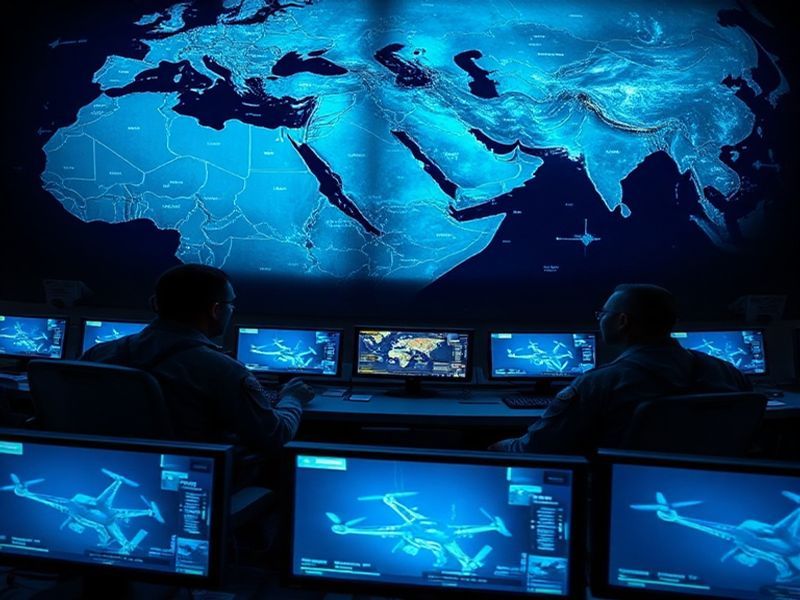
The United States Central Command, commonly referred to as Centcom, remains one of the most pivotal yet least publicly scrutinized branches of the U.S. military. Operating across 20 nations in the Middle East, North Africa, and Central Asia, Centcom’s influence extends far beyond traditional military operations. Its structure, strategic priorities, and evolving role reflect broader geopolitical shifts that demand closer examination.
Established in 1983, Centcom emerged from the Cold War era as a response to regional instability in the Persian Gulf. Over the past four decades, it has expanded its mandate to include counterterrorism, humanitarian assistance, and great-power competition. In an era where global conflicts increasingly blur the lines between warfare and diplomacy, Centcom’s operations offer a lens into how modern militaries adapt to complex security environments.
What Is Centcom? Structure and Geographic Scope
Centcom is one of the eleven unified combatant commands under the Department of Defense, reporting directly to the Secretary of Defense and the President. Unlike geographic commands focused on specific regions, Centcom’s operational domain spans from Egypt to Kazakhstan, encompassing some of the world’s most volatile regions. This vast area includes key maritime chokepoints like the Strait of Hormuz and the Suez Canal, making Centcom a linchpin in global trade and security.
The command is structured around several functional components:
- Land Forces: Including Army units and special operations forces tailored for rapid deployment.
- Naval Forces: Led by the U.S. Fifth Fleet, which patrols the Arabian Gulf and Red Sea.
- Air Forces: Including fighter wings, aerial refueling, and intelligence-gathering platforms.
- Special Operations Command Central (SOCCENT): Focused on counterterrorism and direct action missions.
- Coalition Forces: Centcom routinely coordinates with allied nations through Combined Joint Task Forces.
This layered structure allows Centcom to respond to crises ranging from humanitarian disasters to high-intensity combat operations. Its headquarters, located at MacDill Air Force Base in Florida, serves as the nerve center for planning and coordination, while forward-deployed units maintain a constant presence across the region.
The Evolution of Centcom’s Mission: From Cold War to Great Power Competition
Centcom’s origins trace back to the Iran-Iraq War and the Soviet invasion of Afghanistan. During the 1980s and 1990s, its primary focus was deterring regional aggression, particularly from Iraq under Saddam Hussein. Operations like Desert Storm and Iraqi Freedom solidified Centcom’s reputation as a decisive military force.
After the 9/11 attacks, Centcom’s mission shifted dramatically toward counterterrorism. The invasions of Afghanistan and Iraq placed the command at the forefront of the Global War on Terror. Over two decades, it conducted thousands of raids, trained local security forces, and supported drone campaigns against extremist groups like Al-Qaeda and ISIS.
Today, Centcom faces a new strategic environment marked by great-power rivalry. China’s expanding influence in the Middle East and Russia’s military presence in Syria and Libya have forced Centcom to balance counterterrorism with deterring state adversaries. Exercises like the biennial International Maritime Exercise and partnerships with Gulf Cooperation Council (GCC) nations underscore this pivot toward multi-domain deterrence.
This evolution reflects a broader trend in U.S. defense strategy: the need to prepare for large-scale conflicts while sustaining counterterrorism operations. Centcom’s ability to pivot between these priorities will determine its relevance in an increasingly multipolar world.
Key Operations and Controversies: A Look at Centcom’s Legacy
Centcom’s operational history includes some of the most consequential military campaigns of the 21st century. From toppling the Taliban in 2001 to dismantling ISIS’s territorial caliphate in 2019, its forces have reshaped the security landscape of the Middle East. Yet, these successes have often come at a cost, sparking debates over civilian casualties, mission creep, and strategic overreach.
Notable operations include:
- Operation Enduring Freedom (Afghanistan, 2001–2021): A 20-year campaign that toppled the Taliban but ultimately ended in a chaotic withdrawal.
- Operation Iraqi Freedom (2003–2011): The invasion that toppled Saddam Hussein but led to a prolonged insurgency and sectarian conflict.
- Operation Inherent Resolve (2014–Present): The U.S.-led coalition campaign to defeat ISIS in Iraq and Syria.
- Humanitarian Missions: Including disaster response after the 2004 Indian Ocean tsunami and the 2023 Turkey-Syria earthquakes.
Centcom has also faced significant controversies. Investigations by the New York Times and The Intercept revealed flaws in its airstrike reporting, including undercounting civilian deaths in Syria and Iraq. The 2021 drone strike that killed 10 Afghan civilians, including seven children, in Kabul further eroded public trust. These incidents highlight the challenges of modern warfare, where precision and proportionality are increasingly scrutinized.
Despite these setbacks, Centcom remains a critical tool of U.S. foreign policy. Its ability to project power, train allies, and conduct counterterrorism operations ensures its continued relevance, even as geopolitical dynamics shift.
Centcom’s Future: Challenges and Strategic Imperatives
The next decade will test Centcom’s adaptability as it confronts three major challenges: regional instability, technological disruption, and political polarization.
First, the Middle East remains a powder keg. The Israel-Hamas war, Iran’s nuclear ambitions, and the resurgence of extremist groups like ISIS-K demand constant vigilance. Centcom’s role in deterring Iranian aggression while supporting Israel’s security has never been more complex.
Second, rapid advances in technology are transforming warfare. Artificial intelligence, hypersonic missiles, and cyber capabilities are reshaping how conflicts are fought. Centcom is investing in AI-driven intelligence analysis and electronic warfare to maintain its edge. The 2023 establishment of the Joint Artificial Intelligence Center within Centcom’s area of responsibility signals this shift.
Third, political dynamics in the U.S. and host nations complicate long-term planning. Congressional debates over military spending, coupled with growing skepticism about overseas interventions, create uncertainty. Meanwhile, regional partners like Saudi Arabia and the UAE are diversifying their security partnerships, reducing reliance on U.S. forces.
To navigate these challenges, Centcom is likely to prioritize three strategies:
- Enhanced Deterrence: Strengthening missile defense systems and conducting large-scale joint exercises with allies.
- Partnership Building: Expanding training programs for local forces and deepening intelligence-sharing agreements.
- Technological Modernization: Accelerating the integration of AI, unmanned systems, and space-based assets.
As Centcom adapts, its role will continue to evolve from a traditional warfighting command to a hybrid force capable of handling crises across multiple domains. The command’s success will depend not only on its military capabilities but also on its ability to navigate the political and technological complexities of the 21st century.
Conclusion: Centcom’s Enduring Significance
Centcom stands at the intersection of military power, geopolitical strategy, and technological innovation. From its Cold War origins to its current focus on great-power competition, it has continually redefined its mission to meet emerging threats. While its operations have sparked controversy, its role in maintaining regional stability remains indispensable.
As the U.S. shifts its strategic focus toward Asia, Centcom’s importance in the Middle East will not diminish. Instead, it will face new challenges that demand agility, foresight, and cooperation with allies. For policymakers, military leaders, and the public, understanding Centcom is essential to grasping the complexities of modern warfare and the enduring role of American power abroad.
For further insights into U.S. military strategy and global security, explore our Analysis and News sections. Centcom’s story is far from over—and neither is the debate over its future.