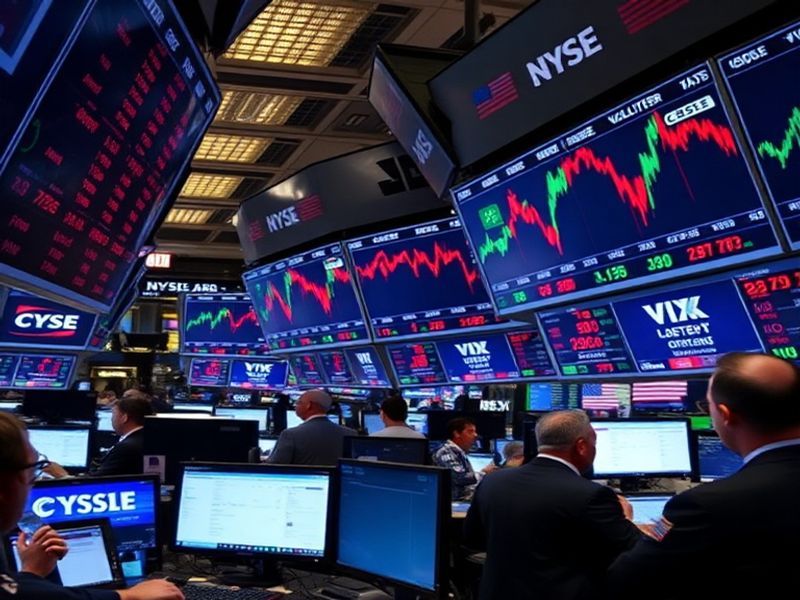
Investors and traders have relied on the Cboe Volatility Index (VIX) as a critical barometer of market sentiment for decades. Often called the “fear gauge,” this index measures expected volatility in U.S. stock markets over the next 30 days. Its movements provide insight into investor psychology, risk appetite, and potential market disruptions.
The VIX was introduced by the Chicago Board Options Exchange (Cboe) in 1993, evolving from earlier volatility models into the benchmark it is today. Unlike traditional market indices that track price movements, the VIX quantifies uncertainty itself—making it a unique tool for portfolio protection and strategic planning.
How the VIX Works: A Technical Breakdown
The VIX is calculated using a weighted blend of prices for a range of S&P 500 index options. These options represent both calls and puts, capturing the market’s collective expectations of future volatility. Higher VIX values indicate greater expected price swings, while lower values suggest stability.
Key inputs include:
- Out-of-the-money options: These are used because their prices are most sensitive to volatility expectations.
- Time decay: The 30-day time horizon ensures the index remains forward-looking without being overly influenced by short-term noise.
- Implied volatility: This reflects what traders are willing to pay for options, directly tying the VIX to market sentiment.
Historically, the VIX has shown a strong inverse relationship with the S&P 500. When stocks decline sharply, the VIX tends to spike—signaling panic. Conversely, during bull markets, it often settles into lower ranges. This dynamic has cemented its role as a contrarian indicator: extreme VIX levels may signal potential market turning points.
Why the VIX Matters Beyond the Trading Floor
The VIX’s influence extends far beyond options traders. Corporate executives, policymakers, and even retail investors use it to gauge economic risk. For example, a rapidly rising VIX can prompt companies to delay expansions or reduce leverage, while a persistently low VIX might encourage risk-taking behavior.
During periods of geopolitical tension, earnings shocks, or financial crises, the VIX often surges. Consider the following historical spikes:
- 2008 Financial Crisis: The VIX peaked at 80.86 in November 2008, reflecting the extreme uncertainty of the Great Recession.
- COVID-19 Pandemic: In March 2020, the VIX hit 85.47 as lockdowns triggered global market sell-offs.
- 2022 Inflation Shock: Rising interest rates and inflation concerns pushed the VIX above 30 multiple times.
These examples underscore how the VIX serves as an early warning system. When it climbs sharply, it often precedes broader economic adjustments, from tightening credit conditions to shifts in consumer spending.
The VIX in Modern Markets: Adaptations and Criticisms
While the VIX remains a cornerstone of risk management, its limitations have sparked debate. Critics argue that it can become detached from actual market movements, especially during periods of low liquidity or extreme central bank intervention. For instance, the VIX rarely fell below 10 from 2012 to 2020—a stretch of unprecedented monetary policy accommodation.
Moreover, the rise of volatility-focused exchange-traded products (ETPs) has introduced new dynamics. Funds like the VXX (iPath S&P 500 VIX Short-Term Futures ETN) allow investors to trade VIX futures, but these instruments often suffer from contango—a situation where longer-dated contracts are more expensive than shorter-term ones. This structural drag can erode returns over time.
Despite these challenges, the VIX continues to evolve. Cboe has expanded its volatility indices to cover sectors like gold, crude oil, and individual stocks, offering more granular insights. The introduction of the VIX of VIX (a measure of VIX volatility) also provides deeper layers of analysis for sophisticated traders.
Practical Applications: Using the VIX in Investment Strategies
For traders, the VIX can be a powerful tool when integrated into broader strategies. Here are some ways to leverage it effectively:
- Hedging: Long VIX positions or options can act as portfolio insurance during market downturns.
- Timing: Contrarian traders may look for VIX extremes (e.g., above 30 or below 12) to identify potential reversals.
- Relative value: Comparing the VIX to historical averages or sector-specific volatility can highlight mispriced risks.
Retail investors can indirectly benefit by monitoring VIX trends. For example, a steadily rising VIX might prompt a shift toward defensive sectors like utilities or healthcare. Conversely, a falling VIX could signal an opportune time to deploy capital into riskier assets.
However, it’s essential to recognize that the VIX is not a predictive tool in isolation. It should complement fundamental analysis, technical indicators, and macroeconomic research. Over-reliance on the VIX without context can lead to costly mistakes, particularly during unprecedented market conditions.
Conclusion: The VIX’s Enduring Relevance
The Cboe Volatility Index remains one of the most widely watched metrics in global finance. Its ability to distill market fear into a single number has made it indispensable for traders, economists, and policymakers alike. While it is not without flaws, the VIX’s adaptability ensures its continued relevance in an ever-changing financial landscape.
For those looking to deepen their understanding, studying historical VIX patterns alongside major market events can provide valuable context. Whether used for hedging, speculation, or risk assessment, the VIX offers a window into the collective psyche of investors—a lens through which the pulse of the market can be measured.
As markets grow more interconnected and complex, tools like the VIX will only become more critical. Its legacy as the original “fear gauge” is secure, but its future may lie in even more refined applications as financial innovation accelerates.
For further reading on market analysis and volatility strategies, visit our Finance and Analysis sections.