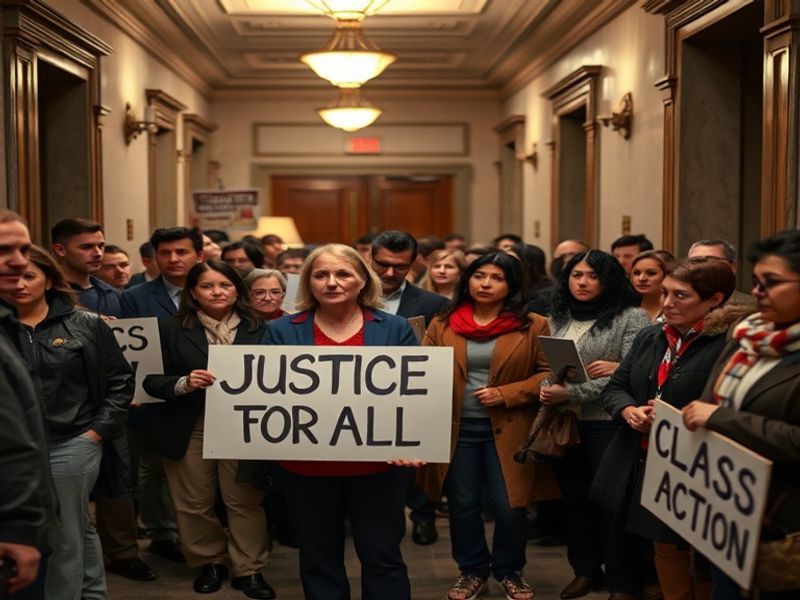
Class Action Lawsuits Explained: Rights, Process, and Impact
“`html
Understanding Class Action Lawsuits: Rights, Process, and Impact
The class action lawsuit remains one of the most powerful legal tools available to groups of people who have suffered similar harm. Unlike individual lawsuits, these cases allow large numbers of plaintiffs to band together under a single legal action, amplifying their collective voice and resources. This mechanism has reshaped how corporations, institutions, and even governments are held accountable for widespread misconduct.
The concept dates back to early 20th-century legal reforms in the United States, designed to streamline justice when individual claims would be too small or numerous to pursue separately. Today, class actions cover everything from defective products and data breaches to employment discrimination and environmental disasters. Their influence extends beyond individual compensation, often prompting systemic changes in industry practices.
The Legal Framework Behind Class Actions
Class action lawsuits are governed primarily by Rule 23 of the Federal Rules of Civil Procedure in the U.S., which outlines four critical requirements for certification:
- Numerosity: The class must be so large that individual lawsuits would be impractical. Courts typically require dozens, if not hundreds, of members.
- Commonality: The legal or factual issues in the case must share common threads across all class members.
- Typicality: The claims of the representative plaintiffs must reflect the experiences of the entire class.
- Adequacy: The class representatives and their attorneys must fairly and competently represent the class’s interests.
Once certified, the case proceeds with a class representative acting on behalf of the group. Settlements or judgments apply to all members, though individuals can choose to opt out if they prefer to pursue separate claims. This structure balances efficiency with fairness, ensuring that systemic wrongs don’t go unaddressed due to financial or logistical barriers.
The certification process itself is often contentious. Defendants frequently challenge whether the proposed class meets Rule 23’s standards, leading to years of pre-trial litigation. For example, in the 2013 case Wal-Mart v. Dukes, the Supreme Court blocked certification of a massive gender discrimination class, citing a lack of commonality in the plaintiffs’ claims. Such rulings highlight the high stakes involved in defining the scope of a class action.
Notable Class Action Cases and Their Consequences
Some of the most consequential legal battles in modern history have unfolded as class actions, reshaping industries and consumer protections. One of the most infamous is the 2017 Equifax data breach, which exposed the personal information of 147 million Americans. The resulting class action settlement topped $700 million, offering compensation to affected individuals while forcing the credit bureau to overhaul its cybersecurity protocols.
Another landmark case involved Volkswagen’s diesel emissions scandal, where the company installed “defeat devices” to cheat emissions tests. The resulting class action led to a $14.7 billion settlement, including buybacks for affected vehicles and environmental remediation funds. This case demonstrated how class actions can hold multinational corporations accountable for fraud on a global scale.
In the healthcare sector, the opioid litigation currently underway consolidates thousands of lawsuits against pharmaceutical companies like Purdue Pharma. These cases allege that manufacturers misled doctors and patients about the addictive risks of opioids, fueling the crisis that has claimed hundreds of thousands of lives. The potential settlement could exceed $50 billion, with funds directed toward addiction treatment and prevention programs.
These examples underscore a critical truth: class actions are not just about money. They serve as a catalyst for change, compelling industries to adopt safer practices and forcing regulators to confront gaps in oversight. When corporations face the prospect of a unified legal front, compliance becomes a business imperative.
The Controversies and Criticisms of Class Actions
Despite their benefits, class actions are not without controversy. Critics argue that these lawsuits often benefit attorneys more than plaintiffs. In many cases, legal fees consume 20-30% of the total settlement, leaving individual payouts disappointingly small. For instance, in the 2013 Target data breach settlement, affected customers received roughly $10 for each year they were inconvenienced, while attorneys walked away with millions.
Another point of contention is the opt-out provision. While it protects individuals who wish to pursue separate claims, it can also weaken the class’s bargaining power. In cases with millions of members, the vast majority may remain unaware of their right to opt out, effectively ceding control to the class representatives and their attorneys.
Corporations and their lobbyists have pushed back against class actions, arguing that they encourage frivolous lawsuits and drive up business costs. In 2005, Congress passed the Class Action Fairness Act (CAFA) to curb perceived abuses by expanding federal jurisdiction over large class actions. The law aimed to reduce forum shopping—where plaintiffs’ attorneys file cases in jurisdictions perceived as more plaintiff-friendly—but its impact remains debated.
Ethical concerns also arise in cases involving medical devices or pharmaceuticals. Critics contend that class actions can create a “race to the courthouse,” where lawsuits are filed before the full extent of harm is known. This dynamic played out in litigation surrounding pelvic mesh implants, where early settlements left many victims without adequate compensation as long-term complications emerged.
How Class Actions Empower Consumers and Workers
For individuals and small businesses, class actions level the playing field against powerful entities. Consider the case of AT&T Mobility v. Concepcion (2011), where the Supreme Court ruled that companies could enforce arbitration clauses that prevent consumers from joining class actions. The decision sparked widespread concern, as it effectively stripped a key tool for challenging corporate misconduct.
Yet even in the face of such setbacks, class actions continue to serve as a vital mechanism for justice. In employment law, for example, class actions have exposed systemic wage theft and discrimination. The 2019 case against Google, where female employees alleged gender pay discrimination, resulted in a $118 million settlement and forced the tech giant to reevaluate its compensation practices.
Class actions also play a crucial role in environmental justice. The 2010 Deepwater Horizon oil spill led to a $20.8 billion settlement, the largest in U.S. history, compensating fishermen, coastal businesses, and local governments for economic losses. Without the class action mechanism, the dispersed and varied harms suffered by affected communities might never have been addressed.
The psychological impact of class actions should not be underestimated. For plaintiffs, the knowledge that their individual struggle is part of a larger movement can provide a sense of validation and solidarity. In cases involving civil rights violations or environmental racism, this collective empowerment is as important as the financial compensation.
Conclusion: The Future of Class Actions
Class action lawsuits remain a cornerstone of the legal system’s ability to deliver justice on a large scale. While they face ongoing challenges—from legislative rollbacks to ethical dilemmas—their role in holding institutions accountable is irreplaceable. As technology advances and corporate power grows, the need for collective legal action will only intensify.
For consumers, workers, and communities, class actions offer a rare opportunity to challenge systemic injustices. However, the system’s effectiveness depends on transparency, strong legal representation, and public awareness. As cases like Equifax and Volkswagen show, the ripple effects of these lawsuits extend far beyond the courtroom, influencing industry standards and regulatory policies for years to come.
In an era where corporate accountability is increasingly scrutinized, class actions serve as a reminder that the law can be a force for equity. The challenge ahead lies in ensuring that this tool remains accessible, equitable, and capable of adapting to the evolving landscape of harm and injustice.