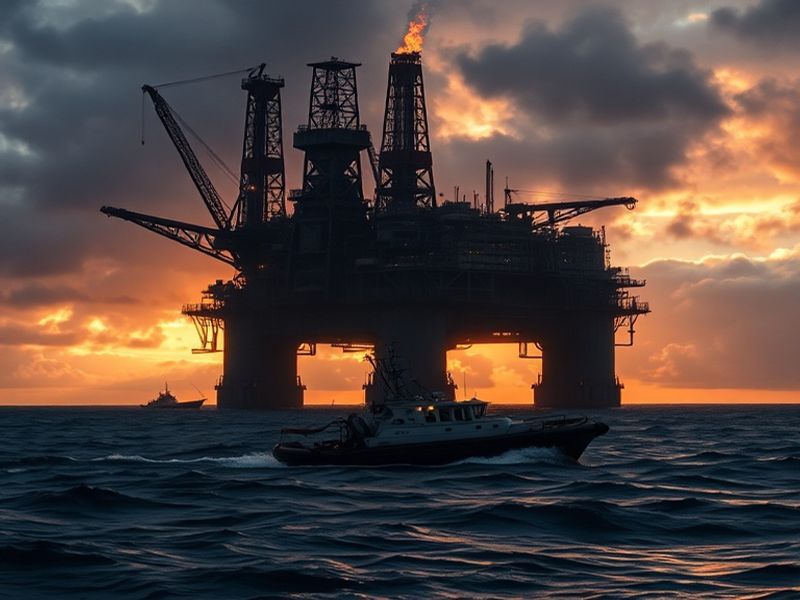
North Sea Oil: The Energy Backbone Powering Europe’s Economy
The North Sea has long been a critical source of oil and natural gas for Europe, forming the backbone of the continent’s energy supply since commercial extraction began in the late 1960s. Stretching from the coasts of the United Kingdom and Norway to the Netherlands, Germany, and Denmark, this body of water holds some of the most productive offshore oil fields in the world. For decades, North Sea oil has fueled industrial growth, supported energy security, and shaped geopolitical relationships across the region.
Yet the role of North Sea oil is evolving. As Europe accelerates its transition toward renewable energy, the future of this mature hydrocarbon province is increasingly uncertain. While still a major contributor to global oil markets, production levels have declined from their peak in the late 1990s, and new investment faces mounting pressure from climate policies and investor sentiment. The tension between energy security, economic stability, and environmental responsibility has never been more pronounced.
A Brief History of North Sea Oil
The discovery of the giant Ekofisk field in Norwegian waters in 1969 marked the beginning of large-scale North Sea oil production. Within a few years, the UK followed with the discovery of the Forties and Brent fields, igniting a rush of exploration and development. By the mid-1980s, the North Sea had become the world’s third-largest oil-producing region, behind only the Middle East and the former Soviet Union.
The boom transformed economies on both sides of the sea. In the UK, Aberdeen earned the nickname “Oil Capital of Europe,” while Stavanger in Norway became a hub for engineering and maritime expertise. The revenue generated from oil and gas taxes funded public services, infrastructure, and sovereign wealth funds—most notably Norway’s Government Pension Fund Global, now the world’s largest sovereign wealth fund at over $1.4 trillion.
The 1990s and early 2000s brought record production levels, peaking at nearly 6 million barrels per day in the late 1990s. However, natural decline in mature fields and rising operational costs began to erode output. Today, daily production has fallen to around 2.5 million barrels, with the UK and Norway each contributing roughly equal shares.
Economic and Geopolitical Significance
North Sea oil remains vital to Europe’s energy mix, particularly in times of crisis. During the 2022 energy shock triggered by Russia’s invasion of Ukraine, European nations scrambled to reduce dependence on Russian gas. While most attention focused on LNG imports and pipeline diversions, North Sea oil and gas played a stabilizing role, helping fill the supply gap and stabilizing prices.
The UK, despite being a net importer of oil overall, still relies on North Sea production for much of its domestic energy needs. Tax receipts from the sector contribute hundreds of millions of pounds annually to the Exchequer. In Norway, oil and gas revenues account for nearly a quarter of government income, providing fiscal resilience and enabling large-scale investments in social programs and green transitions.
Geopolitically, the North Sea has become a strategic zone. The UK and Norway are key allies in NATO and energy markets, collaborating through frameworks like the North Sea Transition Deal—a partnership aimed at supporting oil and gas workers while accelerating decarbonization. Meanwhile, the development of new interconnectors and floating wind projects is positioning the region as a leader in integrated energy systems.
The Challenges of Decline and Transition
As fields age and production declines, operators face escalating costs to maintain output. Many platforms now produce less than 10,000 barrels per day, making them economically marginal. Decommissioning has become an industry in itself, with an estimated £50 billion required over the next decade to safely plug and abandon wells and remove rigs. This presents both a financial burden and an opportunity for specialized engineering firms.
At the same time, the sector is under intense pressure to decarbonize. The UK has committed to banning new oil and gas licenses in the North Sea by 2030 if they are incompatible with net-zero targets, though existing projects can continue. Norway, while still expanding gas exports to Europe, has imposed stricter emissions standards and is investing heavily in carbon capture and hydrogen technologies.
Investor attitudes are shifting. Major banks and pension funds are divesting from fossil fuel projects, and many North Sea operators are diversifying into offshore wind, hydrogen, and energy storage. Equinor, for example, now generates more revenue from renewables than from oil and gas. The transition is underway, but it is uneven and politically contentious.
Environmental Concerns and Regulatory Pressures
The environmental impact of North Sea oil is significant. Routine flaring, methane leaks, and oil spills have drawn criticism from environmental groups. The Brent Delta platform, once a symbol of British industrial prowess, became a flashpoint in 2017 when its controversial single-piece removal was approved despite concerns over marine ecosystems.
Regulators are tightening oversight. The UK’s North Sea Transition Authority now requires operators to submit decarbonization plans alongside drilling applications. Emissions from production must align with the country’s carbon budgets, and flaring is increasingly restricted. Norway has pioneered carbon taxes on offshore emissions since 1991, making it one of the most expensive places in the world to emit CO₂.
Yet critics argue these measures are insufficient. A 2023 report by the International Energy Agency (IEA) found that no new oil and gas fields are compatible with limiting global warming to 1.5°C. This has intensified calls for a managed decline of the North Sea oil industry, with campaigners pushing for accelerated phase-outs and a just transition for workers.
The Future: Between Security and Sustainability
The next decade will determine whether North Sea oil can balance energy security with climate goals. Several key trends are likely to shape its trajectory:
- Technological innovation: Enhanced oil recovery (EOR) techniques, digital monitoring, and subsea processing could extend the life of mature fields and reduce emissions per barrel.
- Policy divergence: The UK and EU are tightening climate policies, while Norway continues to expand gas exports to Europe as a “bridge fuel.”
- Investment shifts: Capital is flowing toward low-carbon energy, with offshore wind in the North Sea now a faster-growing sector than oil in terms of new capacity.
- Workforce transformation: Thousands of jobs in oil and gas are at risk, but retraining programs and government support aim to transition workers into renewables, hydrogen, and decommissioning roles.
One emerging opportunity is the potential for the North Sea to become a global leader in carbon capture and storage (CCS). Projects like the UK’s HyNet and Norway’s Northern Lights initiative aim to store millions of tons of CO₂ annually in depleted oil reservoirs. This could not only decarbonize domestic industry but also position the region as a hub for international carbon storage services.
At the same time, the geopolitical context remains volatile. Disruptions in global oil markets—whether from conflicts, sanctions, or supply chain bottlenecks—can quickly reshape the calculus around North Sea production. In an era of energy transition, the North Sea’s role is no longer just about pumping oil; it’s about managing decline, financing transition, and redefining energy leadership.
Conclusion
North Sea oil has been a defining force in Europe’s modern energy history. It powered post-war economies, funded public welfare systems, and helped shape geopolitical alliances. Yet its legacy is now being rewritten by climate imperatives and market realities. The challenge ahead is not simply to phase out oil, but to do so in a way that protects livelihoods, maintains energy security, and leverages the region’s unique infrastructure and expertise for a sustainable future.
As Europe moves toward net-zero, the North Sea stands at a crossroads. It may never return to its production peaks, but its transformation could serve as a model for how mature hydrocarbon regions can evolve into centers of innovation, decarbonization, and green energy leadership. The era of North Sea oil as a dominant global supplier may be waning, but its next chapter—one of transition and reinvention—has only just begun.
For those interested in the broader implications of energy transitions, explore our Analysis section, where we examine policy shifts, market trends, and technological disruptions shaping industries worldwide. To understand how oil markets influence global economics, visit our Business category for in-depth reporting and expert commentary.