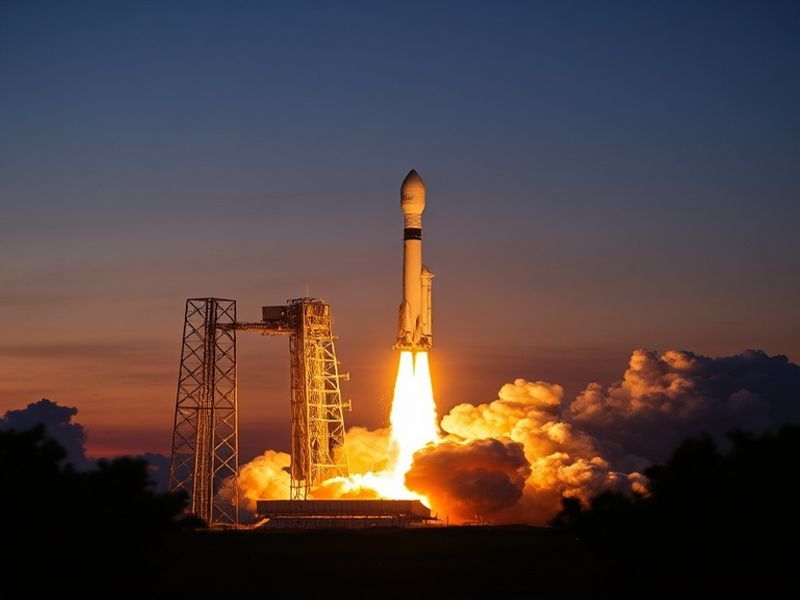
SpaceX Falcon 9 Launch: How Private Enterprise is Reshaping Space Travel
“`html
SpaceX Falcon 9 Launch: A New Chapter in Space Exploration
On a clear Tuesday morning at 5:44 a.m. EDT, a SpaceX Falcon 9 rocket roared to life on Launch Complex 39A at NASA’s Kennedy Space Center in Florida. The mission, designated Starlink 6-52, carried 23 Starlink satellites into low Earth orbit, marking another step in SpaceX’s ambitious plan to blanket the globe with high-speed internet connectivity. But this launch was more than just another payload delivery—it was a reminder of how private enterprise is reshaping humanity’s relationship with space.
For decades, space exploration was the exclusive domain of governments and their space agencies. The Soviet Union’s Sputnik in 1957 and the United States’ Apollo 11 moon landing in 1969 defined an era of geopolitical competition. Today, the landscape has shifted dramatically. Commercial companies like SpaceX, founded by Elon Musk in 2002, now lead the charge in making space more accessible and sustainable. The Falcon 9, with its partially reusable first stage, has become a symbol of this transformation—reducing the cost of space travel and opening new possibilities for scientific research, global communication, and even tourism.
The Technical Marvel Behind the Launch
The Falcon 9 rocket stands at 70 meters tall and is powered by nine Merlin engines in its first stage, capable of generating over 1.7 million pounds of thrust. What sets it apart from traditional rockets is its ability to return to Earth and land vertically on a drone ship or landing pad. This reusability has slashed the cost of launches from roughly $200 million per mission in the early 2000s to as low as $62 million today, according to some estimates.
The rocket’s second stage, while not reusable, carries the payload to its designated orbit. For the Starlink 6-52 mission, the second stage deployed 23 satellites, each weighing around 260 kilograms. These satellites join a constellation of over 5,000 active Starlink units, providing internet services to more than 100 countries. The network has proven particularly vital in remote and underserved regions, where traditional infrastructure is lacking.
SpaceX’s achievements haven’t gone unnoticed. In 2020, NASA selected SpaceX to develop the Human Landing System for the Artemis program, which aims to return humans to the moon by 2026. This partnership underscores the growing trust in private companies to handle critical missions. Meanwhile, competitors like Blue Origin and international players such as China’s SpaceX equivalent, LandSpace, are racing to catch up, signaling a new space race driven by innovation rather than Cold War tensions.
Global Impact: Connecting the Unconnected
The Starlink constellation is more than a technological feat—it’s a social and economic game-changer. In rural areas of the United States, Starlink has enabled farmers to use precision agriculture tools that require high-speed internet. In Africa, where only about 40% of the population has internet access, Starlink is bridging the digital divide. Schools in Nigeria and Kenya are now equipped with online learning platforms, and telemedicine services are reaching remote villages.
Yet, the project hasn’t been without controversy. Astronomers have raised concerns about the brightness of Starlink satellites, which can interfere with ground-based telescopes and disrupt observations of the night sky. SpaceX has responded by developing visors to reduce reflectivity and working with the astronomy community to mitigate impacts. Still, the debate highlights the challenges of balancing technological progress with environmental and cultural considerations.
SpaceX isn’t the only player in the global connectivity space. Competitors like OneWeb and Amazon’s Project Kuiper are also deploying satellite constellations. However, SpaceX’s head start and cost advantages give it a significant lead. The company’s ability to rapidly iterate and improve its technology has set a new standard for the industry. As of 2024, SpaceX is valued at over $180 billion, making it one of the most valuable private companies in the world.
The Cultural Shift: From Government to Private Enterprise
The rise of companies like SpaceX reflects a broader cultural shift in how society views space exploration. In the 20th century, space was often romanticized as the final frontier—a place of mystery and adventure, reserved for heroes in spacesuits. Today, space is increasingly seen as a commercial opportunity, a resource to be exploited, and a platform for technological innovation. This shift is evident in popular culture, where films like Interstellar and The Martian explore the challenges of space travel, while shows like For All Mankind reimagine history with a space race dominated by corporations.
This commercialization of space has also sparked debates about ethics and governance. Who owns space? How should resources like the moon’s water ice be allocated? The Outer Space Treaty of 1967, which forms the basis of international space law, prohibits nations from claiming celestial bodies. However, it doesn’t address the actions of private companies. As more corporations venture into space, the need for updated regulations becomes urgent.
SpaceX’s influence extends beyond Earth. The company’s Starship program, designed to carry humans to Mars, has captured the public imagination. While critics question the feasibility and ethics of colonizing another planet, the vision has inspired a new generation of engineers, scientists, and dreamers. SpaceX’s culture of innovation and risk-taking mirrors the Silicon Valley ethos, where failure is seen as a stepping stone to success. This approach has drawn both admiration and criticism, with some praising its boldness and others warning of its potential dangers.
Looking Ahead: The Future of Spaceflight
The success of the Falcon 9 and the Starlink program sets the stage for even more ambitious projects. SpaceX’s next-generation Starship rocket, currently under development in Texas, aims to be fully reusable and capable of carrying up to 100 metric tons to Mars. If successful, it could revolutionize interplanetary travel and make humanity a multi-planetary species.
But the journey won’t be easy. The Starship program has faced setbacks, including a dramatic explosion during a test flight in 2023. Yet, SpaceX’s ability to learn from failure and rapidly iterate has kept the project on track. The company’s approach contrasts sharply with traditional aerospace giants, which often prioritize safety and caution over speed.
As space becomes more crowded, collaboration will be key. International partnerships, like those between SpaceX and the European Space Agency, are already underway. These collaborations could lead to joint missions to the moon, Mars, and beyond. Meanwhile, the rise of space tourism—companies like SpaceX and Blue Origin are selling seats to private individuals—is making space more accessible to the public. In 2021, the Inspiration4 mission carried four civilians to orbit, proving that spaceflight isn’t just for astronauts.
The next decade promises to be an exciting one for space exploration. From the moon to Mars, from global internet connectivity to asteroid mining, the possibilities are endless. One thing is certain: the era of government-dominated space exploration is over. The future belongs to those who dare to dream—and to those who build the machines to make those dreams a reality.
Key Takeaways from the Falcon 9 Launch
- Reusability: The Falcon 9’s ability to land and reuse its first stage has drastically reduced the cost of space travel.
- Global Connectivity: The Starlink constellation is providing high-speed internet to underserved regions, bridging the digital divide.
- Private Sector Leadership: Companies like SpaceX are taking the reins in space exploration, moving beyond government-led missions.
- Cultural Shift: Space is increasingly seen as a commercial opportunity, reflecting broader changes in how society views exploration and innovation.
- Future Ambitions: Projects like Starship aim to make humanity a multi-planetary species, setting the stage for the next era of spaceflight.
As we look to the stars, it’s clear that the future of space exploration will be shaped by a mix of ambition, innovation, and collaboration. The Falcon 9 launch is just one chapter in this ongoing story—a story that is still being written by those who dare to reach for the skies.