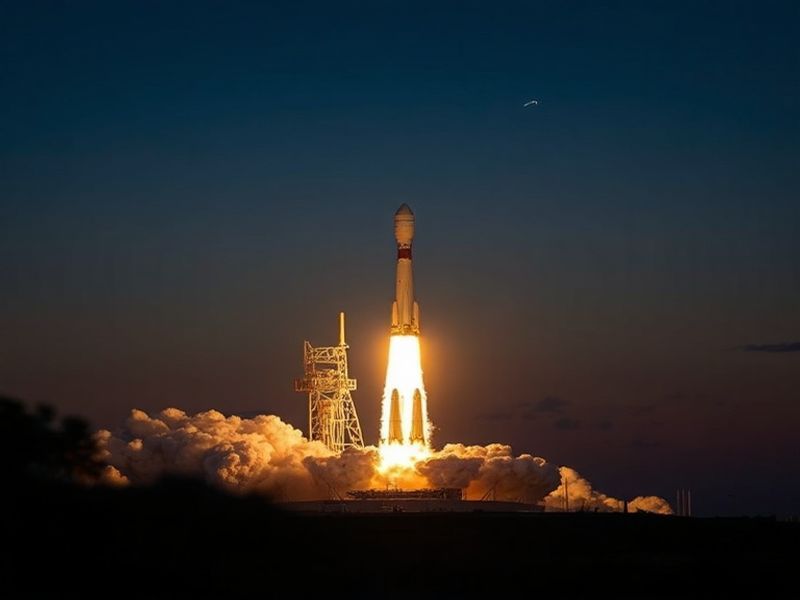
On a clear Tuesday morning, SpaceX successfully launched another batch of Starlink satellites aboard a Falcon 9 rocket from Cape Canaveral Space Force Station. The mission, designated Starlink 6-51, marked another routine but critical step in SpaceX’s ambitious plans to expand global internet coverage. While such launches have become almost commonplace in recent years, the underlying technology and implications deserve closer examination.
The Falcon 9 rocket lifted off at 6:14 a.m. EDT, carrying 23 Starlink satellites into low Earth orbit. What stood out this time wasn’t the payload or the timing, but the rocket’s first stage, which completed its 19th successful flight and landing. This particular booster, originally debuting in November 2020, has now supported missions for NASA, commercial clients, and SpaceX’s own Starlink program. Its reuse underscores the company’s commitment to reducing spaceflight costs through reusability—a cornerstone of its long-term vision.
Breaking Down the Technical Achievement
Reusability remains SpaceX’s most disruptive innovation in the space industry. Unlike traditional expendable rockets, the Falcon 9’s first stage is designed to return to Earth after launch, landing vertically on either a drone ship in the ocean or a ground pad. This approach has slashed launch costs by millions per mission, making space more accessible to both government and private entities.
The Starlink 6-51 mission highlighted another critical aspect of SpaceX’s operations: rapid turnaround. The same booster that launched this mission had previously flown just 10 days earlier, setting a new record for Falcon 9’s turnaround time. Such efficiency is only possible through meticulous engineering and a streamlined launch cadence that few organizations in history have matched.
Beyond the rocket itself, the payload—23 Starlink satellites—represents another layer of SpaceX’s broader strategy. These satellites are part of a constellation designed to provide high-speed internet access to underserved regions across the globe. With thousands already in orbit and more launching regularly, Starlink is reshaping how we think about global connectivity, particularly in remote or rural areas where traditional infrastructure is lacking.
Why This Launch Matters Beyond SpaceX
The success of missions like Starlink 6-51 has implications that extend far beyond SpaceX’s immediate goals. For one, it sets a precedent for the commercial space industry. As more companies adopt reusable rocket technology, the cost of accessing space will continue to decline, opening doors for scientific research, commercial ventures, and even space tourism.
Additionally, the rapid deployment of satellite constellations like Starlink is forcing regulators and policymakers to reconsider existing frameworks. Issues such as orbital debris, frequency allocation, and international cooperation on space traffic management are becoming increasingly urgent. The sheer scale of Starlink’s presence in low Earth orbit—with over 5,000 satellites launched to date—demands proactive solutions to prevent collisions and ensure long-term sustainability.
The Ripple Effects on the Space Industry
SpaceX’s achievements with the Falcon 9 have not gone unnoticed. Competitors like Blue Origin and Rocket Lab are developing their own reusable rockets, while traditional aerospace giants such as Boeing and Lockheed Martin are investing in reusability to stay competitive. Even international players like China’s SpaceX equivalent, LandSpace, are taking cues from SpaceX’s playbook.
This competitive pressure is accelerating innovation across the board. For instance, Rocket Lab’s Electron rocket, while not yet fully reusable, has demonstrated partial recovery of its first stage. Meanwhile, Blue Origin’s New Shepard and New Glenn rockets are designed with reusability in mind, though they have yet to match Falcon 9’s operational tempo.
The broader impact extends to scientific missions as well. NASA’s decision to rely on SpaceX’s Crew Dragon spacecraft for transporting astronauts to the International Space Station (ISS) highlights how commercial partnerships are becoming the norm. This shift allows NASA to focus its resources on deeper space exploration, such as the Artemis program aimed at returning humans to the Moon.
Challenges and Criticisms
Despite its successes, SpaceX faces scrutiny on multiple fronts. Environmental advocates have raised concerns about the long-term impact of thousands of satellites in orbit, particularly regarding light pollution and the potential for Kessler syndrome—a scenario where collisions create a cascade of debris, making certain orbits unusable. SpaceX has responded by introducing measures like “VisorSat” satellites, which are designed to reduce reflectivity, and by deorbiting older satellites to mitigate these risks.
Another challenge is the sheer volume of launches. SpaceX’s ambitious cadence—averaging one launch every few days—has led to congestion in key orbital regimes. Regulators are still playing catch-up, and there’s an ongoing debate about how to balance innovation with safety and sustainability. The recent near-miss between a Starlink satellite and a European Space Agency (ESA) satellite in 2019 serves as a stark reminder of the potential consequences of unchecked growth in satellite deployments.
What’s Next for SpaceX and the Falcon 9?
Looking ahead, SpaceX shows no signs of slowing down. The company has outlined plans to launch up to 144 missions in a single year—a goal that would dwarf its current record of 96 launches in 2023. To achieve this, SpaceX is expanding its launch sites and refining its operations to maximize efficiency.
One of the most anticipated developments is the debut of Starship, SpaceX’s next-generation rocket designed to carry humans to Mars. While Starship is still in the testing phase, its potential to drastically reduce the cost of deep space missions could redefine humanity’s relationship with space. In the meantime, the Falcon 9 will continue to serve as the workhorse of SpaceX’s fleet, supporting commercial, scientific, and governmental missions.
The broader implications for the space industry are profound. As reusable rockets become the standard, we may witness a democratization of space access. Smaller companies and even academic institutions could launch their own satellites without the prohibitive costs that once made space exploration the domain of superpowers and billionaires. This shift could unlock new opportunities in fields ranging from climate science to asteroid mining.
Key Takeaways from the Latest Falcon 9 Launch
- Reusability Milestone: The Falcon 9’s first stage completed its 19th flight, demonstrating the rocket’s reliability and cost-effectiveness.
- Rapid Turnaround: A record 10-day turnaround between flights highlights SpaceX’s operational efficiency.
- Starlink Expansion: The mission added 23 more satellites to SpaceX’s global internet constellation, bringing total launches to over 5,000.
- Industry Impact: Competitors are accelerating their reusable rocket programs in response to SpaceX’s dominance.
- Regulatory Scrutiny: The growing number of satellites is prompting calls for better space traffic management and debris mitigation strategies.
For enthusiasts and industry watchers alike, the Falcon 9’s latest mission is more than just another launch—it’s a testament to how far we’ve come and a glimpse into the future of space exploration. As SpaceX continues to push boundaries, the lessons learned from each flight will shape the next generation of rockets, satellites, and perhaps even human settlements beyond Earth.
For those interested in following the broader trends in space technology, Dave’s Locker’s Technology section offers in-depth analysis and updates on the latest developments. Alternatively, for stories that intersect with scientific exploration and innovation, the Science category provides additional context and reporting on humanity’s journey into the cosmos.
Conclusion
The Starlink 6-51 mission may have been just another day for SpaceX, but it represents a critical chapter in the story of modern spaceflight. By continuing to refine reusable rocket technology and expand satellite constellations, SpaceX is not only driving down the cost of access to space but also redefining what’s possible in the 21st century. The challenges ahead—regulatory, environmental, and logistical—are significant, but the progress is undeniable. As we look to the stars, missions like this one remind us that the future of space exploration is being written right now, one launch at a time.