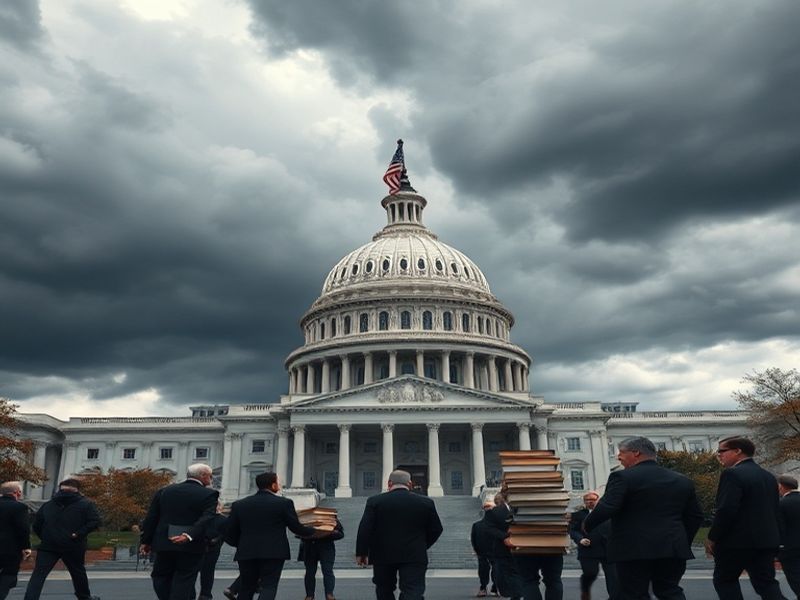
The concept of impeachment is one of the most powerful tools the U.S. Constitution provides to maintain checks and balances in government. At its core, an article of impeachment is a formal accusation against a federal official—typically the president, vice president, or a federal judge—for misconduct. These accusations are not criminal charges but rather political and constitutional remedies designed to address serious abuses of power.
Impeachment proceedings begin in the U.S. House of Representatives, which has the sole power to bring charges. If a majority of the House votes to approve one or more articles of impeachment, the process moves to the Senate, where a trial is conducted. This two-step process reflects a deliberate balance: the House acts as the accuser, while the Senate serves as the jury, with the Chief Justice of the Supreme Court presiding in presidential cases.
The Constitutional Foundation of Impeachment
The U.S. Constitution outlines impeachment in Article II, Section 4, which states: “The President, Vice President and all civil Officers of the United States, shall be removed from Office on Impeachment for, and Conviction of, Treason, Bribery, or other high Crimes and Misdemeanors.” This language is intentionally broad, allowing for a wide range of misconduct to be considered “high crimes and misdemeanors.”
Unlike criminal offenses, which require proof beyond a reasonable doubt, impeachable offenses are judged by standards of political and constitutional legitimacy. The phrase “high crimes and misdemeanors” originates from British parliamentary practice and refers to abuses of power, dereliction of duty, or conduct unbecoming of public office. Historically, impeachment has been used not only for criminal acts but also for gross incompetence, abuse of authority, or conduct that undermines public trust.
For example, in 1974, the House Judiciary Committee approved articles of impeachment against President Richard Nixon for obstruction of justice, abuse of power, and contempt of Congress—none of which were traditional crimes but were deemed serious constitutional violations.
How Articles of Impeachment Are Drafted and Approved
The process of drafting and approving articles of impeachment begins with an investigation. This may be conducted by the House Judiciary Committee, a special committee, or through public hearings. The investigation gathers evidence, interviews witnesses, and reviews documents to assess whether impeachable offenses have occurred.
Once the investigation concludes, the House Judiciary Committee drafts the articles of impeachment. These are formal charges, typically numbered and phrased precisely. Each article must articulate a specific allegation of misconduct. For instance, during the impeachment of President Bill Clinton in 1998, the House approved two articles: one for perjury and one for obstruction of justice.
The full House then debates and votes on each article. A simple majority (218 votes in a 435-member House) is required to approve an article. If one or more articles are approved, the process moves to the Senate.
It’s worth noting that impeachment is a political—not legal—process. Representatives are not bound by legal standards but by their interpretation of constitutional duty, public interest, and political consequences.
Notable Impeachment Cases in U.S. History
Only three U.S. presidents have been impeached by the House: Andrew Johnson in 1868, Bill Clinton in 1998, and Donald Trump twice—in 2019 and 2021. Richard Nixon resigned in 1974 before the House could vote on articles of impeachment. Each case offers insight into how impeachment functions in practice.
- Andrew Johnson (1868): Impeached for violating the Tenure of Office Act by removing Secretary of War Edwin Stanton without Senate approval. The Senate acquitted him by one vote. The case is often viewed as a clash between Congress and the presidency during Reconstruction.
- Bill Clinton (1998):
- Impeached for perjury and obstruction of justice related to his affair with Monica Lewinsky and subsequent testimony. The Senate acquitted him on both charges.
- Donald Trump (2019): Impeached for abuse of power and obstruction of Congress regarding his dealings with Ukraine and a pressure campaign to investigate political rivals. The Senate acquitted him in February 2020.
- Donald Trump (2021): Impeached for incitement of insurrection following the January 6, 2021, attack on the U.S. Capitol. The Senate acquitted him after he had left office, raising questions about the scope of impeachment.
Federal judges have also been impeached and removed from office. Notable examples include Judge Alcee Hastings (impeached in 1988 for bribery and perjury) and Judge Thomas Porteous (impeached in 2010 for corruption and perjury). These cases demonstrate that impeachment is not solely a tool for presidential accountability but applies to all civil officers.
The Consequences and Limits of Impeachment
Impeachment and conviction result in removal from office, and in some cases, disqualification from holding future federal office. However, the person may still face criminal prosecution after impeachment. For example, Nixon was later pardoned by President Ford, while Clinton was acquitted in the Senate but faced no further legal consequences.
One significant limitation of impeachment is the political nature of the process. Because representatives and senators are elected officials, their decisions are influenced by public opinion, party loyalty, and electoral consequences. This can lead to partisan impeachments, where charges are seen as politically motivated rather than based on clear constitutional violations.
Another limitation is the requirement for a two-thirds majority in the Senate to convict and remove an official. This high threshold makes conviction difficult, especially in a closely divided Senate. For instance, Trump’s second impeachment resulted in acquittal despite bipartisan condemnation of his role in the Capitol riot.
Impeachment also carries long-term consequences for the presidency and the nation. It can polarize the public, erode trust in institutions, and set precedents for future use of the process. Some scholars argue that frequent or frivolous impeachments may weaken the legitimacy of the tool itself.
Ultimately, impeachment remains one of the most solemn and consequential powers in American democracy. It serves as a safeguard against tyranny and corruption but must be used judiciously to preserve constitutional balance and public trust.
Conclusion: Impeachment as a Constitutional Safeguard
Articles of impeachment represent more than just legal accusations—they are a reflection of a nation’s commitment to accountability and the rule of law. While the process is inherently political, its constitutional roots demand seriousness, fairness, and a commitment to the public good.
As political tensions rise and public trust in institutions fluctuates, the impeachment process remains a critical tool for addressing serious misconduct. However, its effectiveness depends on wise and restrained use, guided by constitutional principle rather than partisan advantage.
For a deeper look at how impeachment intersects with other constitutional crises, explore our Politics section on Dave’s Locker, where we analyze the legal and historical dimensions of governance under pressure.