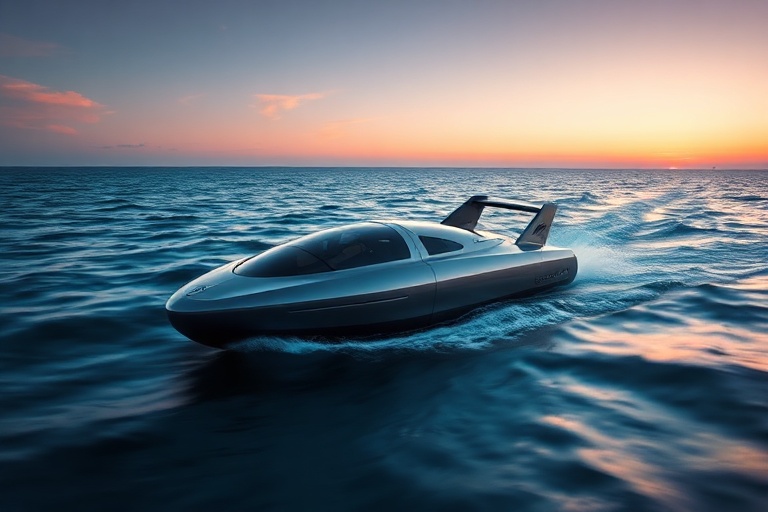
Unmanned Surface Vehicles: Redefining Maritime Operations Across the Globe
From the icy waters of the Arctic to the coral reefs of the Pacific, unmanned surface vehicles (USVs) are transforming how humans interact with the world’s oceans. These autonomous or remotely operated platforms are no longer confined to research labs or military prototypes. Today, they patrol coastlines, map uncharted seafloors, monitor marine life, and even assist in disaster response. Unlike their aerial or underwater counterparts, USVs operate at the critical interface between air and sea—where human presence is often risky, expensive, or impossible.
The rise of USVs reflects a broader shift in global maritime strategy, driven by advances in robotics, artificial intelligence, and sensor technology. Governments, corporations, and environmental organizations are investing heavily in these systems, recognizing their potential to reduce operational costs, improve safety, and expand scientific discovery. In Japan, for instance, USVs are being deployed to inspect aging coastal infrastructure following years of saltwater corrosion. Meanwhile, in the Mediterranean, marine biologists use them to track endangered species without disturbing their habitats.
The Technology Behind the Movement
At their core, USVs are sophisticated platforms equipped with propulsion systems, navigation tools, and payloads tailored to specific missions. Most rely on GPS for positioning and inertial measurement units to maintain stability in rough seas. Some advanced models integrate LiDAR and multibeam sonar for high-resolution seabed mapping, while others carry hyperspectral cameras to monitor water quality or detect oil spills.
Power sources vary widely. Solar-powered USVs, like those developed by Technology firms in Silicon Valley, can operate for months without refueling. Diesel-electric hybrids offer greater thrust for heavy-duty tasks such as dredging or salvage operations. Wireless communication remains a challenge, especially beyond coastal ranges, which is why many long-endurance USVs now carry satellite modems to transmit data in real time.
The autonomy spectrum ranges from fully remote-controlled systems to fully autonomous vehicles guided by AI. The latter use machine learning to avoid obstacles, adjust course based on weather forecasts, and even make mission decisions without human input. This level of independence is particularly valuable in areas like the South China Sea, where geopolitical tensions make manned patrols risky and politically sensitive.
Global Applications: From Science to Security
One of the most visible roles for USVs is in environmental monitoring. The Great Barrier Reef, facing unprecedented bleaching events, is now patrolled by autonomous surface vehicles equipped with underwater cameras and sensors. These systems collect data on coral health, water temperature, and acidification levels, feeding into global climate models. Similarly, in the Baltic Sea, USVs track harmful algal blooms that threaten both marine ecosystems and regional fisheries.
In the energy sector, offshore wind farms are turning to USVs for routine inspections. Traditional crewed vessels can cost millions per year in operational expenses. In contrast, a single USV can conduct visual and thermal surveys, detect corrosion, and assess structural integrity at a fraction of the cost. Companies like Equinor and Ørsted have integrated USVs into their maintenance workflows across the North Sea, where rough weather often delays manned missions.
Security applications are equally compelling. In the Strait of Malacca, a critical shipping lane, USVs equipped with radar and AIS (Automatic Identification System) track vessel traffic and detect suspicious behavior. These platforms operate 24/7 in all weather conditions, providing continuous surveillance without risking human lives. The U.S. Coast Guard has also tested USVs for search-and-rescue missions, where they can quickly cover large areas and relay data to rescue teams.
The following list highlights key sectors benefiting from USV deployment:
- Scientific Research: Seafloor mapping, biodiversity surveys, climate data collection
- Oil & Gas: Pipeline inspection, leak detection, platform monitoring
- Renewable Energy: Wind turbine inspection, wave energy assessment
- Fisheries Management: Stock assessment, illegal fishing detection
- Disaster Response: Flood monitoring, tsunami damage assessment, pollution tracking
Cultural and Ethical Considerations
The rapid adoption of USVs raises important questions about sovereignty, labor displacement, and environmental ethics. In nations like Norway and Canada, where fishing communities are central to cultural identity, the introduction of USVs has sparked debates about job loss and the dehumanization of maritime labor. Fishermen argue that while USVs can monitor fish populations, they lack the nuanced decision-making skills of experienced crews who understand local ecosystems.
There are also concerns about data ownership. When a USV maps a new shipping route or discovers a shipwreck, who controls that information? In 2022, a USV operated by a private company in Indonesia inadvertently discovered a WWII-era submarine. The government initially claimed the data as public property, but legal challenges followed, highlighting the need for clearer international frameworks on marine data sovereignty.
Ethical dilemmas extend to wildlife interaction. While USVs can reduce human disturbance in sensitive areas, their propellers and sonar can still harm marine animals. Researchers are now testing bio-inspired designs, such as USVs with whale-tail-inspired propulsion, to minimize ecological impact. This intersection of nature and technology reflects a growing global consciousness about responsible innovation.
The Future: Toward a Networked Ocean
The next decade will likely see USVs evolve into interconnected networks, forming a digital ocean where thousands of autonomous vehicles share data in real time. Projects like the European Union’s “Robotic Vehicles for Marine Environments” initiative aim to create a swarm of USVs that can collectively monitor vast ocean areas, detect illegal activities, and respond to environmental crises autonomously.
In Asia, countries like South Korea and Singapore are investing in “smart ports” where USVs act as mobile sensors, guiding cargo ships, detecting piracy risks, and even autonomously refueling at sea. These smart systems are expected to reduce port congestion by up to 30%, according to industry projections. Meanwhile, in Africa, USVs are being used to combat illegal fishing along the coast of West Africa, where foreign trawlers have depleted local fish stocks for decades.
As artificial intelligence matures, USVs may soon operate with predictive capabilities. Imagine a vehicle that not only detects a storm approaching but also reroutes itself to avoid it, or one that identifies a brewing oil spill and alerts authorities before it reaches shore. Such capabilities could redefine disaster preparedness on a planetary scale.
Yet challenges remain. Cybersecurity threats loom large—hackers could potentially hijack a USV or feed it false data. Battery life still limits long-range missions, and regulatory frameworks lag behind technological innovation. The International Maritime Organization has begun drafting guidelines for autonomous vessels, but global consensus remains elusive.
Despite these hurdles, the trajectory is clear: unmanned surface vehicles are not a fleeting trend but a fundamental shift in how humanity engages with the ocean. They offer a bridge between human curiosity and the vast, often unforgiving marine environment. Whether safeguarding coastal communities, uncovering the mysteries of the deep, or powering the green energy transition, USVs are silently redefining the boundaries of possibility.
As these vehicles become more intelligent, affordable, and connected, they will increasingly shape not only maritime industries but also global culture. The ocean, long seen as a barrier or a resource to exploit, is becoming a space of collaboration between humans and machines. In this new era, the unmanned surface vehicle is more than a tool—it is a silent partner in humanity’s quest to understand and protect our blue planet.