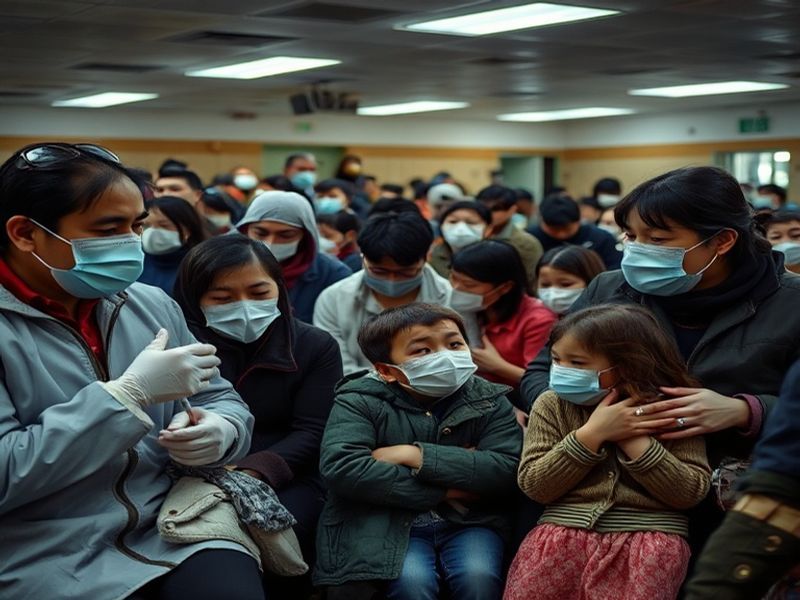
Measles remains one of the most contagious diseases known to medicine, yet it has seen a troubling resurgence in recent years. Once declared eliminated in many countries, the virus has made a dramatic comeback, fueled by declining vaccination rates and misinformation campaigns. The World Health Organization reported a 79% increase in measles cases globally in 2022 compared to the previous year, with outbreaks reported in every region of the world.
This resurgence is not confined to low-income nations with limited healthcare access. Wealthy countries like the United States, France, and the United Kingdom have also experienced alarming spikes in infections. The paradox of modern medicine—where preventable diseases return despite available vaccines—highlights deeper societal fractures. Vaccination skepticism, amplified by social media, has eroded public trust in public health measures, creating conditions for measles to spread with frightening efficiency.
The Global Resurgence of Measles
Measles is a highly infectious respiratory disease that can linger in the air for up to two hours after an infected person has left a room. A single case can lead to 12–18 additional infections in unvaccinated populations, making herd immunity critical. The disease kills more than 100,000 children annually, mostly in regions with weak health infrastructure. Yet even in countries where vaccination programs were once highly effective, outbreaks are now occurring in schools, hospitals, and communities with low immunization coverage.
In 2023, the European Centre for Disease Prevention and Control recorded over 30,000 measles cases across 40 countries. France saw more than 1,000 cases in the first half of the year, while Italy reported clusters in unvaccinated migrant communities and anti-vaccine strongholds. In the United States, the Centers for Disease Control and Prevention (CDC) confirmed 58 measles cases in early 2024, a number that has risen steadily since 2020. These incidents are not isolated incidents but part of a coordinated global trend.
The decline in vaccination rates is multifactorial. In some countries, war and displacement have disrupted healthcare systems. In others, such as the UK, reduced uptake is linked to the 1998 fraudulent study by Andrew Wakefield that falsely linked the MMR vaccine to autism. Though thoroughly debunked and retracted, the myth persists online, fueled by algorithm-driven misinformation. Social media platforms have become vectors for anti-vaccine propaganda, with Facebook groups and YouTube channels spreading fear under the guise of “parental rights” or “medical freedom.”
Cultural and Socioeconomic Factors Driving the Crisis
Measles outbreaks are not just medical events; they are cultural and socioeconomic phenomena. In Japan, where vaccination coverage plummeted after a 2013 court ruling that allowed parents to opt out based on personal beliefs, measles surged from just dozens of cases in 2017 to over 1,000 in 2019. The decision reflected a broader shift in public sentiment, where individual autonomy was prioritized over collective health—a sentiment echoed in movements across Europe and North America.
In some communities, vaccine hesitancy is rooted in historical medical abuses. African American and Indigenous populations in the U.S., for instance, have long-standing distrust of government health initiatives due to unethical experiments like the Tuskegee Syphilis Study. This skepticism has been exploited by anti-vaccine groups, who frame immunization as part of a broader system of oppression. Meanwhile, in ultra-Orthodox Jewish and certain Christian fundamentalist circles, religious exemptions are often used to avoid vaccination, leading to localized outbreaks during religious gatherings.
Economic disparities also play a role. In India, where measles remains endemic, rural areas with poor access to healthcare see higher infection rates. Children in these regions often miss scheduled vaccinations due to long travel distances to clinics or lack of awareness. Urban slums, meanwhile, face overcrowding and poor sanitation, creating ideal conditions for rapid transmission. While wealthier nations grapple with ideological resistance, developing countries continue to battle structural barriers to immunization.
What’s Being Done—and What’s Failing
Governments and health organizations are responding with a mix of enforcement and education. Several U.S. states have tightened vaccine exemption laws, requiring parents to consult a healthcare provider or view state-approved educational materials before opting out. France has reinstated mandatory vaccination for children, imposing fines on unvaccinated pupils. The European Union has launched campaigns targeting migrant communities with multilingual outreach, acknowledging that language barriers and cultural mistrust can hinder vaccine uptake.
Yet these efforts face resistance. In New York, a 2019 measles outbreak in ultra-Orthodox Jewish neighborhoods led to a temporary ban on unvaccinated children attending school, sparking protests and accusations of discrimination. In Samoa, where a 2019 measles crisis killed 83 people—mostly children—authorities responded by imposing strict lockdowns and mandatory vaccination drives. The government even made vaccination a requirement for obtaining a driver’s license, a move that drew both praise and criticism for its authoritarian overreach.
Technology has also been deployed in the fight. Apps like ImmunizeCA and Vaccine Passport systems in the EU aim to streamline record-keeping and remind parents of upcoming doses. Artificial intelligence is being used to predict outbreaks by analyzing social media sentiment and travel patterns. However, these digital tools are only as effective as the trust they inspire—and in an era of deep societal polarization, even data-driven solutions are politicized.
Looking Ahead: Can Measles Be Stopped Again?
The path forward requires a multi-pronged approach. First, public health messaging must move beyond fear-based appeals and instead focus on building trust. This means engaging community leaders, religious figures, and local doctors—not just government officials—to deliver accurate information in culturally appropriate ways. In the UK, campaigns featuring Muslim scholars and Jewish doctors have helped counter misinformation within those communities.
Second, vaccine mandates must be carefully balanced with equity. Blanket bans on unvaccinated children from schools, for example, can alienate marginalized groups and push them further from healthcare systems. Instead, targeted outreach—such as mobile vaccination clinics in rural areas or culturally tailored educational materials—can improve compliance without coercion.
Finally, social media platforms must take greater responsibility for the spread of vaccine misinformation. While companies like Facebook and YouTube have taken steps to demote anti-vaccine content, enforcement remains inconsistent. The algorithms that prioritize engagement over accuracy continue to amplify fear and division, creating echo chambers where measles outbreaks thrive.
Measles is not just a disease of the past—it is a disease of the present, resurging in a world where science and skepticism collide. Its resurgence is a warning: public health is not just about vaccines, but about trust. When communities stop believing in institutions, even life-saving measures become casualties of war—whether ideological, cultural, or political.
To read more about global health trends and how they intersect with policy, visit our Health section. For insights into how misinformation spreads in modern society, explore our Analysis category.