<!DOCTYPE html>
<html lang="en">
<head>
    <meta charset="UTF-8">
    <meta name="viewport" content="width=device-width, initial-scale=1.0">
    <title>Fireball Meteor Streaks Across Northeast Skies</title>
</head>
<body>
    <article>
        <h1>Fireball Meteor Illuminates Northeast Skies in Rare Celestial Display</h1>

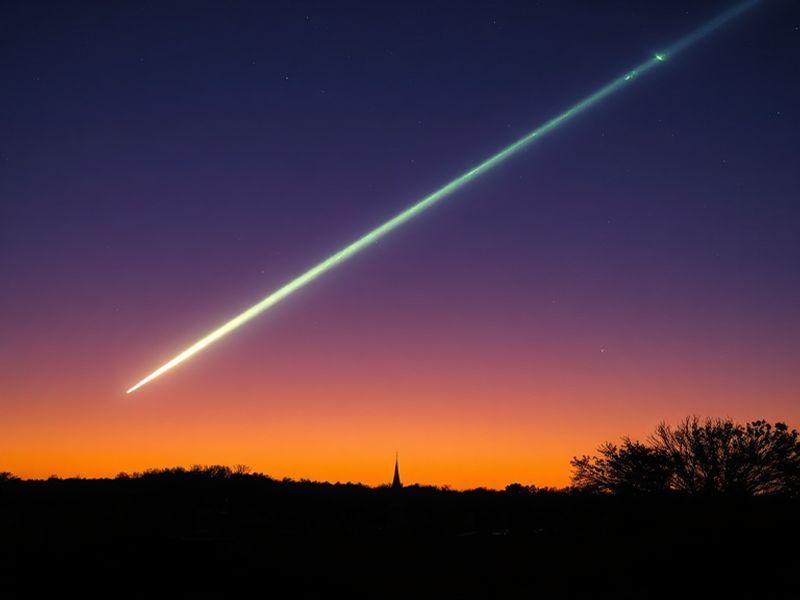
        <p>The night sky over the northeastern United States transformed into a temporary canvas of fire on March 21, 2024, as a brilliant fireball meteor blazed across multiple states. The spectacle lasted approximately seven seconds, captivating thousands of observers from New York to Pennsylvania before disintegrating high above the Atlantic Ocean. Astronomers later confirmed the event as one of the most significant meteor sightings in the region over the past decade.</p>

        <p>Witnesses reported seeing a bright greenish-blue streak, accompanied by a thunderous sonic boom that rattled windows in some areas. The American Meteor Society (AMS) received over 200 reports within hours of the event, with many describing the fireball as brighter than the full moon. Social media platforms exploded with videos and photos, some showing the meteor breaking apart into multiple fragments during its descent.</p>

        <h2>Scientific Analysis: What Made This Meteor So Special</h2>

        <p>Fireball meteors—defined as meteors brighter than magnitude -4 (approximately the brightness of Venus)—are relatively rare occurrences, with only about 100 reported annually across North America. What set this particular event apart were several key factors:</p>

        <ul>
            <li><strong>Duration:</strong> Most fireballs last between 1-3 seconds, making the seven-second display unusually prolonged.</li>
            <li><strong>Brightness:</strong> Early estimates suggest the meteor reached magnitude -10 or brighter, outshining most urban streetlights.</li>
            <li><strong>Fragmentation:</strong> Multiple accounts indicate the meteor broke apart in at least three distinct pieces before vanishing.</li>
            <li><strong>Sonic effects:</strong> The accompanying boom suggests the meteor penetrated deep enough into the atmosphere for its sound to travel to the ground.</li>
        </ul>

        <p>Dr. Emily Chen, an astronomer at Harvard-Smithsonian Center for Astrophysics, noted that the meteor's unusual color likely resulted from its composition. "Green hues typically indicate the presence of magnesium burning up in our atmosphere," she explained. "This suggests the meteor may have contained higher-than-average amounts of magnesium-rich minerals."</p>

        <p>Initial calculations by NASA's Meteor Watch team suggest the meteor was traveling at approximately 35,000 miles per hour when it entered Earth's atmosphere. The object is estimated to have been between 1-3 feet in diameter before breaking apart, releasing energy equivalent to several tons of TNT.</p>

        <h2>Cultural Impact: When the Cosmos Puts on a Show</h2>

        <p>For millennia, celestial events have held profound significance across cultures. The sudden appearance of a fireball meteor often carries different meanings depending on societal context. In ancient China, such phenomena were considered omens of imperial change, while Norse mythology associated them with the god Loki's mischief.</p>

        <p>Modern interpretations vary widely. Some social media users jokingly referenced the 1994 movie <em>Night of the Comet</em>, while others saw more spiritual significance. A viral TikTok trend emerged where users filmed themselves making wishes as the meteor passed, reminiscent of meteor shower traditions during events like the Perseids.</p>

        <p>The event also sparked renewed interest in astronomy, with local planetariums reporting a 300% increase in visitors the following weekend. The Liberty Science Center in New Jersey saw lines stretching for blocks as families waited to view telescopic images of the fireball's trajectory.</p>

        <p>In some communities, the meteor became a unifying moment. Local restaurants in Vermont reported record ice cream sales as families celebrated the unexpected event, while schools in Connecticut incorporated the sighting into science lessons about solar system dynamics.</p>

        <h2>Global Context: Fireballs Through History and Across Cultures</h2>

        <p>While the Northeast event was spectacular, it's worth noting that fireball meteors occur regularly worldwide. The 2013 Chelyabinsk meteor in Russia, which injured over 1,500 people, serves as a reminder of the potential dangers these objects pose. That meteor was approximately 65 feet in diameter—far larger than the recent Northeast visitor.</p>

        <p>Historical records contain numerous accounts of fireballs that left lasting impressions:</p>

        <ol>
            <li><strong>1492:</strong> A meteorite from a fireball landing near Ensisheim, France, was preserved and became one of the earliest scientifically documented extraterrestrial objects.</li>
            <li><strong>1908:</strong> The Tunguska event in Siberia flattened 80 million trees over 800 square miles—an airburst from a fireball meteor that released energy equivalent to 15 megatons of TNT.</li>
            <li><strong>1992:</strong> A fireball over Peekskill, New York, became famous when a fragment struck a parked car, creating one of the most documented meteorite recoveries in history.</li>
            <li><strong>2018:</strong> The "Sutter's Mill" fireball over California led to the recovery of rare carbonaceous chondrite meteorites that provided insights into early solar system formation.</li>
        </ol>

        <p>In many indigenous cultures, fireball meteors hold spiritual significance. The Navajo people traditionally view such events as "star excrement," a natural phenomenon without supernatural meaning. Meanwhile, the Māori of New Zealand historically associated meteors with the god Tāwhirimātea, who separated his parents (sky father Ranginui and earth mother Papatūānuku) to create the world we know today.</p>

        <p>Modern scientific study has largely replaced these mythological interpretations, but the awe these events inspire remains universal. The Northeast fireball's timing—occurring during the vernal equinox—added an extra layer of symbolism for some observers, who saw it as a cosmic reminder of nature's power and unpredictability.</p>

        <h2>What Happens Next: Tracking and Studying the Fireball</h2>

        <p>NASA and other space agencies rely on a global network of cameras and sensors to track fireball events. The recent meteor was captured by multiple all-sky cameras, including those operated by the NASA Fireball Network and the Global Fireball Observatory. These systems help scientists calculate trajectories and potential landing sites for any surviving meteorites.</p>

        <p>As of this writing, no meteorite fragments have been recovered from the Northeast event. However, the dense network of eyewitness accounts and video recordings provides astronomers with enough data to reconstruct its path with remarkable precision. Preliminary analysis suggests any surviving fragments would have fallen into the Atlantic Ocean approximately 50 miles southeast of the New Jersey coast.</p>

        <p>For those hoping to see more celestial displays, the upcoming Lyrid meteor shower (peaking April 21-22) offers another opportunity. While not expected to produce fireballs, meteor showers provide regular reminders of the constant bombardment Earth experiences from space debris. The American Meteor Society maintains a calendar of upcoming events that skywatchers can use to plan their observations.</p>

        <p>In the meantime, the Northeast fireball serves as a spectacular example of how astronomy connects us to both the vastness of space and the shared human experience of witnessing its wonders. Whether viewed through the lens of science, culture, or simple wonder, such events remind us of our place in the cosmos—and the constant motion of the universe around us.</p>
    </article>

    <!-- Metadata section -->