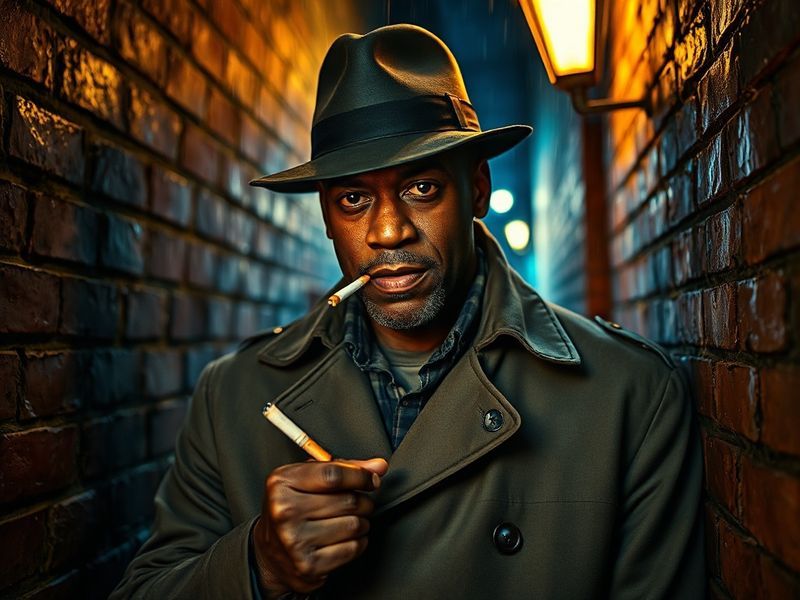
Who Is Denzel Aberdeen?
Denzel Aberdeen is not your typical Hollywood actor. Born in Lagos, Nigeria, in 1989, Aberdeen spent his formative years between West Africa and London, absorbing a rich blend of cultural influences. Unlike many actors who move to Los Angeles early in their careers, Aberdeen built his foundation in theater, studying at the prestigious Guildhall School of Music and Drama in London. This training gave him a depth rarely seen in performers who transition straight to film.
His breakthrough came in 2016 with the indie film Crossroads of Echoes, where he played a Senegalese migrant navigating the complexities of European identity. The role earned him a nomination at the British Independent Film Awards, but Aberdeen remained selective about his projects. He turned down several high-profile studio offers to pursue roles that aligned with his artistic vision—often stories centered on African diaspora experiences, global migration, and postcolonial narratives.
The Global Reach of Aberdeen’s Work
Aberdeen’s career reflects a quiet revolution in global cinema. While Hollywood continues to be dominated by Western narratives, Aberdeen has become a leading figure in a growing movement of African actors and filmmakers shaping international art-house cinema. His filmography includes collaborations with directors from Kenya, France, Brazil, and South Korea, positioning him as a truly global actor.
One of his most celebrated performances was in The Weight of Silence (2019), a French-Algerian drama about a family fractured by the Algerian War. Aberdeen played a second-generation immigrant in Paris, a role that required him to deliver dialogue in both English and French. The film premiered at the Cannes Film Festival and was later distributed across Europe and North America, earning critical acclaim for its nuanced portrayal of identity.
Aberdeen’s ability to transcend linguistic and cultural barriers has made him a favorite among international film festivals. He has appeared in over 20 films, working with directors from diverse backgrounds. This has not only expanded his artistic range but also contributed to a broader shift in global cinema—one where African stories are no longer peripheral but central to the international narrative.
Cultural Influence Beyond the Screen
Beyond acting, Aberdeen has become a cultural bridge. He frequently uses his platform to advocate for African artists in the diaspora, particularly those working in theater and independent film. In 2021, he launched Sankofa Voices, an initiative supporting emerging African filmmakers through mentorship and funding. The program has since helped launch five short films that premiered at the Toronto International Film Festival and the Berlin International Film Festival.
Aberdeen is also known for his public speaking engagements. At the 2022 TEDxAccra event, he delivered a talk titled “Reclaiming Narratives: How Stories Shape Identity”, which has since been viewed over 2 million times. In it, he argued that African stories are often reduced to stereotypes in global media, and that authentic representation requires more than just casting Black actors—it demands creative control by African storytellers.
His influence extends into fashion as well. Aberdeen has walked runways for Nigerian designer Lisa Folawiyo and collaborated with a London-based ethical fashion label that sources textiles from West African cooperatives. He has spoken openly about the importance of sustainable fashion in Africa, positioning himself as a voice for ethical creativity across multiple industries.
A Career Built on Authenticity
What sets Aberdeen apart is his refusal to conform to industry expectations. While many actors chase blockbuster roles or awards, Aberdeen has consistently chosen projects that challenge audiences and expand perspectives. His choices reflect a deep commitment to storytelling that matters—not just to him, but to communities across the African diaspora.
His upcoming project, Beneath the Baobab, a Kenyan-French co-production set during the 1960s Mau Mau uprising, is a testament to this principle. The film explores the psychological toll of colonial resistance through the eyes of a young Kikuyu woman, with Aberdeen starring as her mentor. The script was co-written by a Kenyan historian and a French screenwriter, and the cast is majority East African—a rarity in co-productions that often favor European actors in lead roles.
Aberdeen’s approach to his craft mirrors a broader cultural shift. In an era where representation is often performative, he has consistently prioritized substance over symbolism. His work reminds us that change in global media isn’t just about who is on screen—it’s about who is behind the camera, who is funding the stories, and who gets to decide what stories are told.
Key Collaborations in Aberdeen’s Career
- Crossroads of Echoes (2016) – British indie film that launched his career; explores migration and identity.
- The Weight of Silence (2019) – French-Algerian drama screened at Cannes; showcased his bilingual range.
- Sankofa Voices Initiative (2021–present) – Supports African filmmakers with mentorship and funding.
- Beneath the Baobab (2024) – Kenyan-French historical drama set during the Mau Mau uprising.
Why Aberdeen Matters in Global Cinema
Denzel Aberdeen represents more than a rising star—he embodies a new wave of African artists redefining global narratives. In a film industry still grappling with diversity, Aberdeen’s career is a case study in how authenticity and cultural grounding can transcend borders. His work challenges the assumption that African stories belong only to African audiences. Instead, he proves that these stories belong to the world—and that the world is finally ready to listen.
As global audiences grow more curious about diverse perspectives, Aberdeen’s influence will likely continue to expand. Whether through film, advocacy, or fashion, he is not just participating in global culture—he is helping to shape it, one story at a time.
Looking Ahead
With several high-profile projects on the horizon, including a potential Hollywood collaboration and a documentary on African theater, Aberdeen shows no signs of slowing down. Yet, he remains grounded in his mission: to tell stories that reflect the complexity of African experiences, to uplift new voices, and to redefine what it means to be a global artist in the 21st century.
In a landscape where representation is often debated but rarely executed with depth, Denzel Aberdeen stands out—not just as an actor, but as a cultural architect. His work reminds us that art is not just a mirror, but a bridge. And in a divided world, bridges are more necessary than ever.