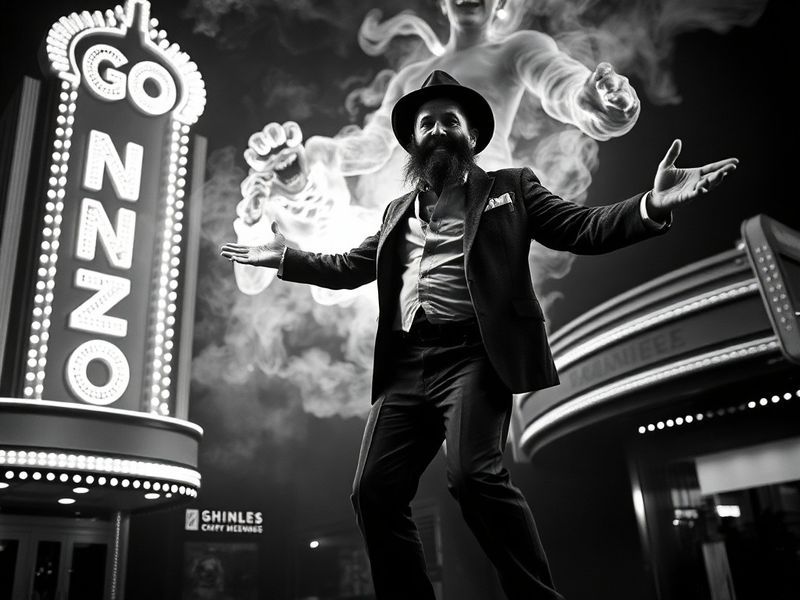
The term “Gonzo Sonic Genie” emerged from the underground electronic music scene as a playful yet accurate description of artists who defy genre constraints while conjuring sounds that feel almost supernatural. These musicians don’t just create tracks—they manifest auditory experiences that bend reality, blending genres, eras, and even physics. What started as niche experimentation has evolved into a defining characteristic of modern electronic music’s most exciting voices.
This phenomenon isn’t confined to a single subgenre. Instead, it spans the spectrum from hyperkinetic footwork to meditative ambient textures, all united by an almost alchemical approach to sound. The “genie” aspect reflects how these artists pull unexpected elements from their sonic hats, while “gonzo” captures their fearless, rule-breaking ethos. Together, they’ve redefined what electronic music can be.
The Birth of a Movement: How Gonzo Sonic Genie Took Shape
The roots of Gonzo Sonic Genie trace back to the early 2010s, when producers began dismantling electronic music’s traditional structures. Acts like Arca and Oneohtrix Point Never dismantled genre boundaries by fusing club music with avant-garde composition. Their work laid the groundwork for a new wave of artists who saw music not as a set of rules but as a playground.
By the mid-2010s, the movement gained momentum as artists like Yves Tumor and Kaitlyn Aurelia Smith incorporated elements of psychedelia, jazz, and even folk into their electronic soundscapes. This wasn’t just fusion for the sake of novelty—it was a deliberate rejection of categorization. These musicians embraced chaos, treating their studios like laboratories where sonic experiments could yield unpredictable results.
One defining trait of Gonzo Sonic Genie is its embrace of the “happy accident.” Producers often leave room for improvisation, whether through live instrumentation, field recordings, or glitchy digital detritus. This approach mirrors the ethos of gonzo journalism, which prioritizes raw experience over polished narrative. In music, it means prioritizing emotional impact over technical perfection.
The Artists Leading the Charge
Several artists have become synonymous with the Gonzo Sonic Genie aesthetic, each bringing a distinct flavor to the movement:
- Arca: Known for her androgynous vocals and seismic production, Arca’s work with artists like Bjork and FKA twigs has pushed electronic music into uncharted territory. Her album KiCk ii is a masterclass in sonic alchemy, blending reggaeton, industrial noise, and operatic flourishes.
- Yves Tumor: Tumor’s evolution from noise-rock project to polished electronic auteur reflects the movement’s fluidity. Albums like Heaven to a Tortured Mind merge glam rock, R&B, and industrial beats into a cohesive yet unpredictable whole.
- Kaitlyn Aurelia Smith: Smith’s modular synth compositions are both technically intricate and emotionally resonant. Her use of the Buchla 200e synthesizer creates sounds that feel otherworldly, as if conjured from another dimension.
- Gabor Lazar: A lesser-known but influential figure, Lazar’s hyperkinetic breakbeat compositions sound like they were recorded on a malfunctioning time machine. His work with the label UIQ has become a touchstone for the Gonzo Sonic Genie aesthetic.
These artists share a willingness to take risks, often alienating purists in the process. Yet their fearlessness has earned them devoted followings, proving that innovation often thrives at the edges of acceptability.
The Role of Technology in Gonzo Sonic Genie
Technology has been both a catalyst and a crutch for the Gonzo Sonic Genie movement. On one hand, digital production tools have democratized the creation of experimental sounds. Software like Ableton Live, Serum, and modular synths allow producers to sculpt audio in ways that were once impossible. On the other hand, this accessibility has led to a glut of derivative work, where “gonzo” becomes a lazy shorthand for “random” rather than a deliberate artistic choice.
Yet the most compelling Gonzo Sonic Genie artists use technology as a means to an end, not the end itself. For example, Kaitlyn Aurelia Smith’s modular synth setups require deep technical knowledge, yet the resulting music feels organic and alive. Similarly, Yves Tumor’s production often involves live instrumentation, grounding his electronic experiments in tangible human expression.
The movement also highlights the tension between digital and analog. While many Gonzo Sonic Genie artists rely on software, others—like the Berlin-based collective Rabit—embrace hardware like the Roland TR-808 and tape loops to create sounds that feel tactile and unpredictable. This duality reflects the broader cultural shift toward hybridity in art and technology.
Why Gonzo Sonic Genie Resonates Today
In an era where algorithms dictate what we listen to, Gonzo Sonic Genie offers a refreshing alternative: music that refuses to be neatly categorized or commodified. It thrives in the cracks of the mainstream, where listeners seek out the unfamiliar rather than the familiar. This appeal is particularly strong among younger audiences, who crave authenticity and surprise in an increasingly curated digital landscape.
The movement also reflects broader societal trends. Just as climate change and political instability make the future feel uncertain, Gonzo Sonic Genie embraces chaos as a creative force. Its unpredictability mirrors the way life itself often feels—unscripted, messy, and full of surprises.
Moreover, the rise of platforms like Bandcamp and niche festivals has given Gonzo Sonic Genie artists a space to thrive outside the traditional music industry. These artists don’t chase radio play or streaming numbers; instead, they cultivate dedicated fanbases through live performances, underground releases, and word-of-mouth buzz.
The Future of Gonzo Sonic Genie
As the movement continues to evolve, several trends are worth watching. First, the fusion of electronic music with global sounds is becoming more pronounced. Artists like Oklou and Helado Negro are blending electronic production with West African rhythms, Latin folk, and Middle Eastern melodies, creating a truly global Gonzo Sonic Genie sound.
Second, live performance is taking on new importance. As artists push the boundaries of what electronic music can be, they’re also reimagining how it’s experienced. Immersive audiovisual shows, like those by the duo Yves Tumor & serpentwithfeet, blur the line between concert and performance art, offering audiences a multisensory experience that transcends traditional gigs.
Finally, the movement’s influence is seeping into other genres. Mainstream pop artists like Rosalía and Billie Eilish have incorporated Gonzo Sonic Genie elements into their work, signaling that its ethos is trickling into the cultural mainstream. This cross-pollination ensures that the movement’s spirit—its embrace of risk, experimentation, and unpredictability—will continue to shape music for years to come.
A Final Thought
Gonzo Sonic Genie isn’t just a trend; it’s a testament to the enduring power of artistic rebellion. In a world where music is often reduced to data points and algorithms, these artists remind us that the most exciting art is often the most unpredictable. Whether through the seismic drops of Arca, the glitchy experiments of Gabor Lazar, or the hypnotic modular synths of Kaitlyn Aurelia Smith, Gonzo Sonic Genie proves that electronic music is still a frontier worth exploring.
For listeners tired of the same old formulas, the movement offers a tantalizing promise: that the next great sound might be lurking just around the corner, waiting to be unleashed by the next gonzo sonic genie.