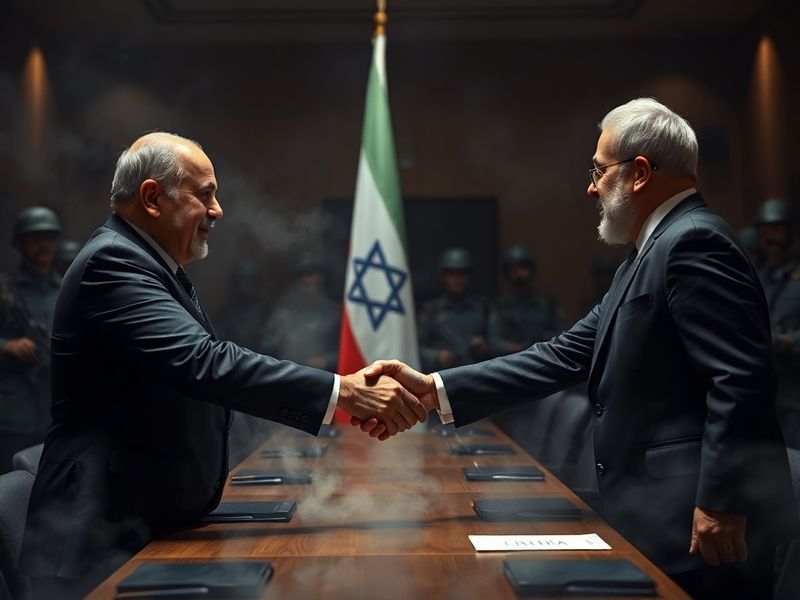
The announcement of a ceasefire between Israel and Iran in late 2024 marked one of the most significant de-escalations in the Middle East in decades. While details remain scarce, the agreement signals a potential shift in a decades-long conflict characterized by proxy wars, covert operations, and direct confrontations. Analysts are divided on whether this truce represents a durable peace or merely a temporary pause in hostilities.
The ceasefire follows months of heightened tensions, including Iran’s unprecedented direct missile and drone attacks on Israel in April 2024—an escalation that brought the two nations to the brink of all-out war. Regional mediators, including Qatar and Oman, played a crucial role in brokering the agreement, highlighting the complex web of alliances and geopolitical interests at play.
How Did This Ceasefire Come About?
The path to the ceasefire began with indirect negotiations held in Doha and Muscat, where representatives from both sides engaged in marathon talks mediated by Gulf states. According to reports, the ceasefire was finalized after Israel agreed to scale back its military operations in Syria—where it has long targeted Iranian-backed militias—and Iran committed to halting proxy attacks through groups like Hezbollah and Hamas.
A key turning point came when Israel released several Lebanese prisoners in exchange for the remains of two soldiers killed in clashes along the northern border. While neither side has publicly confirmed the full terms, leaked details suggest a commitment to non-aggression pacts and the establishment of a joint crisis hotline to prevent miscalculations.
Key Conditions of the Ceasefire
- No direct military strikes: Both nations pledge not to launch attacks on each other’s sovereign territory.
- Proxy restraint: Iran agrees to reduce support for groups like Hezbollah and Palestinian Islamic Jihad.
- Monitoring mechanism: A third-party observer force (likely from the UN or Arab League) will oversee compliance.
- Economic concessions: Gradual easing of sanctions and trade restrictions between Israel and Iran, mediated by European diplomats.
Broader Implications for the Region
The ceasefire’s ripple effects extend far beyond Israel and Iran. For Saudi Arabia and the UAE, this development could accelerate their own normalization talks with Israel—part of the Abraham Accords framework. A stable Israel-Iran relationship might also ease pressure on Lebanon, where Hezbollah’s arsenal has long been a flashpoint.
Yet, skepticism runs deep. Many regional experts argue that the ceasefire is fragile, hinging on the political survival of both Israeli Prime Minister Benjamin Netanyahu and Iranian Supreme Leader Ali Khamenei—neither of whom has a strong incentive to make long-term concessions. “This is a truce, not a peace treaty,” said Dr. Lina Khatib, director of the Middle East Institute at SOAS University. “Both sides are buying time, but the structural issues—nuclear ambitions, territorial disputes, and ideological opposition—remain unresolved.”
What’s Next for Israel and Iran?
For now, the immediate focus is on implementation. Early reports suggest a cautious adherence to terms, with both sides scaling back military posturing. Israel has reportedly reduced reconnaissance flights over Lebanon, while Iran appears to have dialed back weapons shipments to its proxies in Syria.
However, the risk of backsliding is ever-present. Hardliners in Tehran may view the ceasefire as a sign of weakness, while Israeli hardliners could push for preemptive strikes if they perceive Iran as violating the agreement. The U.S. and EU have cautiously welcomed the deal, offering economic incentives to both sides to maintain stability.
One possible outcome is a gradual thaw in relations, with backchannel talks exploring broader issues like nuclear oversight and regional security frameworks. Alternatively, the ceasefire could collapse under the weight of mutual distrust, plunging the region back into a cycle of retaliation and reprisal.
Analyzing the Ceasefire’s Long-Term Viability
To assess whether this ceasefire can endure, it’s worth examining the precedents. The 2020 U.S.-Iran “maximum pressure” campaign failed to curb Tehran’s regional ambitions, instead pushing it toward deeper alliances with Russia and China. Meanwhile, Israel’s 2023-2024 operations in Gaza and Lebanon demonstrated its willingness to take bold military risks—suggesting that any truce is conditional on Israel’s security calculus.
For Iran, the ceasefire offers economic relief at a critical time. Sanctions have crippled its oil exports and currency, while internal protests over living standards have intensified. By reducing tensions, Iran gains breathing room to address domestic crises and potentially re-enter nuclear negotiations.
The international community’s role cannot be overstated. The EU has already floated a multi-billion-dollar reconstruction fund for Lebanon, contingent on Hezbollah’s compliance with the ceasefire. Meanwhile, China and Russia may see an opportunity to expand their influence by brokering further agreements.
“This ceasefire is less about peace and more about survival—for both regimes. Iran needs a lifeline, and Israel needs to avoid another multi-front war. The question is whether their mutual exhaustion can outlast their mutual enmity.”
— Dr. Michael Rubin, American Enterprise Institute
Ultimately, the Israel-Iran ceasefire is a gamble on stability. It buys time but doesn’t resolve the underlying grievances that have fueled conflict for generations. Whether it leads to lasting change depends on forces far beyond the negotiating table—geopolitical shifts, domestic politics, and the ever-present threat of miscalculation.
For now, the guns are silent. But in a region where peace is often just a prelude to war, silence may be the most fragile peace of all.
Stay updated on Middle East developments and global conflicts by visiting our News and Analysis sections.