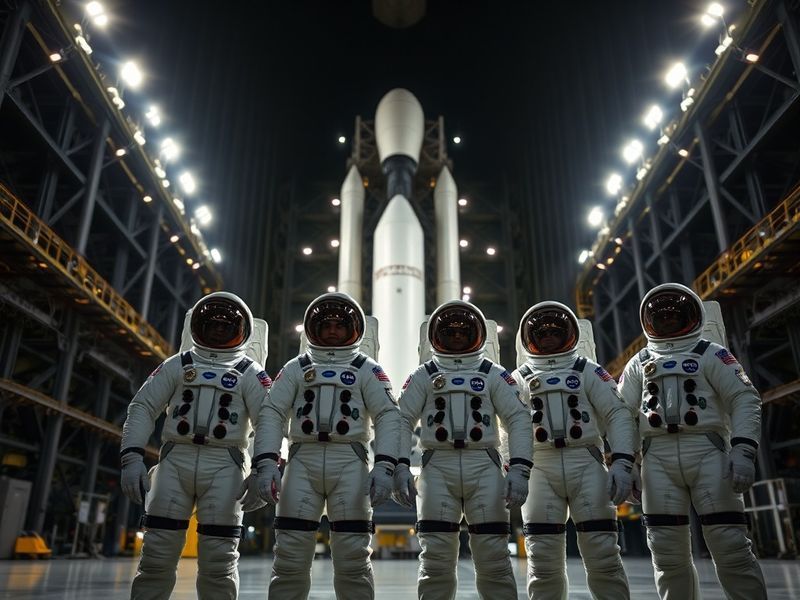
NASA’s Artemis II Astronauts: Who They Are and Why Their Mission Matters
“`html
NASA Announces Artemis II Astronauts: A New Era of Lunar Exploration Begins
The selection of the four astronauts for NASA’s Artemis II mission marks a pivotal moment not just for American spaceflight, but for global aspirations in space exploration. Scheduled for late 2024, this 10-day mission will send humanity’s first crewed spacecraft beyond low Earth orbit in over 50 years. The crew—three Americans and one Canadian—will orbit the Moon, testing systems critical for the Artemis III lunar landing and beyond.
The Artemis program isn’t just about planting flags or leaving footprints. It represents a collaborative, international effort to establish a sustainable human presence on the Moon, serving as a stepping stone for deeper space missions, including Mars. With geopolitical tensions rising on Earth, space remains one of the few areas where cooperation persists. This mission underscores how space exploration continues to bridge divides, uniting nations under a shared scientific vision.
The Crew: A Blend of Experience and Firsts
Commanding the mission is Reid Wiseman, a veteran astronaut and former chief of the Astronaut Office. Wiseman’s leadership brings stability to a crew that includes three first-time lunar travelers. His experience during a 165-day stay on the International Space Station (ISS) in 2014 demonstrated his ability to handle long-duration spaceflight, a crucial skill for the upcoming mission.
Victor Glover, the mission’s pilot, will become the first Black astronaut to venture beyond low Earth orbit. His 2020-2021 ISS expedition included four spacewalks, proving his technical expertise. Glover’s selection reflects NASA’s commitment to diversity and inclusion, sending a powerful message about who gets to represent humanity in space.
Christina Koch, mission specialist, holds the record for the longest single spaceflight by a woman—328 days on the ISS. Her expertise in electrical engineering and physics will be vital for the mission’s scientific objectives. Koch’s inclusion also highlights the growing role of women in space exploration, a shift from the Apollo era’s male-dominated crews.
The final crew member is Jeremy Hansen, a Canadian Space Agency astronaut making his first spaceflight. Hansen’s participation reinforces the Artemis program’s international partnerships, particularly with Canada, which is contributing the Canadarm3 robotic system for the Lunar Gateway. This collaboration ensures that space exploration remains a global endeavor.
A Global Perspective on Lunar Ambitions
While NASA leads the Artemis program, it’s not acting alone. The mission is part of the Artemis Accords, a set of principles for peaceful and cooperative space exploration signed by 28 countries to date. These accords emphasize transparency, resource sharing, and the preservation of historic lunar sites—efforts to prevent the kind of unchecked competition seen during the Cold War space race.
China, through its Chang’e program and planned International Lunar Research Station, is also advancing its lunar ambitions. While cooperation between NASA and China remains politically fraught, the Artemis program’s inclusive approach offers an alternative model for international collaboration. The European Space Agency (ESA), Japan Aerospace Exploration Agency (JAXA), and private companies like SpaceX are also key players, each contributing technology and expertise.
This global participation reflects a broader shift in space exploration. The Apollo missions were a product of Cold War rivalry, but Artemis is a collaborative effort in an era where space is increasingly commercialized and accessible. The inclusion of Hansen, for example, ties into Canada’s long-standing partnership with NASA, dating back to the Shuttle era. Such alliances ensure that lunar exploration isn’t just an American endeavor but a collective human achievement.
Scientific and Cultural Significance
The Artemis II mission isn’t just a symbolic return to the Moon—it’s a scientific mission with tangible goals. The crew will test Orion’s life support systems, communications, and navigation in deep space, all critical for the Artemis III lunar landing. They’ll also conduct experiments, including studying the effects of radiation on the human body, a key challenge for long-duration missions to Mars.
Culturally, the mission resonates in an era where space exploration is no longer confined to government agencies. Private companies like SpaceX and Blue Origin are reshaping the industry, while social media amplifies every milestone. The Artemis II crew’s diverse backgrounds and firsts—Glover’s historic role, Koch’s record-setting flight—reflect a broader societal shift toward inclusivity.
Artemis also carries symbolic weight. The Moon, once a Cold War battleground, is now a symbol of unity. The mission’s name itself harks back to Greek mythology, where Artemis was Apollo’s twin sister—a nod to NASA’s Apollo program while emphasizing a new, inclusive vision. This blend of myth and modernity underscores how space exploration continues to inspire humanity’s collective imagination.
Challenges and the Road Ahead
Despite the optimism, Artemis II faces significant challenges. The Orion spacecraft, while tested in uncrewed missions, has yet to carry humans beyond Earth. The mission’s success hinges on flawless performance of its heat shield, life support, and propulsion systems—all tested under the extreme conditions of deep space.
Political and budgetary hurdles also loom. NASA’s funding depends on congressional approval, and delays in the Space Launch System (SLS) rocket or Orion capsule could push the timeline. Meanwhile, international partners like Canada and Europe must balance their contributions with domestic priorities.
Yet, the Artemis program’s long-term vision offers a compelling counterpoint to these challenges. Unlike Apollo, which ended after six missions, Artemis aims to establish a sustainable presence on the Moon, including the Lunar Gateway—a small space station orbiting the Moon. This infrastructure will support future missions, including crewed landings and robotic exploration of the lunar south pole, where water ice may exist.
The crew’s training reflects this forward-looking approach. They’ve spent years preparing for contingencies, from system failures to medical emergencies. Their mission isn’t just about reaching the Moon—it’s about proving that humanity can live and work in deep space, a prerequisite for Mars missions.
Why Artemis Matters Beyond Science
The Artemis II mission is more than a technical achievement. It’s a statement about who we are as a species and what we aspire to become. In an era marked by division, space exploration offers a rare opportunity for unity. The crew’s diversity—gender, nationality, and background—sends a message about inclusion, both in space and on Earth.
The mission also highlights the growing role of private industry. SpaceX’s Starship, selected as the lunar lander for Artemis III, exemplifies how commercial innovation is accelerating space exploration. Meanwhile, companies like Axiom Space are developing commercial modules for the ISS, hinting at a future where space is accessible to more than just astronauts and billionaires.
Culturally, Artemis II will captivate a global audience. Unlike Apollo, which was broadcast in grainy black-and-white, this mission will be streamed in high definition, shared on social media, and dissected by analysts worldwide. The crew’s interactions—whether conducting experiments or simply gazing at Earth from space—will remind us of our shared humanity.
As the mission unfolds, it will also confront us with ethical questions. Who gets to go to space? How do we ensure that lunar resources are shared equitably? What responsibilities do we have to preserve the Moon’s environment? These questions, once abstract, are now urgent as humanity stands on the brink of a new era.
A Legacy in the Making
The Artemis II crew will join an elite group of explorers who have ventured beyond Earth’s orbit. Their names—Wiseman, Glover, Koch, Hansen—will be etched into history alongside Armstrong, Aldrin, and Collins. But their mission is different. They’re not just going to the Moon; they’re paving the way for a sustainable human presence there.
Their journey will inspire the next generation of scientists, engineers, and dreamers. It will also test the limits of human endurance, technological ingenuity, and international cooperation. In many ways, Artemis II is a microcosm of humanity’s potential: capable of greatness, yet constantly challenged by its own divisions.
As the crew embarks on their historic flight, they carry with them the hopes of a planet watching from afar. Their mission isn’t just about reaching the Moon—it’s about proving that humanity can still reach for the stars, together.
For those eager to follow the mission’s progress, NASA’s official channels and partner agencies will provide real-time updates. The world will watch as four humans venture where only 24 have gone before, not as representatives of a single nation, but as ambassadors of Earth.