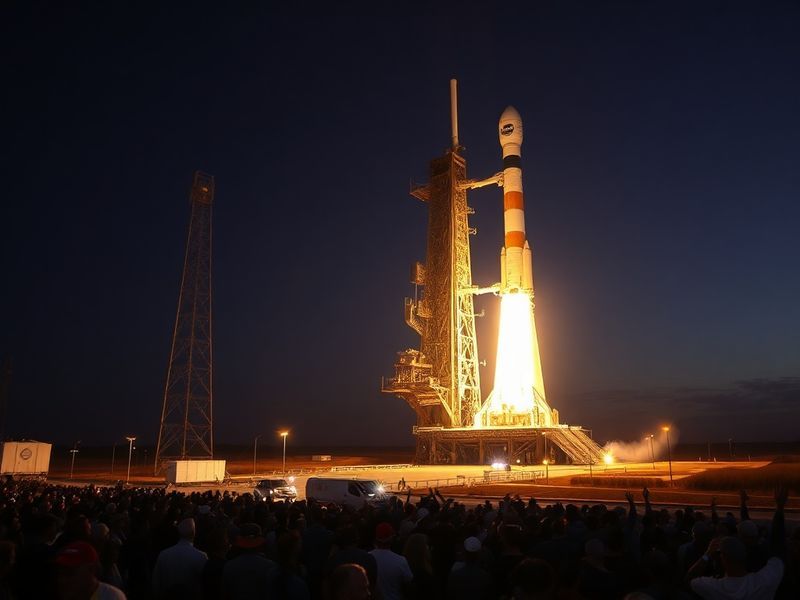
NASA’s Artemis program represents the agency’s most ambitious effort to return humans to the Moon since the Apollo era. Artemis 3, the mission slated for no earlier than September 2026, will mark humanity’s first crewed lunar landing in over five decades. Unlike its predecessors, this mission isn’t just about planting a flag and returning home—it’s the critical first step toward establishing a sustainable human presence on the Moon.
The program’s name itself carries significance. Artemis, the Greek goddess of the Moon, is also the twin sister of Apollo, tying the new initiative directly to the historic missions of the 1960s and 70s. But where Apollo was a Cold War-driven sprint to the Moon, Artemis is a marathon with broader scientific, economic, and geopolitical objectives.
The Mission’s Technical Breakdown
Artemis 3 will rely on three core components: the Space Launch System (SLS) rocket, the Orion spacecraft, and the Human Landing System (HLS). The SLS, NASA’s most powerful rocket since the Saturn V, will launch Orion into Earth orbit. From there, Orion will dock with the HLS, which will ferry the crew to the lunar surface.
A key innovation is the mission’s landing site selection. NASA has narrowed its choices to 13 regions near the lunar south pole, where permanently shadowed craters are believed to contain water ice. This ice could be crucial for future lunar habitats, providing drinking water, oxygen, and even rocket fuel through hydrogen extraction.
The crew for Artemis 3 will consist of four astronauts, though only two will descend to the surface. These astronauts will spend up to six days on the Moon, conducting scientific experiments and collecting samples. Their suits, developed by Axiom Space, are designed for greater mobility and flexibility than the Apollo-era suits, allowing for more efficient exploration.
Key Objectives of Artemis 3
- Demonstrate NASA’s ability to land humans on the Moon and return them safely to Earth
- Establish foundational infrastructure for future lunar missions, including the Lunar Gateway space station
- Conduct groundbreaking scientific research, particularly in the lunar south pole region
- Test new technologies that will support long-term human presence on the Moon
- Inspire the next generation of scientists, engineers, and explorers
Broader Implications for Space Exploration
Artemis 3 isn’t just about the Moon—it’s a stepping stone for even more ambitious goals, including crewed missions to Mars. The technologies and methodologies developed for Artemis 3 will directly inform future deep-space missions. For instance, the lunar surface operations will test life support systems, power generation methods, and in-situ resource utilization techniques that could be adapted for Martian exploration.
The mission also represents a shift in how space exploration is conducted. Unlike Apollo, which was a purely government-led effort, Artemis involves commercial partners like SpaceX, which is developing the HLS under a $2.9 billion contract. This public-private partnership model could significantly reduce costs and accelerate the pace of exploration.
Additionally, Artemis 3 has significant geopolitical implications. By involving international partners through the Artemis Accords, NASA is fostering collaboration with countries like Canada, Japan, and the European Union. This approach contrasts with the competitive space race of the 20th century, positioning space exploration as a unifying rather than divisive endeavor.
Challenges and Controversies
Despite its promise, Artemis 3 faces several challenges. The mission’s timeline has already been delayed multiple times, raising questions about NASA’s ability to meet its 2026 target. Technical hurdles, such as the development of the HLS and the upgrades to Orion, have contributed to these delays.
Budget constraints are another concern. The Artemis program has faced criticism for its high costs, with some estimates suggesting it could exceed $93 billion by 2025. Critics argue that these funds could be better spent on other scientific endeavors or social programs. However, proponents counter that the economic benefits of space exploration—such as job creation, technological innovation, and inspiration for STEM fields—far outweigh the costs.
Environmental concerns have also been raised. The SLS rocket, while powerful, is not reusable and produces significant emissions during launch. NASA has conducted environmental impact assessments, but the sustainability of heavy-lift rockets remains a topic of debate among scientists and policymakers.
Looking Ahead: The Future of Artemis
Artemis 3 is just the beginning. Following this mission, NASA plans to launch Artemis 4, which will deliver the first European Service Module to the Lunar Gateway. Subsequent missions will focus on expanding lunar infrastructure, including habitats, power systems, and rovers. The ultimate goal is to establish a sustainable human presence on the Moon by the end of the decade.
For those interested in following the mission’s progress, Dave’s Locker’s Technology section offers regular updates on NASA’s advancements. Additionally, our Science category provides in-depth analysis of space exploration trends and discoveries.
Artemis 3 is more than a return to the Moon—it’s a bold declaration of humanity’s intent to become a multi-planetary species. As the mission unfolds, it will not only expand our scientific understanding but also redefine our relationship with space. The challenges are significant, but the potential rewards—scientific discovery, economic growth, and inspiration—are even greater.
For now, the world watches as NASA prepares for this historic journey. The Moon, once a distant dream, is now within reach, and Artemis 3 is the key to unlocking its secrets.