From the shimmering Arabian Sea to the endless hum of its streets, Bombay—now officially known as Mumbai—is a city that defies easy definition. It is not merely a metropolis. It is a living organism, pulsing with energy, contradictions, and stories that span centuries. Bombay does not just exist; it thrives, relentlessly, in the face of time, tide, and transformation.
The Name That Speaks of Identity
The city’s name itself is a subject of deep cultural and political significance. For centuries, it was known as Bombay, a name derived from the Portuguese phrase “Bom Bahia,” meaning “Good Bay.” When India gained independence in 1947, the city retained its colonial-era name under British rule. But in 1995, the Shiv Sena-led state government officially renamed it Mumbai, after the goddess Mumbadevi, patron deity of the Koli fishing community who originally inhabited the islands.
This shift was more than linguistic. It was an assertion of identity, a reclamation of heritage. Yet, even today, the name Bombay lingers in popular culture, in literature, in the fond memories of those who grew up calling it by its former name. The duality of Bombay and Mumbai reflects the city’s layered history—where the past and present coexist, sometimes in harmony, sometimes in tension.
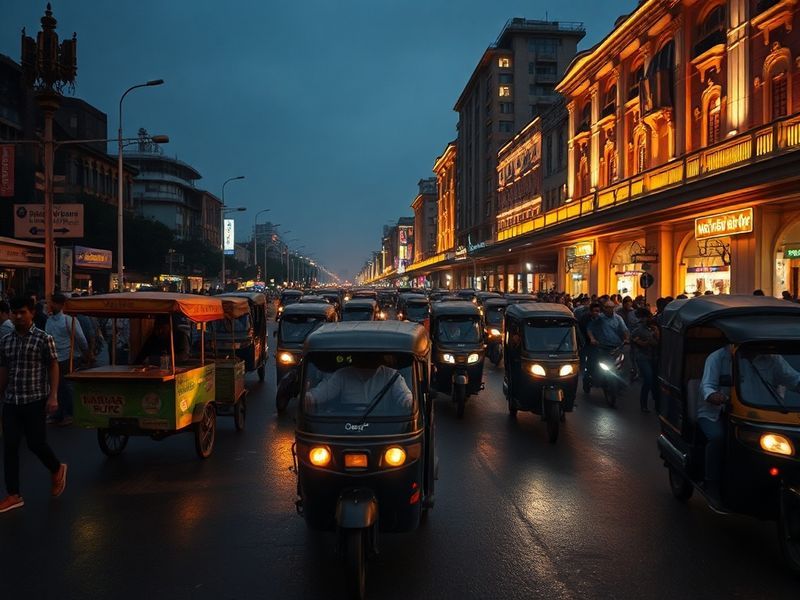
Film director Danny Boyle, who shot Slumdog Millionaire in the city, once remarked that Mumbai is “a city that feeds on chaos.” That chaos is not just physical—it’s cultural, linguistic, and emotional. In a city where over 16 million people speak more than 100 languages, Bombay’s identity crisis is also its strength. It is a place where a Marathi-speaking local can share a rickshaw with a Tamil laborer, where a Gujarati trader can negotiate with a Punjabi artist, and where the aroma of vada pav mingles with the scent of sea salt and diesel fumes.
A Global Hub of Commerce and Creativity
Bombay has long been India’s commercial capital, home to the Bombay Stock Exchange and the Reserve Bank of India. The city contributes nearly 7% of India’s GDP and is a magnet for multinational corporations, startups, and freelancers alike. Yet its economic significance extends far beyond finance. The port of Mumbai handles over 50% of India’s container traffic, making it a critical node in global trade.
But Bombay’s influence is not confined to balance sheets and shipping manifests. It is the beating heart of India’s entertainment industry, particularly Bollywood, which produces over 1,500 films annually and reaches audiences across South Asia and the diaspora. From the golden age of Raj Kapoor to the contemporary blockbusters of Ranveer Singh, Bombay’s film culture is a mirror to the nation’s aspirations, anxieties, and dreams.
The city’s creative energy spills into literature as well. Authors like Salman Rushdie, Rohinton Mistry, and Suketu Mehta have immortalized Bombay in words, capturing its chaos, its beauty, and its unrelenting pace. Rushdie’s Midnight’s Children begins with the protagonist born at the stroke of midnight on August 15, 1947—a symbolic birth that mirrors the city’s own emergence into independence.
Even the city’s architecture tells a story. The Gothic Revival structures of the University of Mumbai stand in stark contrast to the art deco elegance of Marine Drive. The colonial-era Chhatrapati Shivaji Maharaj Terminus, a UNESCO World Heritage Site, coexists with the sleek, modern towers of the Bandra-Kurla Complex. Bombay does not erase its past; it builds upon it, layer by layer, like sediment in a river delta.
Key Industries Driving Bombay’s Economy
- Entertainment: Bollywood, streaming platforms, music labels, and independent filmmakers
- Finance: Bombay Stock Exchange, National Stock Exchange, commercial banks, and fintech startups
- Ports & Shipping: Jawaharlal Nehru Port Trust, one of India’s largest container ports
- Technology & IT: Emerging tech hubs in Andheri, Powai, and Navi Mumbai
- Textiles & Manufacturing: A historic industry still thriving in areas like Dadar and Lalbaug
Social Fabric: Diversity, Division, and Resilience
Bombay’s greatest strength—and its greatest challenge—is its diversity. The city is a mosaic of communities: Parsis who arrived a thousand years ago, Goan Catholics, Jewish traders, Gujarati traders, Tamil laborers, and a vast diaspora of migrants from across India. This diversity has fueled innovation but also created fault lines.
Communal tensions have flared at different points in history. The 1992-93 riots, following the demolition of the Babri Masjid, left deep scars. The 2008 terror attacks, which targeted the Taj Mahal Palace Hotel and other landmarks, shook the city to its core. Yet, Bombay has repeatedly shown an extraordinary capacity to heal. After each crisis, the city returns to its rhythm—shopkeepers reopen, commuters fill the local trains, and street vendors resume their trade.
Its resilience was on full display during the COVID-19 pandemic. When the virus surged in 2020, Mumbai became a symbol of struggle and solidarity. Dharavi, one of Asia’s largest slums, emerged as a model of containment through community effort. The city’s healthcare workers, sanitation staff, and delivery personnel became unsung heroes in a battle that tested every system.
Bombay’s social fabric is also defined by its informal economies. Over 60% of the city’s workforce operates in the unorganized sector—street vendors, auto-rickshaw drivers, domestic workers, and daily wage laborers. These workers form the invisible backbone of the city, sustaining its economy through sweat and grit. Organizations like the Social Impact sector have long highlighted their contributions, advocating for better labor rights and urban infrastructure.
Bombay in the World: A City of Migration and Memory
Bombay is not just an Indian city—it is a global city. Its diaspora stretches from London to Dubai, from Toronto to Singapore. Overseas Indians often return with nostalgia, seeking the flavors of their childhood in a vada pav from Matunga or the scent of rain on Marine Drive. For many, Bombay is a place of memory, a touchstone of identity.
Meanwhile, the city continues to attract new waves of migrants. Young professionals from across India arrive daily, drawn by the promise of opportunity. Students from Nepal, Bangladesh, and Africa come to study in its universities. Artists and musicians migrate to its vibrant cultural scene. Bombay does not discriminate by origin; it consumes talent, ambition, and identity, and transforms them into something new.
This constant churn has given rise to a unique urban culture. The city’s street food—from bhel puri in Chowpatty to Irani chai in Colaba—is a testament to its cosmopolitanism. Its nightlife, from jazz bars in Breach Candy to underground EDM clubs in Andheri, pulses with youthful energy. Its festivals—Ganesh Chaturthi, Eid, Christmas, Diwali—are celebrated with equal fervor, often overlapping in a dazzling display of communal harmony.
Yet, Bombay’s global identity is not without its critics. Rapid urbanization has led to overcrowding, pollution, and stark inequality. The city’s slums, though vibrant communities, lack basic amenities. The gap between the ultra-rich and the daily wage laborer is visible in every neighborhood. As urban planner P.K. Das noted, “Mumbai is a city of dreams, but also a city of nightmares for many.”
Bombay’s Global Connections
- Diaspora Networks: Strong communities in the UK, US, Canada, Australia, and Gulf countries maintain cultural and economic ties
- Trade Links: Mumbai’s port connects India to East Africa, the Middle East, and Southeast Asia
- Cultural Exchange: Bollywood films, Indian classical music, and contemporary art circulate globally
- Educational Hub: Institutions like IIT Bombay and Tata Institute of Social Sciences attract international students
- Tech & Startup Scene: A growing number of global tech firms and co-working spaces operate in the city
Conclusion: The Eternal City of Reinvention
Bombay is a city that refuses to be defined. It is chaotic and orderly, poor and prosperous, ancient and modern. It is a place where dreams are made and broken, where fortunes are lost and found, where cultures collide and coalesce. It is a city that never sleeps because it cannot afford to—and perhaps, it does not want to.
As the world becomes increasingly urbanized, Bombay stands as a case study in resilience, adaptability, and cultural fusion. It is not just a city on the map; it is a force of nature. It breathes, it grows, it reinvents itself with every sunrise. Whether you call it Bombay or Mumbai, one thing is certain: this city will always be more than its name. It will always be alive.
For those who have lived in it, Bombay leaves an indelible mark. For those who visit, it leaves a memory. For those who study it, it leaves a question: How does a city of contradictions thrive so effortlessly? The answer, perhaps, lies not in its infrastructure or its economy, but in its spirit. Bombay is not just a place. It is an experience—and one that continues, unending, like the tides of the Arabian Sea.