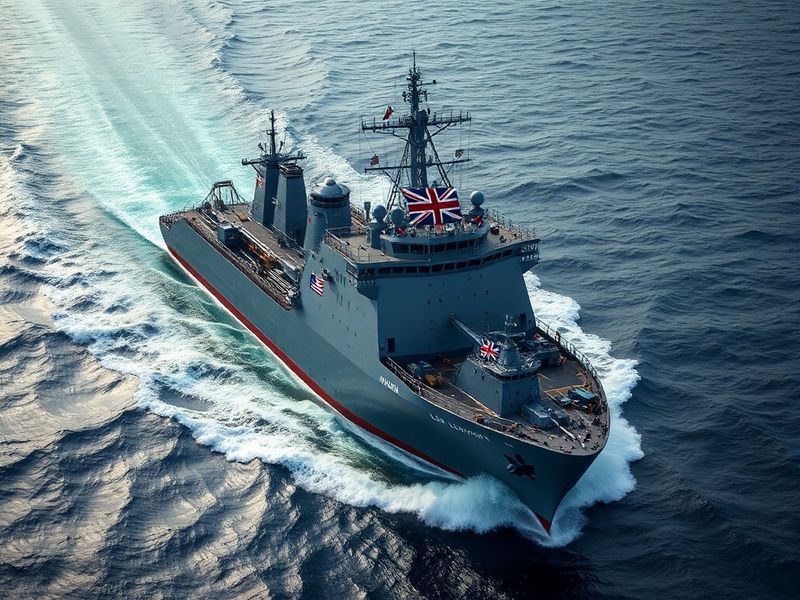
The Royal Fleet Auxiliary (RFA) operates in the shadows of the Royal Navy, performing critical logistical and operational support roles that keep the fleet moving. While the RFA may not receive the same public attention as frontline warships, its vessels and personnel are indispensable to the UK’s maritime defense strategy. From refueling destroyers in the South China Sea to delivering humanitarian aid after natural disasters, the RFA’s reach extends across the globe.
Established in 1905, the RFA has evolved into a modern, highly specialized fleet. It comprises a mix of replenishment oiler ships, landing ship docks, and aviation training vessels, each designed to extend the operational range and endurance of the Royal Navy. Unlike commissioned warships, RFA ships are manned by civilian crews under the Royal Navy’s operational command—a unique arrangement that combines civilian expertise with military discipline.
The Structure and Capabilities of the Royal Fleet Auxiliary
The RFA’s fleet is built around four primary classes of vessels, each tailored to specific mission profiles. The largest of these are the four Tide-class tankers, commissioned between 2017 and 2019. These 37,000-tonne ships are among the most advanced replenishment vessels in the world, capable of supplying fuel, food, and ammunition to Royal Navy ships while underway. Their dual-role design also allows them to support NATO and allied operations, enhancing interoperability.
Complementing the Tide-class are the three Fort Victoria-class replenishment ships, which entered service in the 1990s. These versatile vessels can carry up to 12,500 tonnes of fuel, 650 tonnes of ammunition, and 250 tonnes of food, making them essential for long-range deployments. Their helicopter decks and hangar facilities enable them to support Merlin and Wildcat helicopters, further extending their logistical reach.
The RFA’s amphibious capabilities are provided by the two Albion-class landing ship docks, which replaced the older Fearless-class in the 2000s. These ships can launch and recover landing craft via their stern dock, transport up to 400 Royal Marines, and operate as command platforms for amphibious operations. Their versatility was demonstrated during the 2018 NATO exercise Trident Juncture, where they supported large-scale landings in Norway.
- Tide-class tankers: 37,000 tonnes, advanced replenishment capabilities, NATO interoperable.
- Fort Victoria-class: 12,500 tonnes fuel capacity, helicopter support, long-range missions.
- Albion-class LSDs: Amphibious assault, command platforms, Royal Marine transport.
- Argus-class aviation training ship: Helicopter training, casualty receiving facility, secondary disaster relief role.
The RFA’s Role in Global Operations
The RFA’s operational tempo is relentless, with ships frequently deployed to high-threat areas and crisis zones. During the 2021 Afghanistan evacuation, RFA ships such as RFA Lyme Bay and RFA Cardigan Bay played a crucial role in transporting personnel and equipment out of Kabul. Their ability to operate in contested environments without requiring escorts underscores their strategic value.
In the Indo-Pacific, RFA vessels regularly conduct freedom-of-navigation operations alongside the Royal Navy. In 2023, RFA Tideforce accompanied HMS Spey on a deployment to the South China Sea, demonstrating the UK’s commitment to upholding international maritime law. These operations are not merely symbolic; they challenge excessive territorial claims and ensure safe passage for commercial shipping.
The RFA also plays a pivotal role in NATO’s collective defense. During Exercise Steadfast Defender 2024, RFA ships conducted replenishment drills with vessels from 10 NATO nations, showcasing the alliance’s logistical cohesion. Their participation in Standing NATO Maritime Group 2 further highlights their integration into allied operations.
The Civilian-Military Partnership: Strengths and Challenges
The RFA’s civilian-manned model is a double-edged sword. On one hand, it allows the Royal Navy to maintain a smaller active fleet while retaining operational flexibility. Civilian crews, often drawn from the merchant navy, bring invaluable experience in commercial shipping and logistics, reducing the need for redundant military training.
However, this model also presents challenges. Civilian crews lack the combat training of their military counterparts, limiting their ability to defend their ships in high-risk scenarios. While RFA vessels are armed with light defensive weapons, their primary role remains support rather than combat. This vulnerability was a point of concern during the 2022 Red Sea crisis, where commercial shipping faced increased threats from Houthi rebels.
The UK government has taken steps to address these gaps. In 2023, the Ministry of Defence announced plans to enhance RFA ships’ defensive capabilities, including the installation of Phalanx close-in weapon systems on the Albion-class vessels. Additionally, the RFA is exploring the use of unmanned systems for force protection, reducing the need for additional crew.
- Advantages of civilian manning:
- Cost-effective compared to fully military-crewed ships.
- Access to a global pool of merchant navy talent.
- Reduced administrative overhead for the Royal Navy.
- Challenges and mitigations:
- Limited combat readiness requires enhanced defensive systems.
- Dependence on civilian supply chains for spare parts and maintenance.
- Training gaps addressed through targeted military integration programs.
The Future of the Royal Fleet Auxiliary
The RFA is on the cusp of a major modernization effort, with several new vessels planned or under construction. The most significant of these is the Multi-Role Support Ship (MRSS), a £1.5 billion program aimed at replacing the Albion-class LSDs. Expected to enter service in the early 2030s, the MRSS will feature a flexible design capable of supporting amphibious operations, disaster relief, and even humanitarian evacuations.
Another critical program is the Fleet Solid Support (FSS) ship, which will replace the aging Fort Rosalie-class stores ships. The FSS will be designed to carry dry cargo such as food, spare parts, and ammunition, reducing the Royal Navy’s reliance on foreign suppliers. Tendering for the FSS began in 2023, with construction expected to start in 2025.
These upgrades reflect a broader shift in the UK’s defense strategy, which emphasizes expeditionary capabilities and global power projection. The RFA’s role in this strategy cannot be overstated; without its logistical backbone, the Royal Navy would struggle to sustain operations beyond the immediate vicinity of the British Isles.
Looking ahead, the RFA must also adapt to emerging threats, including cyber warfare and drone attacks. The integration of autonomous systems and AI-driven logistics could further enhance its efficiency, but these technologies also introduce new vulnerabilities. Balancing innovation with operational security will be a key challenge for the RFA’s leadership.
Ultimately, the Royal Fleet Auxiliary remains one of the UK’s most cost-effective defense assets. While its contributions are often overlooked, the RFA’s ships and crews enable the Royal Navy to project power, deter aggression, and respond to crises on a global scale. As geopolitical tensions rise, the importance of this unsung fleet is only set to grow.