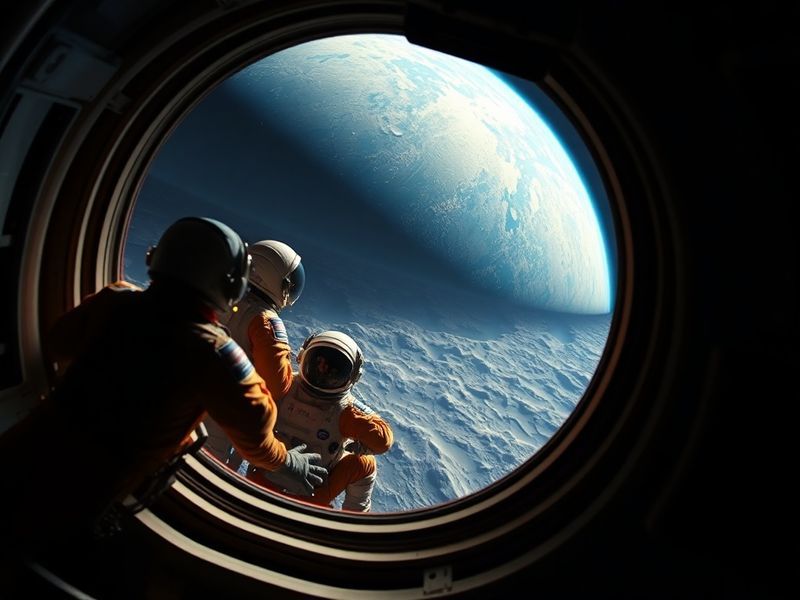
The crew of NASA’s Artemis II mission has achieved a milestone that blends human ambition with cosmic perspective. On the fourth day of their lunar flyby, astronauts Reid Wiseman, Victor Glover, Christina Koch, and Jeremy Hansen captured a striking Earthset—a phenomenon where Earth appears to set behind the Moon from the crew’s viewpoint.
This moment, reminiscent of the iconic Earthrise photo from Apollo 8 in 1968, marks a new chapter in space exploration. Unlike the earlier image, which showed Earth rising over the lunar horizon, Earthset offers a different vantage point—one that underscores the fragility and isolation of our planet in the vastness of space.
The Significance of Earthset in Space Photography
Earthset is more than a visual spectacle; it carries deep symbolic weight. The image forces humanity to confront its place in the universe. When Apollo 8’s Earthrise first appeared, it galvanized the environmental movement. Earthset, captured over half a century later, arrives at a time of global climate anxiety and geopolitical tension. It serves as a reminder of Earth’s singularity—a blue marble suspended in darkness.
From a technical standpoint, capturing Earthset required precise orbital mechanics. The Artemis II crew entered a unique trajectory around the Moon, allowing them to witness Earth dip below the lunar limb. This positioning is only possible with modern spacecraft like Orion, which boasts advanced navigation and communication systems. The moment was broadcast live, though with a slight delay due to transmission speeds, adding an element of suspense.
Cultural Echoes and Artistic Influence
Space photography has long influenced global culture. The Earthrise image became a symbol of environmentalism, inspiring posters, album covers, and even postage stamps. Earthset, with its reverse perspective, may similarly shape future art and media. Already, artists and musicians are reimagining the image—some as a metaphor for climate crisis, others as a call for international cooperation in space.
In Japan, where lunar exploration holds deep cultural significance (see Culture), the Earthset has been interpreted through manga and animation. A popular indie game developer announced a new title set on a lunar colony, where players witness Earthset daily—a daily reminder of home. Meanwhile, in Kenya, where space science is rapidly growing, the image has been used in educational programs to inspire the next generation of astronomers.
Technical Breakthroughs Behind the Shot
The Artemis II mission is not just a repeat of Apollo—it’s a leap forward. Orion’s high-definition cameras, developed in collaboration with the European Space Agency, delivered unprecedented clarity. Unlike the grainy footage of the 1960s, this Earthset was captured in 4K, revealing subtle atmospheric layers and the curvature of Earth with stunning precision.
Engineers at NASA’s Johnson Space Center emphasized the challenges of timing. “We needed the Moon to block just enough of Earth to create the silhouette effect,” explained a mission specialist. “Too much, and you lose the blue marble entirely. Too little, and it doesn’t feel like a true Earthset.” The result was a carefully calculated alignment, achieved through a series of trajectory burns over several days.
Global Reactions and Public Engagement
The release of the Earthset image sparked immediate global reactions. Social media platforms, particularly in regions with emerging space programs like India and Brazil, saw a surge in discussions. NASA’s live stream peaked at over 2 million concurrent viewers, with translations available in Spanish, Hindi, and Arabic—reflecting the mission’s international scope.
A viral TikTok trend emerged where users superimposed the Earthset image onto famous landmarks, such as the Eiffel Tower and the Great Pyramid of Giza, to emphasize Earth’s shared heritage. Meanwhile, in South Africa, a local artist created a mural in Johannesburg’s Maboneng district, blending the Earthset with traditional Ndebele patterns.
Governments also responded. The European Space Agency announced increased funding for lunar missions, while Japan’s JAXA revealed plans to send a probe to photograph Earthrise and Earthset from a stationary orbit around the Moon. Even private companies took notice—SpaceX’s CEO posted the image with the caption, “Earth is our only home. Let’s take care of it.”
What’s Next for Artemis II and Beyond
The Artemis II crew is not yet halfway through their 10-day mission. After their lunar flyby, they will conduct experiments on radiation exposure, test life-support systems, and deploy CubeSats for lunar observation. Their return to Earth, scheduled for December 2024, will be a critical validation of Orion’s heat shield and re-entry systems.
But the cultural and scientific impact of Earthset has already cemented its place in history. It arrives at a pivotal moment—amid debates about space militarization, the ethics of lunar resource extraction, and the sustainability of human spaceflight. The image serves as both a unifying symbol and a prompt for difficult conversations.
As Christina Koch remarked during a live broadcast from orbit: “We see Earth not as countries, but as one planet. This image is a reminder that our challenges—climate, conflict, inequality—are planetary. They require planetary solutions.”
The Artemis program, named after the Greek goddess of the Moon, is often framed as a return to lunar exploration. But in capturing Earthset, the crew has done something more profound. They’ve given humanity a new mirror—a chance to see itself from the edge of another world.
For those following space exploration, this mission is a bridge between past and future. For artists, it’s a new canvas. For scientists, it’s a data point. And for everyone else, it’s a quiet moment of reflection in an era of constant noise.
As the Orion capsule continues its journey home, one thing is clear: Earthset will be studied, celebrated, and reinterpreted for decades to come.