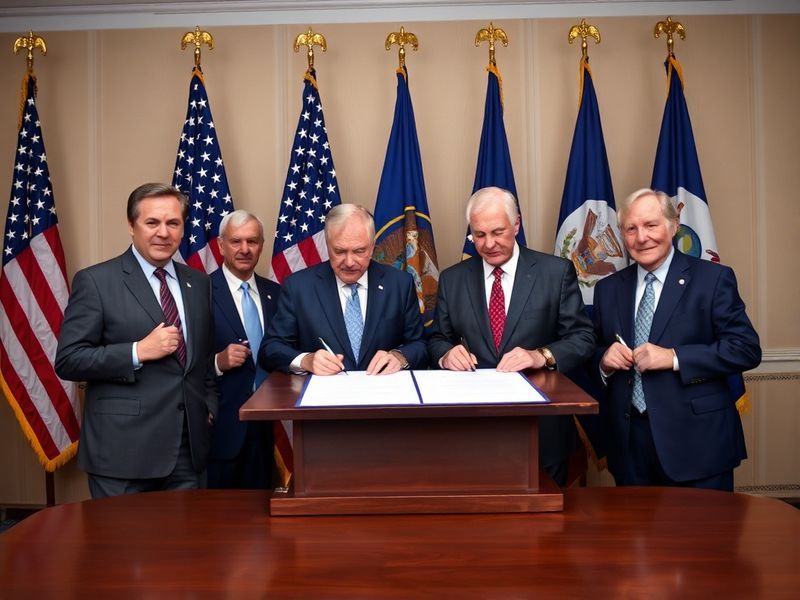
Virginia officially became the 20th state to join the National Popular Vote Interstate Compact (NPVIC) on April 12, 2024, bringing the coalition tantalizingly close to the 270 electoral votes needed to guarantee the presidency to the national popular vote winner. The move marks a significant shift in the electoral reform landscape, as states continue to explore alternatives to the Electoral College system that has governed U.S. presidential elections since the nation’s founding.
Governor Glenn Youngkin signed the legislation despite his own party’s opposition to the compact, signaling that the issue transcends traditional political divides. The Virginia General Assembly passed the measure along party lines in February, with all Democratic votes in favor and all Republican votes opposed. This reflects the broader national debate about whether the current system adequately represents the will of the American people.
The Mechanics of the National Popular Vote Compact
The NPVIC is an agreement among states to award all their electoral votes to the presidential candidate who wins the national popular vote, regardless of the outcome in their individual state. The compact only takes effect once enough states have joined to collectively hold 270 electoral votes—the majority needed to elect a president. With Virginia’s addition, the compact now includes states and D.C. totaling 209 electoral votes.
States that have joined the compact include deep-blue bastions like California and New York, as well as competitive states such as Colorado and Minnesota. The coalition has grown steadily since Maryland became the first state to join in 2008, with recent additions like New Mexico in 2023 and now Virginia demonstrating the compact’s momentum.
The compact’s supporters argue that it would make every vote in every state equally important in presidential elections, rather than concentrating campaign attention in a handful of swing states. They point to the 2016 and 2000 elections, where the Electoral College resulted in the popular vote loser winning the presidency, as evidence of the system’s flaws.
How the Compact Would Work in Practice
Under the current system, presidential campaigns focus their resources on battleground states like Pennsylvania, Michigan, and Wisconsin, while largely ignoring states that reliably vote for one party or the other. The NPVIC would change this dynamic by making votes in every state consequential.
For example, in the 2020 election, President Joe Biden won Georgia by just 12,000 votes out of nearly 5 million cast. Under the NPVIC, that slim margin would contribute to Biden’s national popular vote total, regardless of Georgia’s electoral votes. The same would be true for votes in deep-red Alabama or deep-blue California.
Critics of the compact argue that it would diminish the influence of smaller states in presidential elections. The U.S. Constitution gives each state a number of electoral votes equal to its representation in Congress (two senators plus the number of House members). This means less populous states have a slightly higher per-capita influence in the Electoral College than more populous states.
Political Implications of Virginia’s Decision
Virginia’s decision to join the NPVIC carries particular significance because it’s a state that has trended from reliably Republican to highly competitive in recent years. The shift reflects changing demographics in the Old Dominion, particularly the growth of Northern Virginia’s suburbs outside Washington D.C.
The state’s presidential election results mirror this transformation. In 2000, Virginia voted for Republican George W. Bush by 8 percentage points. By 2020, Democrat Joe Biden won the state by nearly 10 points. This political evolution has made Virginia a critical battleground in modern elections, hosting high-profile campaigns and significant advertising spending.
Governor Youngkin’s decision to sign the compact despite opposition from his own party demonstrates the growing acceptance of electoral reform among some Republicans. While the GOP remains overwhelmingly opposed to the NPVIC at the national level, some Republican-led states have shown interest in the concept. In 2023, Oklahoma considered joining the compact before ultimately rejecting the idea.
The compact’s supporters in Virginia see the state’s inclusion as a way to make the presidential election more representative of the nation’s diverse population. “Every vote should count equally, regardless of where you live,” said Del. Sally Hudson, the bill’s chief sponsor in the House of Delegates. “Virginia joining the National Popular Vote Compact is a step toward a fairer democracy.”
Legal and Constitutional Challenges Ahead
The National Popular Vote Compact faces significant legal and constitutional obstacles. Critics argue that the compact violates the Constitution’s requirement that states appoint electors “in such manner as the Legislature thereof may direct.” They contend that the compact effectively dictates how states must direct their electors, which they say oversteps legislative authority.
To date, no court has ruled on the compact’s constitutionality, and legal scholars remain divided on the issue. Some argue that the compact is a valid exercise of state authority, while others believe it represents an unconstitutional end-run around the Electoral College.
The compact’s supporters counter that it doesn’t change how states appoint electors—it merely changes the criteria for how those electors are awarded. They point to the fact that states have changed their methods of appointing electors throughout history, from legislative selection to statewide popular votes.
Legal challenges could delay or prevent the compact from taking effect, even if it reaches the 270-vote threshold. Some states have included provisions in their NPVIC legislation that would withdraw from the compact if it’s found to be unconstitutional, adding another layer of uncertainty to the process.
Potential Paths Forward
The compact needs 61 more electoral votes to take effect. Several states are considered likely to join in the coming years, including Maine, Nevada, and Oregon. If all three were to join, the compact would reach 270 electoral votes.
However, the path forward isn’t guaranteed. The compact faces opposition from both major political parties at the national level, with Democrats generally supportive and Republicans uniformly opposed. The issue has become increasingly partisan, with some Republicans viewing the compact as an attempt to gain partisan advantage by making traditionally red states more competitive.
For now, the compact remains in a state of legal and political limbo. While it has made significant progress in recent years, its ultimate fate may depend on the outcome of the 2024 election and the willingness of states to take the risk of joining before the compact’s constitutionality is definitively settled.
The Broader Movement for Electoral Reform
Virginia’s decision to join the NPVIC is part of a larger movement to reform the U.S. electoral system. While the National Popular Vote Compact is the most prominent effort to change how presidents are elected, it’s not the only one.
Other proposed reforms include:
- Ranked Choice Voting: A system where voters rank candidates in order of preference, and votes are redistributed until one candidate achieves a majority. Maine and Alaska currently use ranked choice voting for statewide elections.
- Proportional Allocation: A system where states award electoral votes proportionally based on the popular vote, rather than winner-take-all. Maine and Nebraska currently use this system for their electoral votes.
- Automatic Voter Registration: A system where eligible citizens are automatically registered to vote when they interact with government agencies, unless they opt out. This has been implemented in several states, including Virginia in 2020.
- Expanding Voting Access: Efforts to make voting easier, including early voting, mail-in ballots, and expanded polling locations. Virginia has implemented several of these measures in recent years.
These reforms reflect a growing recognition that the U.S. electoral system faces significant challenges, from low voter turnout to perceptions of unfairness. While the National Popular Vote Compact is one of the most ambitious proposals, it’s part of a broader conversation about how to make democracy work better for all Americans.
For supporters of the compact, Virginia’s decision is a step toward a more equitable and representative democracy. “This is about making sure every vote matters,” said one advocacy group representative. “It’s about ensuring that the person who gets the most votes becomes president, not just the person who happens to win a handful of swing states.”
Conclusion: What Comes Next for the NPVIC
Virginia’s decision to join the National Popular Vote Compact marks a significant milestone in the movement to reform the U.S. electoral system. With 209 electoral votes now committed to the compact, the coalition is closer than ever to achieving its goal of guaranteeing the presidency to the national popular vote winner.
However, the compact still faces formidable challenges, from legal battles to political opposition. Whether it ultimately succeeds may depend on factors outside its control, including the outcome of future elections and the willingness of states to take a gamble on untested electoral reform.
For now, the compact remains a symbol of the ongoing debate about how best to conduct presidential elections in a diverse and divided nation. Whether it becomes a reality or remains a theoretical alternative, its impact on the national conversation about democracy and representation is undeniable.
As Virginia’s example shows, the movement for electoral reform is gaining momentum. While the path forward is uncertain, one thing is clear: the debate over how to elect the president is far from over.
For more on electoral reform efforts, visit our Politics category. To learn about other state-level political developments, check out our News section.