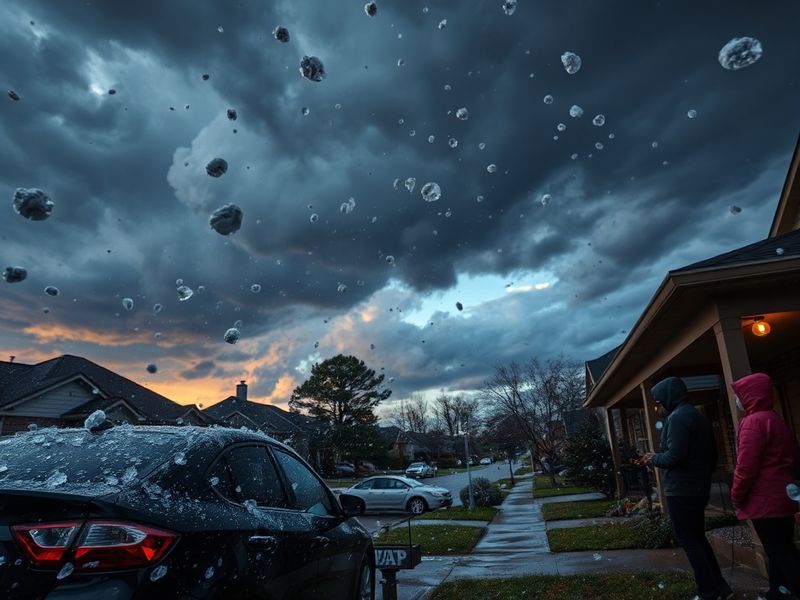
The rhythmic drumming of rain on a roof is often soothing, but when the sky unleashes a barrage of ice pellets instead, the experience shifts from calming to potentially destructive. Hail storms, though brief, can leave behind a trail of damaged property, agricultural losses, and even injuries. These storms are not mere weather quirks; they are powerful atmospheric events that demand attention and respect.
Meteorologists classify hail as precipitation in the form of balls or irregular lumps of ice, typically ranging from pea-sized to golf-ball-sized, though reports of grapefruit-sized hail exist. The formation process is as fascinating as it is violent. Hailstones develop within severe thunderstorms, where updrafts carry raindrops upward into extremely cold regions of the atmosphere. As these droplets freeze, they accumulate layers of ice, growing larger with each cycle of ascent and descent until they become too heavy for the updraft to support.
How Hail Forms: The Science Behind the Ice
Hail formation begins with a single raindrop caught in a thunderstorm’s updraft. At altitudes where temperatures drop below freezing, this droplet freezes into a tiny ice pellet. As it falls, it may be swept back upward by the storm’s powerful winds, collecting more supercooled water droplets that freeze upon contact. This process repeats, layering the hailstone like an onion until it reaches a critical mass.
Several factors influence hail size and intensity:
- Updraft strength: Stronger updrafts can suspend hailstones longer, allowing them to grow larger. Storms with updrafts exceeding 100 mph have been known to produce hailstones over 4 inches in diameter.
- Temperature gradients: Steep temperature drops with altitude create ideal conditions for rapid freezing and layering.
- Moisture availability: Storms drawing moisture from warm, humid air masses provide the raw material for hail growth.
- Storm duration: Longer-lived storms have more opportunities to cycle hailstones, increasing their size.
Interestingly, hail rarely forms in winter. The most severe hailstorms occur during warm seasons when atmospheric instability is high. The infamous “hail alley” of the central United States—stretching from Texas to South Dakota—experiences over 2,000 hailstorms annually, thanks to the collision of warm, moist air from the Gulf of Mexico with cold, dry air from Canada.
Record-Breaking Hail: When Nature Goes Extreme
While most hailstones measure less than an inch in diameter, history has recorded some truly monstrous examples. The largest officially recognized hailstone fell in Vivian, South Dakota, on July 23, 2010. Weighing nearly 2 pounds and measuring 8 inches in diameter, it shattered windows, damaged roofs, and left a crater in the ground where it landed. Its irregular shape suggested a complex growth pattern, with one side nearly flat from partial melting before refreezing.
Other notable hail records include:
- A hailstone in Aurora, Nebraska (2003), measured 7 inches in diameter but was not officially weighed due to damage upon collection.
- The costliest hailstorm in U.S. history struck Denver, Colorado, in 2017, causing over $2.3 billion in damages to vehicles, homes, and infrastructure.
- In Bangladesh, a 2010 hailstorm killed 20 people and injured hundreds, with some stones weighing over 2 pounds—an extreme rarity outside the U.S.
These records highlight the destructive potential of hail, which can travel at speeds exceeding 100 mph when propelled by storm winds. Even smaller hailstones, when driven by hurricane-force winds, can shatter windshields, dent cars, and strip paint from buildings.
The Human Impact: Damage Costs and Precautions
Hailstorms are not just meteorological curiosities; they are billion-dollar disasters. According to the National Oceanic and Atmospheric Administration (NOAA), hail causes an average of $15 billion in damages annually in the United States alone. Agriculture bears a significant brunt, with crops like wheat, corn, and soybeans particularly vulnerable to hail damage, which can strip leaves, break stems, and reduce yields.
Urban areas face different challenges. The roofing industry sees a surge in repairs after major hail events, as shingles, gutters, and siding are pelted with ice. Insurance claims skyrocket, often leading to disputes over whether damage resulted from hail or wind. In 2019, a single hailstorm in Colorado Springs generated over 50,000 insurance claims.
Preparedness is key to mitigating hail damage. Homeowners in hail-prone regions can take steps such as:
- Installing impact-resistant roofing materials, such as Class 4 shingles rated for hail resistance.
- Parking vehicles in garages or under sturdy carports during storms.
- Trimming trees to prevent branches from becoming hail-propelled projectiles.
- Installing storm shutters or reinforced windows to protect against flying debris.
For those caught outside during a hailstorm, seeking shelter indoors is critical. If no building is available, lying flat in a ditch or low-lying area can reduce the risk of injury from large hailstones. Avoid hiding under trees, as branches can break under the weight of ice and wind.
Climate Change and the Future of Hailstorms
As global temperatures rise, scientists are investigating whether climate change will alter the frequency and intensity of hailstorms. Warmer air can hold more moisture, potentially fueling stronger thunderstorms. However, the relationship is complex. Higher freezing levels in the atmosphere might reduce hail formation in some regions, while increased instability could enhance it in others.
A 2020 study published in Nature Climate Change projected that hailstorm frequency could increase in Europe and Australia by mid-century, while parts of North America might see a decrease. The study also warned that hailstones could become larger due to more intense updrafts in a warmer climate. This shift could exacerbate damage to property and agriculture, particularly in vulnerable regions.
Insurance companies are already adjusting their models to account for these changes. Some are raising premiums in hail-prone areas or offering discounts for homes equipped with hail-resistant features. Researchers are also exploring new technologies, such as radar systems that can detect hail within storms and issue more precise warnings.
One such tool is the Multi-Radar Multi-Sensor (MRMS) system, which combines data from multiple radar sources to provide real-time hail detection. By analyzing the reflectivity and velocity of precipitation, MRMS can estimate hail size and trajectory, giving communities precious minutes to take cover.
Conclusion: Respecting Nature’s Fury
Hailstorms are a reminder of nature’s power and unpredictability. While they may lack the immediate drama of tornadoes or hurricanes, their ability to cause widespread damage makes them a force to be reckoned with. Understanding how hail forms, where it strikes, and how to prepare can reduce risks and protect lives and property.
As climate patterns shift, the conversation around hailstorms must evolve. Investing in resilient infrastructure, improving early warning systems, and advancing scientific research are essential steps toward minimizing the impact of these icy tempests. For now, the best defense remains vigilance—keeping an eye on the sky and heeding the warnings when dark clouds gather.
Whether you live in hail alley or a region rarely touched by ice, respecting the storm’s potential is a lesson worth learning.