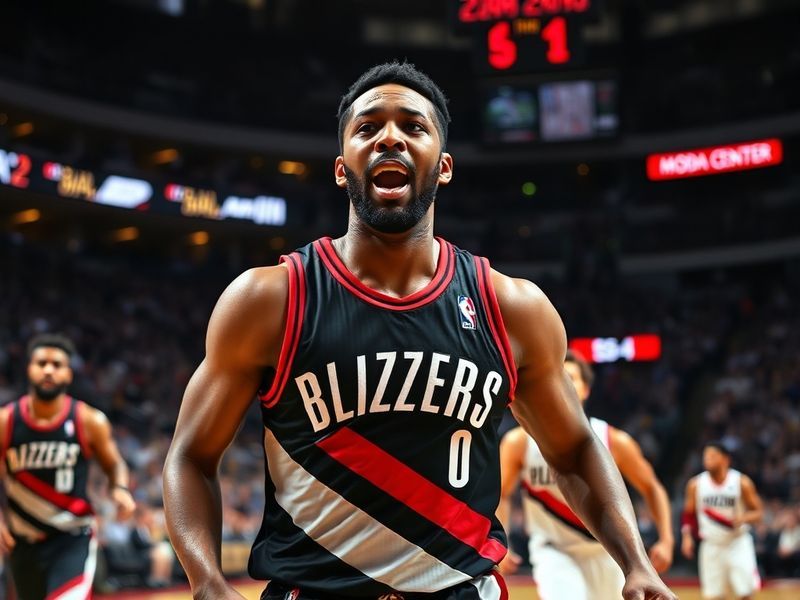
Rasheed Wallace remains one of the most fascinating figures in NBA history—a player whose talent was matched only by his unpredictability. Standing at 6’11” with a wingspan that could disrupt offenses at will, Wallace combined elite skills with an attitude that made him both beloved and controversial. His 16-year career took him from Portland to Detroit, where he became a cornerstone of one of the league’s most dominant teams, and finally to Boston, where he added championship experience to his resume.
Wallace wasn’t just a player who filled the stat sheet; he was a cultural force who brought energy, intensity, and a no-nonsense approach to every game. Whether it was his clutch shooting, his defensive versatility, or his willingness to speak his mind, Sheed—as he was affectionately known—left an indelible mark on the sport. This is the story of a player who defied expectations at every turn.
The Rise of a Basketball Prodigy
Born in Philadelphia in 1974, Rasheed Wallace’s journey to the NBA began at Simon Gratz High School, where he quickly established himself as one of the top prospects in the country. His combination of size, skill, and athleticism made him a coveted recruit, and he ultimately chose to play for Dean Smith at the University of North Carolina. Under Smith’s guidance, Wallace developed into a dominant force, averaging 10.1 points and 6.6 rebounds per game as a freshman while leading the Tar Heels to the 1993 NCAA Championship.
His college success translated seamlessly to the NBA, where he was selected fourth overall by the Washington Bullets in the 1995 draft. Though his time in D.C. was brief—he was traded to Portland midway through his rookie season—Wallace quickly proved he belonged in the league. By his second year, he was averaging 15.1 points and 6.8 rebounds per game, earning NBA All-Rookie Second Team honors. His smooth shooting stroke, defensive instincts, and knack for making big plays hinted at the stardom that lay ahead.
Portland: The Making of a Trailblazer
Wallace’s tenure in Portland (1996-2004) was transformative, both for the franchise and for his own legacy. Playing alongside Damon Stoudamire, Steve Smith, and later, Zach Randolph and Bonzi Wells, he became the emotional leader of a Trail Blazers team that reached the Western Conference Finals in 2000. Wallace’s ability to stretch the floor with his three-point shooting, combined with his shot-blocking and rebounding, made him a matchup nightmare for opponents. In the 2001-02 season, he posted career-highs of 19.4 points, 7.2 rebounds, and 1.3 blocks per game, cementing his status as an All-Star.
Yet, Wallace’s time in Portland wasn’t without controversy. His fiery temperament and occasional technical fouls—he led the league in technicals four times—became as much a part of his identity as his on-court play. In one infamous incident during the 2000 playoffs, he was caught on camera mouthing the words “ball don’t lie” after a missed free throw, a phrase that would later become synonymous with his unfiltered personality. Despite the occasional clashes, Wallace’s impact on the franchise was undeniable. He helped Portland become a perennial contender and left the organization as one of its most iconic players.
The Detroit Era: Championship Pedigree
In 2004, Wallace was traded to the Detroit Pistons in a blockbuster deal that reunited him with his former college coach, Larry Brown. The move proved to be a turning point in his career. Detroit, already a defensive powerhouse, added Wallace’s scoring and versatility to a roster that included Chauncey Billups, Richard Hamilton, and Tayshaun Prince. The result was immediate: in the 2004 playoffs, Wallace and the Pistons defeated the heavily favored Los Angeles Lakers in the NBA Finals, giving him his first and only championship.
Wallace’s role in Detroit was multifaceted. He was the team’s primary stretch big man, capable of hitting threes or bullying opponents in the post. His defense, particularly in the 2005 playoffs, was instrumental in limiting opponents like the Miami Heat and San Antonio Spurs. That year, Detroit returned to the Finals but fell to the Spurs in a hard-fought seven-game series. Though they fell short, Wallace’s contributions were undeniable, and he remained a key piece of the Pistons’ core for several more seasons.
The Detroit years also showcased Wallace’s leadership. Known for his blunt honesty, he wasn’t afraid to call out teammates or coaches when he felt it was necessary. His relationship with Larry Brown, in particular, was a study in contrasts—Brown valued discipline and structure, while Wallace thrived on spontaneity and creativity. Despite their differences, the two formed a partnership that helped elevate the Pistons to the top of the NBA.
The Later Years: A Legacy of Longevity and Influence
After leaving Detroit in 2009, Wallace played briefly for the Boston Celtics before retiring in 2010. He returned for a final season in 2012-13, suiting up for the New York Knicks at age 38. Though his playing time was limited, his presence added veteran leadership to a young roster. His final game, a 109-99 loss to the Milwaukee Bucks, saw him score six points in 12 minutes—a fitting end to a career that spanned two decades.
Wallace’s impact extended beyond the court. He was one of the first players to embrace the three-point shot for big men, paving the way for players like Kevin Durant and Anthony Davis. His defensive versatility set a standard for modern bigs, and his willingness to speak his mind made him a fan favorite. Even today, he remains a polarizing figure—a player whose talent was undeniable, but whose attitude often sparked debate.
Wallace’s Statistical Legacy
Wallace’s career numbers reflect his all-around contributions:
- 16 seasons in the NBA
- 4× NBA All-Star (2000–2002, 2006)
- NBA champion (2004)
- All-NBA Third Team (2000, 2001, 2003)
- NBA All-Rookie Second Team (1996)
- Led the league in technical fouls four times (2001–2003, 2006)
- 10,112 career points
- 5,059 career rebounds
- 1,033 career blocks
Beyond the numbers, Wallace’s influence can be seen in the way modern big men approach the game. His ability to shoot from distance, defend multiple positions, and provide vocal leadership redefined the role of power forwards and centers. Players like LeBron James and Giannis Antetokounmpo have cited Wallace as an inspiration for their versatility.
Wallace’s Cultural Impact
Wallace’s personality made him a standout figure in the NBA. His catchphrases—”Sheed-ism”—became part of basketball lore, and his unfiltered interviews provided a rare glimpse into the mind of an elite athlete. Whether he was praising his teammates or criticizing referees, Wallace never shied away from speaking his mind. His authenticity resonated with fans, who appreciated his refusal to conform to the polished image of many modern athletes.
Wallace’s legacy also extends to his post-playing career. He has worked as a coach and mentor, sharing his knowledge with younger players. His insights into the game, particularly on defense and leadership, have made him a sought-after voice in basketball circles. Though he has largely stayed out of the spotlight in recent years, his influence on the game remains undeniable.
Conclusion: A Player Who Defied Expectations
Rasheed Wallace’s career was a study in contradictions. He was a player of immense talent who often played the role of the agitator. He was a champion who thrived in the spotlight but often seemed to prefer the shadows. He was a man of few words in interviews but never hesitated to speak his mind when it mattered most. In an era where athletes are often carefully curated by PR teams, Wallace stood out as a raw, unfiltered force of nature.
More than two decades after his NBA debut, Wallace’s legacy endures. He remains a symbol of the unpredictability and passion that make basketball such a compelling sport. Whether it was his clutch shooting, his defensive prowess, or his ability to elevate those around him, Wallace left an indelible mark on the game. For fans of the NBA in the late 1990s and early 2000s, he was an unforgettable presence—one whose impact will continue to be felt for generations to come.
For those looking to explore more about the players and moments that defined this era, check out our Sports and Analysis sections for deeper insights.