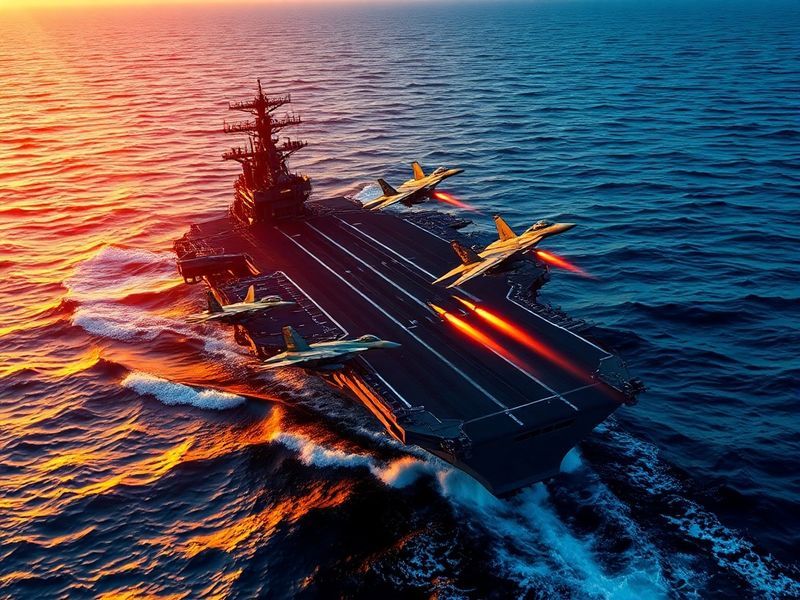
The United States Navy isn’t just a military branch; it’s a floating city of steel and strategy, a 21st-century armada that projects American power across every ocean. With over 340,000 active-duty personnel and a fleet of 290 deployable battle force ships, the Navy remains the world’s dominant maritime force. Its reach extends from the Arctic to the South China Sea, ensuring not just national security but global stability.
Yet its role has evolved. In an era where cyber threats and hypersonic missiles challenge traditional naval doctrine, the U.S. Navy is adapting—faster than some critics claim. The service is investing billions in next-generation destroyers, unmanned surface vessels, and AI-driven fleet management. This isn’t just about maintaining dominance; it’s about redefining it.
A Legacy of Seapower: From Wooden Hulls to Nuclear Fleets
The roots of the U.S. Navy stretch back to October 13, 1775, when the Continental Congress established the Continental Navy to fight the British during the American Revolution. Those early schooners and frigates were nothing like today’s guided-missile cruisers, but they set a precedent: control the seas, and you control the fate of nations.
By World War II, the Navy had transformed into a global powerhouse. Battleships like the USS Missouri became symbols of victory, while aircraft carriers like the USS Enterprise shifted naval warfare from guns to air power. The Cold War solidified its role as America’s first line of defense, with submarines patrolling silently beneath the waves and carrier strike groups asserting presence from the Mediterranean to the Sea of Japan.
Today, that legacy is embodied in platforms like the Zumwalt-class destroyers—stealthy, electric-powered warships designed for land attack and littoral dominance—and the Ford-class aircraft carriers, each costing over $13 billion and capable of launching more sorties per day than any other navy.
Fleet Composition: The Backbone of Blue-Water Dominance
The U.S. Navy’s fleet is a carefully balanced ecosystem of platforms, each serving a distinct purpose in modern naval strategy. While numbers fluctuate due to decommissioning and new construction, the service maintains a core structure built around power projection, sea control, and deterrence.
- Supercarriers: Eleven Nimitz- and Ford-class carriers form the core of naval aviation. These 100,000-ton behemoths carry over 60 aircraft, serve as floating airfields, and project power without relying on foreign bases.
- Cruisers: 22 Ticonderoga-class cruisers act as the fleet’s air and missile defense backbone, equipped with Aegis combat systems and capable of tracking hundreds of targets simultaneously.
- Destroyers: 70 Arleigh Burke-class destroyers combine speed, stealth, and firepower, equipped with Tomahawk cruise missiles and advanced radar systems.
- Attack Submarines: 50 Virginia- and Seawolf-class submarines offer unmatched stealth and intelligence-gathering capabilities, capable of operating in contested waters without detection.
- Amphibious Assault Ships: Ten Wasp- and America-class amphibious ships transport Marines, helicopters, and MV-22 Ospreys, enabling crisis response and expeditionary operations.
- Ballistic Missile Submarines: 14 Ohio-class SSBNs form the sea-based leg of the nuclear triad, ensuring second-strike capability even after a catastrophic first attack.
This mix isn’t accidental. It reflects a doctrine built on flexibility—responding to piracy in the Gulf of Aden, deterring aggression in the Taiwan Strait, or providing humanitarian aid after a tsunami in Southeast Asia. The Navy doesn’t just fight; it shapes the environment in which conflict or cooperation occurs.
Challenges on the Horizon: Cyber Threats, China, and Budget Battles
The Navy faces a trifecta of existential challenges: rising peer competition, technological disruption, and fiscal uncertainty. The most immediate is China’s rapid naval expansion. Beijing has launched more submarines, destroyers, and amphibious ships in the past five years than the U.S. Navy has in total. Its Type 055 destroyers rival Arleigh Burkes, while its aircraft carriers—like the Fujian—are built with lessons learned from Soviet designs.
Then there’s the cyber domain. Naval networks—from shipboard systems to logistics chains—are under constant attack. In 2023, a cyber intrusion into a Navy contractor exposed classified data on submarine propulsion systems. Such breaches aren’t just technical failures; they’re strategic vulnerabilities.
Budget pressures compound the strain. The Navy’s shipbuilding budget has struggled to fund the 355-ship fleet mandated by Congress. Delays in the Columbia-class ballistic missile submarine program and cost overruns on the Constellation-class frigate highlight the tension between ambition and affordability.
Yet the service is responding. The Next-Generation Attack Submarine (NGAS) program aims to replace the Virginia-class by the 2040s with AI-integrated, optionally manned platforms. The Large Unmanned Surface Vessel (LUSV) program seeks to deploy drone ships armed with missiles, extending the fleet’s reach without risking crew. These aren’t just upgrades—they’re a reimagining of what a 21st-century navy can be.
The Broader Implications: Diplomacy, Climate, and the Future of Warfare
The U.S. Navy’s influence extends far beyond kinetic operations. It’s a diplomatic tool, a symbol of alliance strength, and a first responder to global crises.
Consider Operation Unified Assistance in 2004, when the USS Abraham Lincoln and USS Bonhomme Richard delivered critical aid to tsunami-ravaged Indonesia. Or the sustained presence of destroyers in the Black Sea following Russia’s invasion of Ukraine, signaling resolve without firing a shot. Naval diplomacy isn’t just about showing the flag—it’s about shaping behavior through persistent, visible engagement.
Climate change also reshapes naval strategy. Melting Arctic ice opens new shipping lanes and resource opportunities, but also introduces competition with Russia and China. The Navy’s Arctic Strategy outlines increased ice-capable shipbuilding and infrastructure in Alaska, ensuring access to a region that could become a flashpoint.
Moreover, the Navy is rethinking logistics. With resupply lines increasingly targeted by adversaries, the service is investing in unmanned resupply vessels and expeditionary mobile bases—floating logistics hubs that can support operations far from traditional supply chains.
This evolution reflects a deeper truth: the U.S. Navy isn’t just preparing for the next war. It’s preparing for an era where warfare, competition, and cooperation all play out on the same oceanic stage.
Conclusion: The Indispensable Service
In a world where geography still matters, the U.S. Navy remains indispensable. It connects continents, deters aggression, and delivers hope in times of crisis. Its ships are not just instruments of war—they are instruments of order.
Yet its future isn’t guaranteed. Success depends on sustained investment, technological innovation, and strategic patience. The Navy must balance near-term readiness with long-term vision, all while navigating a geopolitical landscape more complex than at any time since the Cold War.
One thing is clear: as long as nations rely on the sea for trade, energy, and security, the United States Navy will remain the guardian of the waves—and the architect of global stability.