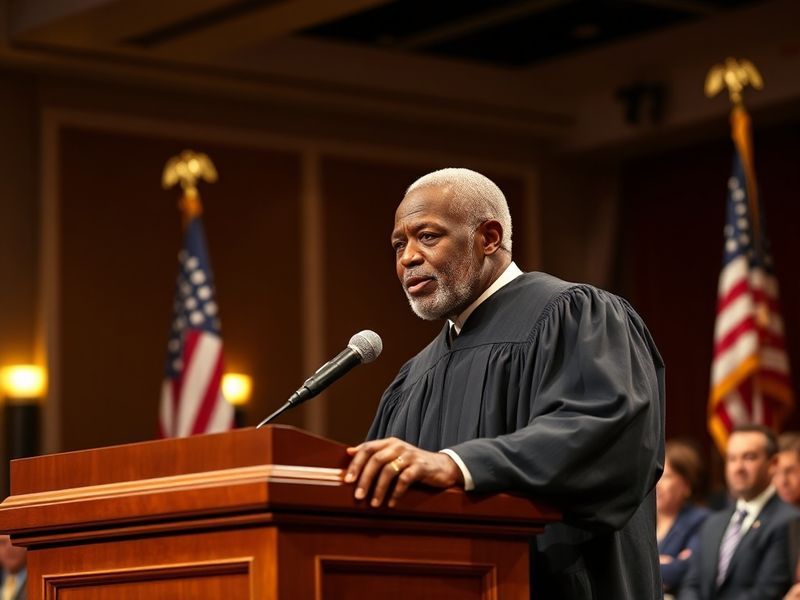
Associate Justice Clarence Thomas delivered a pointed critique of progressive legal philosophy during a recent appearance at the University of Dallas. Speaking to a packed auditorium, Thomas framed his remarks around the dangers he sees in judicial activism and the erosion of constitutional originalism. His comments arrived amid ongoing debates about the role of the Supreme Court in American democracy, particularly regarding issues like abortion rights and administrative state power.
The justice’s speech marked one of his few public addresses in recent years, offering a rare window into his judicial philosophy outside the courtroom. Thomas has long been a vocal advocate for originalism—the belief that the Constitution should be interpreted as it was understood at the time of its ratification. His latest remarks reinforced that stance while directly challenging progressive legal arguments that prioritize evolving social norms over fixed constitutional meaning.
Thomas Links Progressivism to Judicial Overreach
In his address, Thomas argued that progressive judicial philosophy inherently leads to judicial overreach. He cited several landmark Supreme Court decisions—including Roe v. Wade and recent rulings on administrative law—as examples of how judges impose their policy preferences under the guise of constitutional interpretation. According to Thomas, these rulings reflect a broader trend in which courts substitute their own views for the democratic process.
“The Constitution is not a living organism that changes with the times,” Thomas stated. “It is a fixed document that must be understood in its original context.” His comments echoed themes from his earlier writings, particularly his dissent in Obergefell v. Hodges, where he warned against judicial activism in matters of social policy. The justice’s skepticism of progressive jurisprudence aligns with his broader judicial record, which often emphasizes restraint in constitutional interpretation.
Thomas also took aim at the legal academy, suggesting that progressive scholars have distorted the original meaning of the Constitution through revisionist history. He argued that law schools, rather than teaching students to engage with the text as written, increasingly prioritize ideological frameworks that justify judicial intervention in policy disputes. This critique reflects a long-standing tension between originalist and progressive legal scholars, particularly in debates over the separation of powers and federalism.
The Broader Implications of Thomas’s Critique
Thomas’s speech comes at a time when the Supreme Court is under intense scrutiny for its role in shaping American law. His critique of progressivism is not merely academic; it reflects real-world consequences for issues like abortion, gun rights, and executive authority. For example, the Court’s decision to overturn Roe v. Wade in 2022 was a direct repudiation of progressive judicial philosophy, as Thomas argued that the Constitution does not guarantee a right to abortion.
His remarks also raise questions about the future of constitutional law. If originalism continues to gain traction on the Court, it could lead to further challenges against precedents that progressives view as foundational. This includes not only Roe but also cases involving affirmative action, LGBTQ+ rights, and environmental regulations. Thomas’s speech suggests that the Court may be moving toward a more rigid interpretation of the Constitution, one that limits judicial discretion in favor of legislative and executive authority.
Critics of Thomas’s approach argue that originalism is itself a form of judicial activism, as it often requires judges to impose their own interpretations of historical context. They point to cases like District of Columbia v. Heller, where Thomas joined the majority in recognizing an individual right to bear arms under the Second Amendment, as evidence that originalism can lead to expansive rulings. Supporters, however, see it as a necessary corrective to what they view as decades of judicial overreach by progressive courts.
Key Takeaways from Thomas’s Speech
- Originalism vs. Progressivism: Thomas reiterated his belief that the Constitution must be interpreted as it was understood at the time of its ratification, rejecting the idea that courts should adapt its meaning to modern circumstances.
- Judicial Overreach: He argued that progressive judicial philosophy leads to courts imposing their policy preferences, undermining democratic governance.
- Legal Education: Thomas criticized law schools for teaching progressive legal frameworks that distort constitutional history.
- Future of Constitutional Law: His remarks suggest that the Supreme Court may continue to overturn precedents that align with progressive values, particularly in areas like abortion and affirmative action.
Reactions to Thomas’s Speech
Reactions to Thomas’s speech have been sharply divided. Supporters of originalism praised his defense of constitutional restraint, calling it a much-needed counterbalance to progressive judicial activism. Organizations like the Federalist Society have long championed Thomas’s approach, viewing it as essential to preserving the rule of law. His speech was widely shared on conservative media platforms, where it was framed as a bold defense of judicial integrity.
Progressive legal scholars, however, dismissed Thomas’s arguments as outdated and impractical. Some argued that his originalist approach ignores the reality that constitutional interpretation must evolve to address modern challenges. Others pointed to the Court’s recent rulings on LGBTQ+ rights and environmental regulations as evidence that originalism can lead to socially regressive outcomes. Critics also accused Thomas of cherry-picking historical examples to justify his preferred outcomes, rather than engaging in genuine interpretive fidelity.
Public opinion on Thomas’s speech likely mirrors broader divisions over the Supreme Court’s role. Polls consistently show that Americans are split on whether the Court should defer to democratic processes or play an active role in shaping social policy. Thomas’s speech is unlikely to change many minds, but it does highlight the deep philosophical divide that underpins some of the most contentious legal debates of our time.
What’s Next for Originalism and the Supreme Court?
Thomas’s speech raises important questions about the future of originalism and its influence on the Supreme Court. With three originalist-leaning justices now on the Court—Thomas, Samuel Alito, and Neil Gorsuch—there is a real possibility that the Court will continue to overturn precedents that rely on progressive judicial philosophy. This could include cases involving affirmative action, voting rights, and even same-sex marriage, though Thomas himself has suggested that Obergefell is not currently at risk.
However, the longevity of originalism as a dominant judicial philosophy remains uncertain. The Court’s membership could shift in the coming years, particularly if a Democratic president appoints a justice less sympathetic to Thomas’s views. Additionally, originalism faces challenges from within the legal community, where many scholars argue that it is itself a form of judicial activism. The debate over constitutional interpretation is far from settled, and Thomas’s speech is just the latest salvo in a long-running battle.
For now, Thomas’s critique of progressivism serves as a reminder that the Supreme Court remains a battleground for competing visions of constitutional law. Whether originalism will prevail—and what that means for American democracy—remains an open question. What is clear is that the debate over the Court’s role is far from over, and Thomas’s speech has only intensified the conversation.
For more on the evolving dynamics of the Supreme Court, visit our Politics section. To explore the broader implications of judicial philosophy, check out our Analysis category.
Conclusion: A Court at a Crossroads
Clarence Thomas’s speech on progressivism is more than a critique of judicial philosophy; it is a window into the future of constitutional law. His defense of originalism and rejection of progressive jurisprudence reflect a Court that is increasingly divided along philosophical lines. The implications of this divide are vast, touching on everything from abortion rights to the power of federal agencies. As the Supreme Court continues to shape American law, the debate over its role will only grow more intense.
Thomas’s remarks also underscore the importance of public engagement with these issues. The Court’s decisions affect every aspect of American life, yet its inner workings remain opaque to many citizens. Speeches like Thomas’s provide rare insights into the thinking of the justices, offering a chance for Americans to grapple with the philosophical underpinnings of their government. Whether one agrees with Thomas’s views or not, his speech is a reminder that the Constitution is not a static document but a living framework that requires constant debate and interpretation.