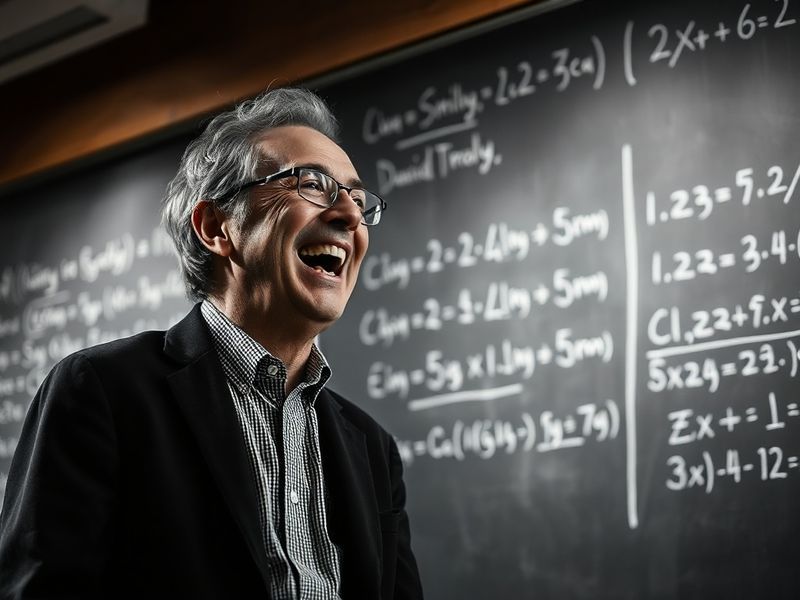
David Gross stands as one of the most influential theoretical physicists of the past half-century. His work reshaped our understanding of the fundamental forces that govern the universe, earning him the 2004 Nobel Prize in Physics alongside David Politzer and Frank Wilczek. Beyond his scientific achievements, Gross has shaped the trajectory of modern physics through leadership, mentorship, and advocacy for fundamental research.
The Quantum Leap: Asymptotic Freedom and the Strong Force
In the early 1970s, Gross and his graduate student Wilczek made a groundbreaking discovery that would redefine particle physics. They demonstrated that the strong nuclear force—responsible for binding quarks inside protons and neutrons—becomes weaker at high energies and distances. This phenomenon, known as asymptotic freedom, contradicted the prevailing assumption that forces always grow stronger with distance.
This insight was pivotal because it provided the mathematical foundation for Quantum Chromodynamics (QCD), the theory describing the strong force. Before their work, physicists struggled to understand why quarks were never observed in isolation. Asymptotic freedom explained that the force between quarks increases as they move apart, effectively trapping them inside composite particles like protons. This discovery was so transformative that it quickly became a cornerstone of the Standard Model of particle physics.
Gross’s collaboration with Wilczek began serendipitously. As Wilczek later recounted, Gross assigned him a seemingly routine problem: to explore the behavior of non-Abelian gauge theories at high energies. What emerged was not just a solution, but a revelation that would alter the course of theoretical physics. Their findings were published in 1973, and by the late 1970s, QCD had become the accepted framework for understanding the strong interaction.
From Academia to the Nobel Stage
Gross’s journey to Stockholm began in Washington, D.C., where he was born in 1941. He earned his bachelor’s degree from the Hebrew University of Jerusalem before completing his Ph.D. at the University of California, Berkeley in 1966. His early academic career took him to Harvard and Princeton, where he refined his theoretical tools and began collaborating with some of the era’s most brilliant minds.
In 1997, Gross joined the faculty of the Kavli Institute for Theoretical Physics (KITP) at the University of California, Santa Barbara, where he served as director for nearly a decade. Under his leadership, KITP became a global hub for theoretical physics, fostering interdisciplinary collaboration and attracting researchers from across the world. Gross’s ability to identify and nurture emerging talent ensured that KITP remained at the forefront of scientific inquiry.
His Nobel Prize, awarded for the discovery of asymptotic freedom, capped decades of relentless intellectual pursuit. Yet, Gross has often emphasized that the recognition was not just his own but a tribute to the collaborative nature of scientific discovery. In his Nobel lecture, he highlighted the contributions of his colleagues, students, and predecessors, underscoring the cumulative and communal aspect of theoretical physics.
Leadership in Science: Shaping the Future of Physics
Beyond his research, Gross has been a vocal advocate for the importance of fundamental science in an era dominated by applied research and short-term goals. He has served as the president of the American Physical Society and has been a prominent voice in discussions about the future of particle physics, particularly in the context of the Large Hadron Collider (LHC) and the proposed next-generation colliders.
Gross has been particularly critical of the challenges facing theoretical physics today. In a 2015 lecture at the Perimeter Institute, he warned that the field risks stagnation if it becomes too focused on incremental progress rather than bold, paradigm-shifting ideas. He has called for greater investment in high-risk, high-reward research, arguing that the next major breakthrough may come from unexpected quarters.
His leadership extends to mentorship as well. Gross has supervised over 50 Ph.D. students, many of whom have gone on to become leaders in their own right. His approach to mentoring blends rigorous intellectual challenge with unwavering support, a combination that has produced generations of physicists equipped to tackle the field’s most complex problems.
Legacy and the Future: What’s Next for Fundamental Physics?
At 82, Gross shows no signs of slowing down. He remains active in research, particularly in the areas of string theory and quantum gravity. His work continues to explore the deep connections between the fundamental forces, seeking a unified theory that could reconcile quantum mechanics with general relativity.
String theory, in particular, has been a major focus of Gross’s later career. He has been a vocal proponent of the idea that the universe may be composed of tiny, vibrating strings rather than point-like particles. While string theory remains unproven, Gross argues that it is the most promising framework for unifying all the forces of nature. His 2000 lecture at the Strings conference in Michigan, where he famously declared that “string theory is physics,” sparked both enthusiasm and controversy.
Gross’s influence is also felt in the public sphere. He has written extensively for both academic and general audiences, including essays on the role of science in society and the ethical responsibilities of scientists. His public lectures, often delivered with a mix of humor and humility, have inspired countless students to pursue careers in physics.
Looking ahead, Gross sees both challenges and opportunities for the field. On one hand, the lack of experimental confirmation for many theoretical predictions—such as supersymmetry or extra dimensions—has led to skepticism about the direction of particle physics. On the other hand, Gross remains optimistic that new technologies and experimental techniques could provide the breakthroughs needed to test these ideas. The upcoming generation of colliders and telescopes, he argues, may finally reveal the deeper structure of reality.
Lessons from a Lifetime in Physics
Gross’s career offers several lessons for aspiring scientists and the broader public. First, his work demonstrates the importance of persistence and curiosity. The discovery of asymptotic freedom was not the result of a single eureka moment but rather years of patient exploration and collaboration. Gross has often spoken about the role of failure in scientific progress, noting that many of his early ideas were wrong before they led to the right ones.
Second, his leadership in science highlights the need for institutions that foster creativity and risk-taking. KITP, under his guidance, became a model for how to support theoretical physics in an era of increasing specialization and competition. Gross’s emphasis on interdisciplinary collaboration has also paved the way for physicists to work with mathematicians, computer scientists, and even biologists.
Finally, Gross’s advocacy for fundamental research serves as a reminder of the long-term value of science. In an era where research funding is often tied to immediate economic benefits, Gross has consistently argued that curiosity-driven science is essential for human progress. His work on asymptotic freedom, for example, had no immediate practical application when it was first discovered, yet it has since become foundational to our understanding of the universe.
As Gross himself has said, “Science is not about certainty. It is about finding better ways to be wrong.” This philosophy encapsulates his approach to physics and his enduring legacy as one of the field’s most influential figures.
For those interested in exploring more about the intersection of physics and cutting-edge research, the Science section on Dave’s Locker offers a range of articles on similar topics. Additionally, the Technology category features insights into how theoretical breakthroughs are driving innovation in fields like quantum computing and artificial intelligence.