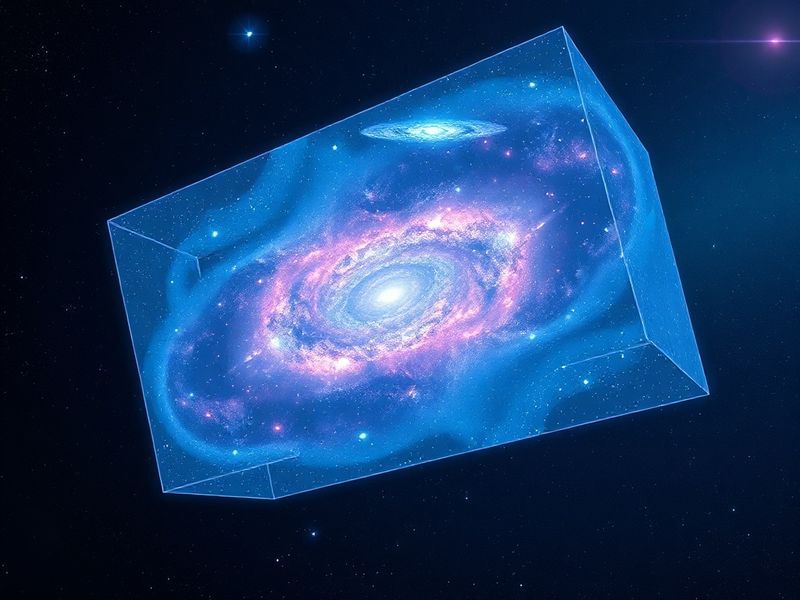
The Sloan Digital Sky Survey (SDSS) has unveiled the most comprehensive 3D map of the universe ever created. Spanning over two million galaxies and quasars, this map stretches back 11 billion years, offering an unprecedented view of cosmic evolution. Researchers spent two decades collecting data using the Apache Point Observatory in New Mexico, pushing the boundaries of observational astronomy.
This achievement isn’t just about scale—it’s about precision. The map provides critical insights into dark energy, the mysterious force accelerating the universe’s expansion. By measuring the distribution of galaxies and the patterns of cosmic structure, scientists can now test theories about the universe’s fundamental properties with greater accuracy than ever before.
How the Map Was Constructed
The creation of this 3D map involved a multi-stage process that combined advanced technology with meticulous data collection. Astronomers used the SDSS telescope to capture images of the night sky in multiple wavelengths, then followed up with spectroscopic measurements to determine the distances and positions of galaxies.
A key component was the Baryon Oscillation Spectroscopic Survey (eBOSS), which specifically targeted quasars—extremely bright objects powered by supermassive black holes—to probe the universe at earlier times. The final dataset includes observations from both the original SDSS and its ongoing extensions, resulting in a map that covers about a third of the sky.
- Phase 1 (1998-2005): Initial survey mapped 25% of the sky, cataloging 800,000 galaxies.
- Phase 2 (2005-2008): Expanded to include 1.5 million galaxies and 160,000 quasars.
- Phase 3 (2014-2020): eBOSS added 300,000 new galaxies and 100,000 quasars, extending the map to 11 billion years.
The precision of this map is staggering. Researchers achieved a distance accuracy of better than 1% for galaxies and 3% for quasars, allowing them to trace the universe’s structure with remarkable detail. This level of accuracy is crucial for understanding the interplay between dark matter, dark energy, and visible matter.
What the Map Reveals About the Universe
One of the most significant findings from this map is the confirmation of dark energy’s dominance in the universe. Measurements show that dark energy makes up about 68% of the total energy density, while dark matter accounts for 27%. Ordinary matter—the stuff that makes up stars, planets, and us—comprises just 5%.
The map also provides evidence for the universe’s accelerated expansion. By observing the imprint of sound waves from the early universe (baryon acoustic oscillations), scientists can see how the distribution of galaxies has evolved over time. These observations align with the theory that dark energy has been driving this acceleration for billions of years.
Another revelation is the discovery of “cosmic voids”—vast regions of space with fewer galaxies than expected. These voids, which can span hundreds of millions of light-years, offer clues about the large-scale structure of the universe. Studying their distribution helps researchers understand how galaxies cluster and how dark matter influences cosmic architecture.
Why This Map Matters for Future Research
The implications of this 3D map extend far beyond its immediate findings. It serves as a foundation for future astronomical surveys, including those planned for the James Webb Space Telescope and the upcoming Euclid mission. These projects will build on SDSS’s work, refining our understanding of cosmic history and the nature of dark energy.
For cosmologists, this map is a tool for testing theories about the universe’s birth, evolution, and ultimate fate. It allows researchers to probe the validity of general relativity on cosmic scales and explore alternative models of gravity. The data also provides a benchmark for simulations, helping scientists recreate the universe’s structure in computer models.
The map’s public accessibility is another critical aspect. The SDSS team has made all data available online, enabling researchers worldwide to conduct their own analyses. This open-source approach accelerates discovery and fosters collaboration across the scientific community.
The Human Element: Collaborative Science in Action
Behind this monumental achievement is a global collaboration of over 100 institutions and hundreds of researchers. The SDSS project exemplifies how large-scale science operates in the modern era, with contributions from astronomers, physicists, engineers, and data scientists. The project’s success hinges on both technological innovation and international cooperation.
One notable example is the involvement of early-career scientists who used the map’s data for their doctoral research. The dataset has become a training ground for the next generation of astronomers, equipping them with the skills to tackle future cosmic mysteries. This aspect underscores the project’s role in education and scientific mentorship.
The map also highlights the importance of public funding in fundamental research. SDSS is supported by institutions like the National Science Foundation and the Alfred P. Sloan Foundation, demonstrating how taxpayer and philanthropic investments yield transformative knowledge. This investment in curiosity-driven science pays dividends in education, technology, and cultural inspiration.
Conclusion: A New Chapter in Cosmic Exploration
The largest 3D map of the universe marks a milestone in our quest to understand the cosmos. It combines technological prowess with human ingenuity to reveal the universe’s hidden patterns and challenge our perceptions of reality. As we stand on the shoulders of this achievement, the next generation of telescopes and surveys will continue to push the boundaries of what we know.
For now, this map serves as both a testament to human achievement and a roadmap for future exploration. It reminds us that the universe is not just a distant abstraction but a tangible, measurable entity—one that we are only beginning to decipher. The journey to map the cosmos is far from over, but with each discovery, we edge closer to answering some of humanity’s oldest questions.
© 2023 Dave’s Locker. All rights reserved.