Few archaeological sites in the Americas command the same awe as Teotihuacan. Located just 30 miles northeast of modern-day Mexico City, this sprawling pre-Columbian complex was once one of the largest cities in the ancient world. Its precise origins remain shrouded in mystery, but its legacy endures through towering pyramids, intricate murals, and a cultural influence that stretched across Mesoamerica.
Unlike many ancient cities, Teotihuacan was not built by the Maya or the Aztecs—though both civilizations revered it centuries later. Its founders, who called themselves the “People of the Place Where the Gods Were Made,” left no written records, forcing scholars to piece together its history through architecture, artifacts, and the accounts of later cultures. What emerges is a portrait of a sophisticated society that thrived for nearly a millennium before its sudden decline around 550 CE.
The Rise of a Megacity
Teotihuacan’s origins trace back to around 100 BCE, when small agricultural villages began coalescing into a larger settlement. By 100 CE, it had ballooned into a metropolis covering roughly eight square miles, with a population estimated between 100,000 and 200,000 inhabitants. This explosive growth coincided with the decline of other regional powers, suggesting Teotihuacan may have absorbed trade networks and resources from neighboring cultures.
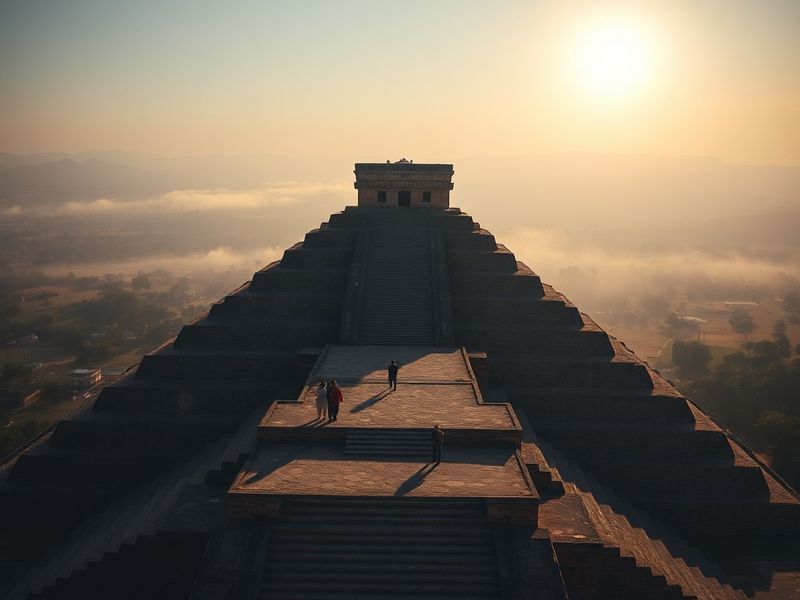
The city’s layout reflects advanced urban planning. Its main thoroughfare, the Avenue of the Dead, stretches over a mile and aligns with celestial events, such as the summer solstice sunset. At its northern end stands the Pyramid of the Moon, while the Pyramid of the Sun dominates the skyline to the west. These monumental structures were likely built in phases, with the Pyramid of the Sun reaching its current height of 246 feet by 200 CE.
Teotihuacan’s influence extended far beyond its borders. Archaeologists have uncovered its artifacts—obsidian tools, pottery, and murals—across Central Mexico, the Maya lowlands, and even as far as modern-day Honduras. This suggests the city was a hub for trade, religion, and political power, though its exact relationship with other Mesoamerican cultures remains debated.
Trade and Economy: The Engine of Growth
The city’s economic strength lay in its control of obsidian, a volcanic glass prized for its sharp edges. Teotihuacan’s workshops produced tools, weapons, and ceremonial objects, which were traded across the region. The city also cultivated maize, beans, and squash, supporting its dense population through advanced agricultural techniques like chinampas—floating gardens similar to those later used by the Aztecs.
Beyond goods, Teotihuacan’s culture spread through art and architecture. The city’s murals, depicting deities, warriors, and geometric patterns, influenced styles from the Maya city of Tikal to the Zapotec center of Monte Albán. Even the Aztecs, who arrived centuries later, incorporated Teotihuacan’s ruins into their own cosmology, naming the site and attributing its construction to their gods.
Theories of Decline: What Happened to Teotihuacan?
Around 550 CE, Teotihuacan experienced a dramatic collapse. The city’s grand structures were burned, its palaces looted, and its population dwindled. Theories abound: internal rebellion, foreign invasion, environmental degradation, or a combination of factors. Some scholars point to evidence of elite overreach, where a ruling class may have alienated the general populace through excessive demands.
Others argue that climate change played a role. Sediment studies suggest prolonged droughts in the 6th century, which could have crippled agriculture and triggered social unrest. The timing also coincides with the “Maya Hiatus,” a period of decline across the Maya lowlands, hinting at a broader regional crisis.
One of the most compelling clues comes from the city’s murals. In the years leading up to the collapse, images of warfare and sacrifice became more prevalent, suggesting growing instability. By 650 CE, Teotihuacan was a shadow of its former self, though its cultural legacy lived on in the traditions of later civilizations.
Rediscovery and Modern Exploration
Teotihuacan’s ruins were never truly lost, but their significance faded after the Spanish conquest. It wasn’t until the 19th century that scholars began systematically studying the site. In the early 20th century, Mexican archaeologist Manuel Gamio excavated the Pyramid of the Moon, uncovering caches of offerings, including greenstone figurines and human sacrifices.
Today, Teotihuacan is a UNESCO World Heritage Site and one of Mexico’s most visited archaeological destinations. Ongoing excavations continue to reveal new secrets, such as the recent discovery of a tunnel beneath the Pyramid of the Feathered Serpent, which may have been used for ritual purposes. Advanced technologies like LiDAR are also helping researchers map the city’s sprawling urban layout, including residential compounds and industrial zones.
Despite these advances, many questions remain unanswered. Who were the people of Teotihuacan? What language did they speak? Why did they build such a vast city, and what led to its downfall? As archaeologists peel back another layer of history, the site only grows more intriguing.
Visiting Teotihuacan: A Journey Through Time
For travelers, Teotihuacan offers a tangible connection to the past. The site is open year-round, though the best time to visit is early morning or late afternoon to avoid the heat and crowds. Climbing the Pyramid of the Sun rewards visitors with panoramic views of the valley below, while the Pyramid of the Moon provides a quieter vantage point over the Avenue of the Dead.
Nearby attractions include the Museum of Teotihuacan Culture, which houses artifacts like the famous “Great Goddess” mural fragments, and the Basilica of Guadalupe in Mexico City, a major religious site with its own layered history. For those interested in Mesoamerican archaeology, a visit to Teotihuacan is a must.
Legacy: Teotihuacan’s Enduring Influence
Teotihuacan’s impact on Mesoamerican civilization cannot be overstated. Its urban planning, art, and religious iconography influenced cultures from the Toltecs to the Aztecs. Even the name “Teotihuacan” comes from Nahuatl, the language of the Aztecs, meaning “Place Where the Gods Were Born.”
The city’s mysteries also inspire modern interpretations, from literature to film. Its pyramids have been featured in everything from Indiana Jones to Mexican soap operas, cementing its place in popular culture. Yet, beyond its cinematic appeal, Teotihuacan remains a symbol of human ingenuity and resilience—a testament to a society that, for a time, reshaped the landscape of ancient Mexico.
As research continues, Teotihuacan challenges our understanding of pre-Columbian societies. It was not just a city but a civilization unto itself, one that thrived through trade, innovation, and cultural exchange. Its ruins stand as a reminder of the fragility of empires and the enduring power of human creativity.
For those who walk its ancient streets, Teotihuacan is more than an archaeological site; it is a window into a world that continues to captivate the imagination.