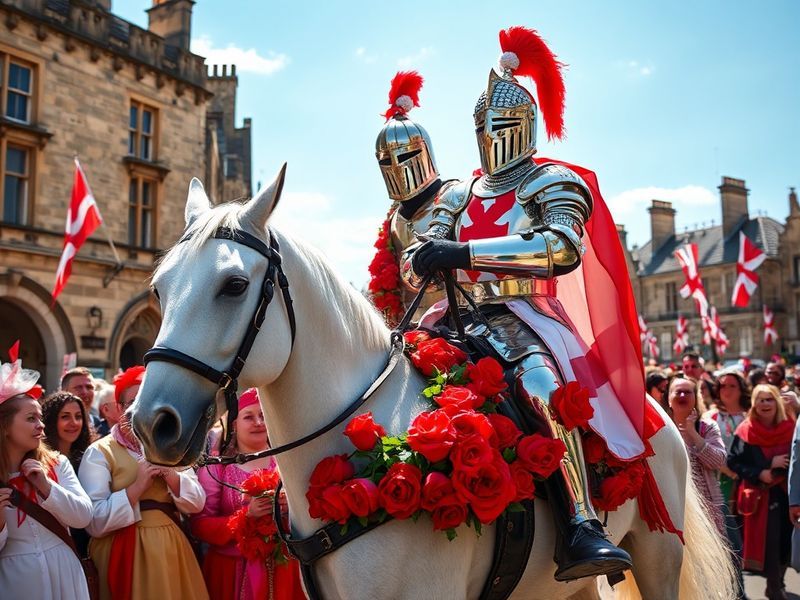
St George’s Day: Why England’s Patron Saint Still Matters
“`html
St George’s Day: Why England’s Patron Saint Still Matters
Every April 23rd, England pauses to remember St George, its patron saint. Unlike some national celebrations, St George’s Day carries a quiet dignity rather than raucous fanfare. The day encourages reflection on identity, history, and what it means to be English in a modern, multicultural society. While it may not rival the grandeur of St Patrick’s Day in Ireland or Hogmanay in Scotland, its significance persists in cultural memory and occasional public observance.
The Historical Roots of St George
St George’s origins trace back to the 4th century, though much of his legend remains shrouded in myth. Born in Cappadocia (modern-day Turkey), he rose through the ranks of the Roman army before resigning his commission over a decree requiring Christians to persecute other Christians. His most famous act—slaying a dragon to save a princess—emerged centuries later, likely inspired by older Near Eastern myths. By the Middle Ages, his story had been Christianized and romanticized across Europe.
In England, his cult gained prominence after the Crusades, when returning knights brought back relics and tales of his bravery. Edward III made him the patron saint in 1348, linking him to the Order of the Garter and the chivalric ideal. Yet George was never a uniquely English figure. He was also venerated in Ethiopia, Georgia, Greece, and Portugal, each nation adapting his legend to local needs.
The dragon, often seen as a symbol of paganism or evil, was likely added to stories to make his martyrdom more dramatic. By the 15th century, his red cross on a white background became a rallying emblem, flown by English armies and later adopted in the Union Jack. But the saint himself was forgotten by many during the Reformation, when Protestant England distanced itself from Catholic saints. His feast day survived, barely, in quiet church services and local customs.
Modern Observance: From Tradition to Revival
Today, St George’s Day is observed in various ways across England. Some towns hold flag-raising ceremonies, Morris dancing, or medieval fairs. A few schools teach children about the saint’s life, though his story is often simplified or omitted entirely. The day is officially marked with church services, particularly in the Church of England, where prayers and hymns honor his memory. In some communities, especially those with strong English heritage, pubs and social clubs host themed events featuring English food, ale, and music.
Yet the day remains understated compared to national holidays in other countries. England lacks a single, unifying celebration like Bastille Day in France or America’s Independence Day. Part of this stems from England’s complex identity within the United Kingdom. While Scotland, Wales, and Northern Ireland each have their own national days, England’s celebration is often seen as secondary or even politically charged. Some argue that St George’s Day has been overshadowed by the commercialization of other holidays, or by modern skepticism toward national symbols.
There have been efforts to revive interest. In 2006, the government first recognized April 23rd as St George’s Day, though without declaring it a public holiday. Charities and cultural groups have since promoted events under themes like “Englishness” and multiculturalism, highlighting contributions from diverse communities. The BBC has aired documentaries and specials, and English heritage sites such as Windsor Castle and Westminster Abbey have hosted commemorative programs.
Controversies and Cultural Tensions
St George’s Day has not escaped debate. Some critics argue that celebrations can veer into nationalist rhetoric, especially when tied to debates about immigration or British identity. Far-right groups have occasionally attempted to co-opt the day, using St George’s cross as a symbol of exclusion rather than unity. This has led to tensions in multicultural areas, where residents may feel uneasy about public displays of English pride.
Others point out that George himself was not English, nor did he set foot in Britain. His relevance today rests more on symbolism than historical fact. In response, many communities emphasize inclusivity, celebrating England’s diversity alongside its traditions. For example, in Leicester, St George’s Day events often feature Caribbean steel bands, South Asian dance, and African drumming, reflecting the city’s rich cultural mix.
There’s also a generational divide. Older generations may cherish the day for its historical continuity, while younger people often view it through a lens of irony or ambivalence. Social media has amplified both support and skepticism. Hashtags like #StGeorgesDay and #EnglandDay trend annually, with some celebrating English culture and others critiquing its perceived irrelevance.
Why St George Still Matters in 2024
Despite these challenges, St George’s Day offers something unique: a moment to reflect on shared values without the pressure of jingoism. The saint’s story—of courage, integrity, and standing against oppression—resonates even today. In a time of political division and rapid change, a national day rooted in a medieval legend might seem quaint, but it also provides continuity. It connects modern England to a thousand years of history, not as a museum piece, but as a living thread.
Moreover, the day invites conversations about what it means to belong. Unlike flags that divide, St George’s red cross can symbolize protection and honor. Many schools now use the day to discuss tolerance, community, and civic duty. Charities like the Royal Society for the Prevention of Cruelty to Animals (RSPCA) have tied their campaigns to the saint’s legacy, citing his compassion for animals in some retellings of the dragon legend.
For those interested in exploring England’s heritage beyond the day itself, consider visiting sites tied to St George. Travel sections often highlight locations like Windsor Castle, where George is said to have appeared to King Edward III in a vision, or the Church of St George in Doncaster, one of many dedicated to him across the country. These places offer deeper insight into how his cult evolved over centuries.
St George’s Day also intersects with literature and the arts. Shakespeare’s birthday is traditionally celebrated on April 23rd, tying English identity to one of its greatest writers. The day becomes an opportunity to revisit works like Henry V, where chivalry and patriotism are celebrated, or to examine how later writers like G.K. Chesterton and J.R.R. Tolkien reinterpreted heroism and virtue.
A Call to Remember, Not to Celebrate Loudly
Perhaps the greatest strength of St George’s Day lies in its restraint. It doesn’t demand fireworks or parades. It doesn’t require costumes or hashtags. Instead, it offers a quiet invitation: to pause, to reflect, and to consider what binds a nation together. In an age of constant noise, that kind of stillness is rare—and valuable.
Whether through a church service, a family meal, or a walk in the countryside, observing St George’s Day can be deeply personal. It doesn’t have to be about politics or propaganda. It can simply be about remembering a figure who, for better or worse, helped shape a collective imagination.
As England continues to evolve, so too will the meaning of its patron saint. But one thing seems certain: St George will endure—not because he was perfect, or uniquely English, but because his story, in all its complexity, still speaks to the human desire for courage and principle.