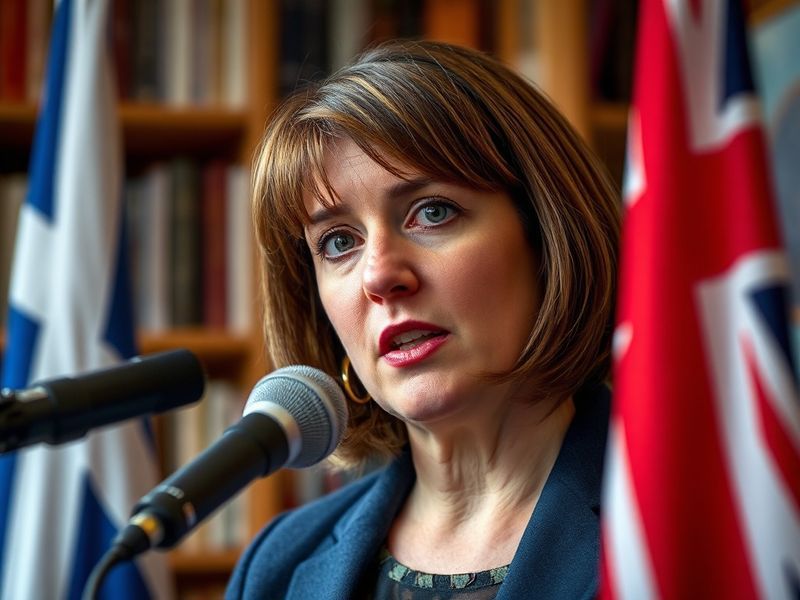
In a political landscape often dominated by familiar names, Mairi McAllan has emerged as a distinctive and influential figure in Scotland’s government. As the Cabinet Secretary for Wellbeing Economy, Net Zero and Energy, she holds a portfolio that sits at the intersection of economic transformation, environmental urgency, and social equity. Her approach blends pragmatic policy-making with a clear-eyed view of Scotland’s unique challenges and opportunities.
McAllan’s trajectory is notable not just for the positions she holds, but for how she carries them forward. She represents a generation of leaders who came of age during the climate movement’s rise, yet entered politics with a focus on action rather than rhetoric. This balance—between idealism and implementation—has shaped her approach to some of Scotland’s most pressing issues.
From Activism to Government: A Career Defined by Purpose
Before stepping into the corridors of power, McAllan was deeply involved in environmental and social justice causes. Her early work with organizations such as Friends of the Earth Scotland and the Scottish Youth Parliament grounded her in grassroots advocacy, where she developed a keen understanding of policy gaps and public sentiment. This foundation has informed her later decision-making, particularly in areas like renewable energy and rural development.
Elected to the Scottish Parliament in 2021 as a Member for Clydesdale, McAllan quickly made an impact. Her background in law—she holds a degree from the University of Glasgow and trained as a solicitor—gave her a structured, analytical approach to governance. This legal precision has been evident in her handling of complex issues, from the Just Transition to the regulation of onshore wind projects.
Her appointment to cabinet in March 2023 marked a significant moment. At just 34 years old, she became one of Scotland’s youngest Cabinet Secretaries, inheriting a brief that demanded both ambition and pragmatism. The portfolio—covering wellbeing economy, net zero, and energy—reflects a modern understanding of governance: one where economic health cannot be separated from environmental sustainability or social justice.
Policy Priorities: Balancing Net Zero and Economic Realities
Under McAllan’s leadership, Scotland’s climate strategy has evolved in tone and focus. While the country remains committed to its 2045 net zero target, she has emphasized the need for a “just transition”—a shift that protects workers and communities dependent on declining industries like oil and gas. This approach acknowledges that decarbonization, if mishandled, could deepen inequality rather than reduce it.
One of her key initiatives has been the expansion of community energy projects. By empowering local groups to develop renewable energy schemes, she aims to decentralize energy production and ensure that financial benefits flow back into rural and deprived areas. This strategy aligns with broader goals of energy democracy and resilience, especially in regions vulnerable to fuel poverty.
McAllan has also been vocal about the role of agriculture in climate action. Recognizing that farming accounts for nearly a quarter of Scotland’s greenhouse gas emissions, she has pushed for greater support for regenerative practices and peatland restoration. These are not just environmental measures, but economic ones—supporting farmers who are willing to adapt while protecting Scotland’s natural capital.
Yet, her tenure has not been without controversy. Critics argue that Scotland’s progress on renewables has been slowed by planning delays and grid constraints. Others point to the contradiction of expanding oil and gas licenses while claiming leadership on climate. McAllan has acknowledged these tensions, framing them as necessary compromises in a devolved context where powers are limited and global pressures are immense.
Key Policy Pillars Under McAllan’s Leadership
- Just Transition Fund: A £500 million investment to support workers and communities affected by the shift away from fossil fuels.
- Community Energy Strategy: Simplifying regulations to help local groups develop wind, hydro, and solar projects.
- Peatland Action Programme: Restoring 250,000 hectares of peatland by 2030 to lock in carbon and improve biodiversity.
- Hydrogen Roadmap: Positioning Scotland as a leader in green hydrogen, leveraging offshore wind potential.
- Rural Support Review: Reforming agricultural subsidies to reward climate-friendly practices and rural resilience.
These initiatives reveal a pattern: McAllan favors systemic change delivered through targeted interventions. She avoids grand pronouncements in favor of incremental, measurable steps—an approach that reflects both her legal training and her political instincts.
The Broader Implications: What McAllan’s Rise Signals for Scotland
McAllan’s prominence is more than a personal success; it reflects broader shifts in Scottish politics. Her ascent coincides with the growing influence of younger, climate-focused legislators who are reshaping the national agenda. This generational shift is not unique to Scotland—similar dynamics are playing out across Europe—but it is particularly pronounced in a country where environmental consciousness has deep cultural roots.
Her leadership also highlights the evolving role of devolved governments in climate action. While Scotland cannot set UK-wide energy policy or international climate targets, it has carved out a reputation as a laboratory for progressive environmental policy. McAllan’s work in energy, agriculture, and rural development demonstrates how subnational governments can drive innovation when national action is slow or inconsistent.
Moreover, her focus on wellbeing economics—a framework that prioritizes quality of life over GDP growth—signals a challenge to traditional economic models. By linking net zero goals to social outcomes like health, housing, and education, she is helping redefine what prosperity looks like in the 21st century. This approach resonates with younger voters and those disillusioned by conventional politics.
Yet challenges remain. Scotland’s climate targets are legally binding, but delivery depends on cooperation across sectors and levels of government. Brexit has complicated trade and regulatory alignment, while fiscal constraints limit the pace of change. McAllan’s ability to navigate these constraints will determine whether her policies translate into tangible progress.
The Road Ahead: Expectations and Uncertainty
Looking forward, McAllan faces a packed agenda. The next two years are critical for Scotland’s 2030 emissions reduction targets, particularly in transport and heating—sectors where decarbonization has lagged. Her willingness to engage with industry, local authorities, and civil society will be tested as she seeks to balance urgency with feasibility.
There are also rising expectations. After years of climate leadership, Scotland must now demonstrate delivery. The global energy crisis has underscored the risks of over-reliance on volatile fossil fuel markets, reinforcing the case for renewables. But public patience is not infinite. If progress stalls, the political cost could be high.
For McAllan, the challenge is both intellectual and political. She must maintain a coherent strategy while responding to crises, defend bold ambitions against accusations of unrealism, and build alliances across a fragmented political landscape. Her success or failure will shape not only her career, but the credibility of Scotland’s climate commitments.
What sets her apart is her refusal to treat these issues in isolation. Whether discussing hydrogen hubs in the Highlands or fuel poverty in Glasgow, she consistently links environmental goals to social and economic outcomes. In doing so, she embodies a new kind of policymaker—one who sees climate not as a standalone challenge, but as the defining context for all governance.
As Scotland positions itself as a global leader in climate action, Mairi McAllan stands at the helm—not as a revolutionary, but as a steady hand guiding a complex transition. Her story is still being written, but one thing is clear: she is a leader who understands that the future is not something to be predicted, but to be built.
For those watching Scotland’s next steps in climate and rural policy, her trajectory offers both inspiration and a reminder: progress is possible, but only through persistent, principled effort.
To explore more on Scotland’s evolving policy landscape, visit our Politics and Environment sections for ongoing analysis and reporting.