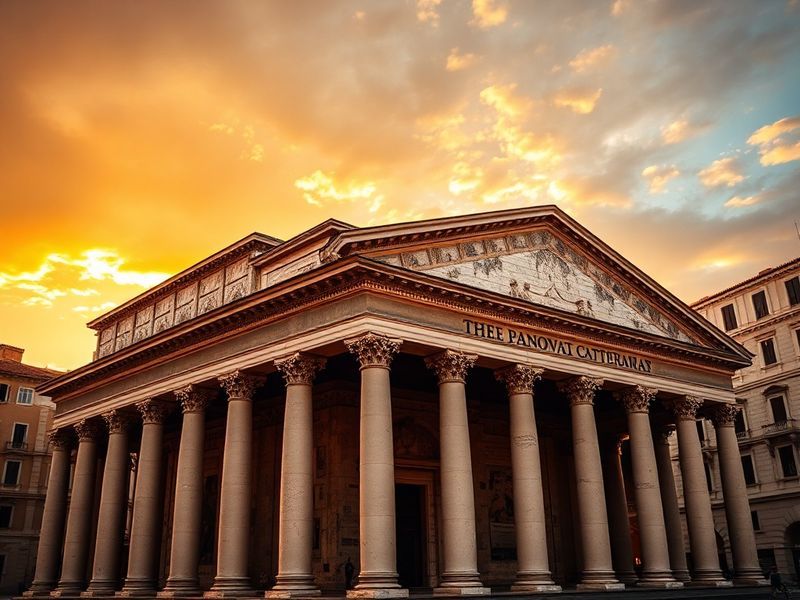
Pantheon: Rome’s 2,000-Year-Old Architectural Masterpiece
“`html
Pantheon: The Enduring Legacy of Rome’s Architectural Marvel
The Pantheon in Rome stands as a testament to the ingenuity of ancient Roman engineering and the enduring power of classical architecture. Completed in 126 AD under Emperor Hadrian, this nearly 2,000-year-old structure has captivated historians, architects, and visitors alike. Its most striking feature—a massive unreinforced concrete dome—remains the world’s largest of its kind, a marvel that has inspired countless imitations yet stands unmatched in its original form.
Unlike many ancient ruins, the Pantheon has been in continuous use for centuries, transitioning from a pagan temple to a Christian church in the 7th century. This adaptability has preserved it through wars, plagues, and the fall of empires. Today, it serves as both a tourist attraction and a place of worship, a rare bridge between antiquity and modernity.
The Architectural Innovations That Defined an Era
The Pantheon’s design is a masterclass in structural efficiency and aesthetic harmony. Its cylindrical body, constructed from brick and concrete, supports a coffered dome with an oculus at its apex. The oculus, a 27-foot-wide opening, is the sole source of natural light, creating a dynamic interplay of shadow and illumination that changes with the time of day and year.
Several innovations made this structure possible:
- Concrete Composition: The Romans used a volcanic ash called pozzolana mixed with lime and aggregate, creating a concrete that hardened underwater—a technique that allowed for the dome’s massive scale.
- Graduated Weight Distribution: The dome’s thickness decreases from 21 feet at the base to just 4 feet at the oculus, while the aggregate changes from heavy basalt at the bottom to lightweight pumice at the top.
- Geometric Precision: The interior is a perfect sphere, with the height from the floor to the oculus equaling the diameter of the dome—a deliberate choice that emphasizes the building’s cosmic symbolism.
- Hidden Supports: The walls are reinforced with eight large niches and two smaller ones, which not only serve decorative purposes but also reduce the dome’s thrust on the supporting walls.
These techniques were revolutionary for their time and remained unmatched until the Renaissance. The Pantheon’s dome wasn’t just a roof—it was a declaration of Rome’s technological supremacy and artistic ambition.
From Pagan Temple to Christian Church: A Story of Transformation
The Pantheon’s survival is as much a story of adaptation as it is of preservation. Originally built as a temple to all the gods of ancient Rome, it was commissioned by Marcus Agrippa during the reign of Augustus but rebuilt by Hadrian after a fire in 80 AD. Its name, derived from the Greek pan (all) and theon (gods), reflects this polytheistic purpose.
In 609 AD, Pope Boniface IV consecrated the building as a Christian church, dedicating it to St. Mary and the Martyrs. This conversion likely saved the Pantheon from destruction, as many pagan temples were demolished or repurposed during the Christianization of the Roman Empire. The transformation was not merely practical but symbolic: the oculus, once a connection to the gods, became a metaphor for the gaze of heaven.
The building has since hosted tombs of Italian royalty, including the Renaissance artist Raphael. These burials further cemented its role as a cultural and spiritual landmark, blending the sacred and the secular across millennia.
The Pantheon’s Influence on Modern Architecture
The Pantheon’s design has echoed through the centuries, influencing landmarks from the U.S. Capitol Building to Thomas Jefferson’s Monticello. Architects such as Brunelleschi studied its dome when designing Florence’s Santa Maria del Fiore, while modern engineers continue to marvel at its structural integrity.
Its influence extends beyond mere aesthetics. The concept of a centralized dome with an oculus inspired:
- Renaissance and Baroque Churches: Structures like St. Peter’s Basilica in Vatican City and Il Redentore in Venice borrowed its proportions and lighting techniques.
- Neoclassical Buildings: The U.S. Capitol’s rotunda and the Panthéon in Paris replicate its grandeur, albeit with less ambitious domes.
- Contemporary Design: Architects like Renzo Piano have cited the Pantheon as a model for sustainable design, noting how its thick walls and small windows regulate temperature naturally.
Even today, the Pantheon remains a benchmark for architectural achievement. In 2023, it was named a UNESCO World Heritage Site, recognizing its status as a “universal symbol of ancient Rome’s architectural genius.”
Preservation Challenges and the Pantheon’s Future
Despite its resilience, the Pantheon faces modern threats. Pollution from Rome’s traffic and tourism has accelerated the erosion of its marble and travertine surfaces. In 2021, restoration work addressed cracks in the dome, using laser technology to clean centuries of grime without damaging the original materials.
Another challenge is balancing preservation with accessibility. The Pantheon receives over 7 million visitors annually, straining its delicate structure. In response, officials have implemented timed entry systems and restricted group sizes to mitigate wear.
Yet, the building’s adaptive reuse offers a blueprint for conservation. Unlike many ancient sites that exist only as ruins, the Pantheon’s ongoing function as a church and tourist destination ensures its upkeep. Donations from visitors and international grants supplement government funding, creating a sustainable model for heritage preservation.
Looking ahead, the Pantheon’s legacy will likely continue to inspire. As cities grapple with climate change and urban density, its passive cooling systems and efficient use of space offer lessons for sustainable design. Meanwhile, its story reminds us that architecture is not merely about shelter—it is about meaning, power, and the human desire to create something eternal.
For those who visit, the Pantheon delivers an experience that transcends time. Stepping inside, one is struck not just by its scale but by its intimacy—a vast space that feels both awe-inspiring and personal. It is a reminder that the greatest structures are not just built to last but to connect us to something larger than ourselves.
To explore more about ancient architectural marvels, visit our Technology section, where we delve into the intersection of history and innovation. For a broader look at cultural landmarks, check out our Culture category.