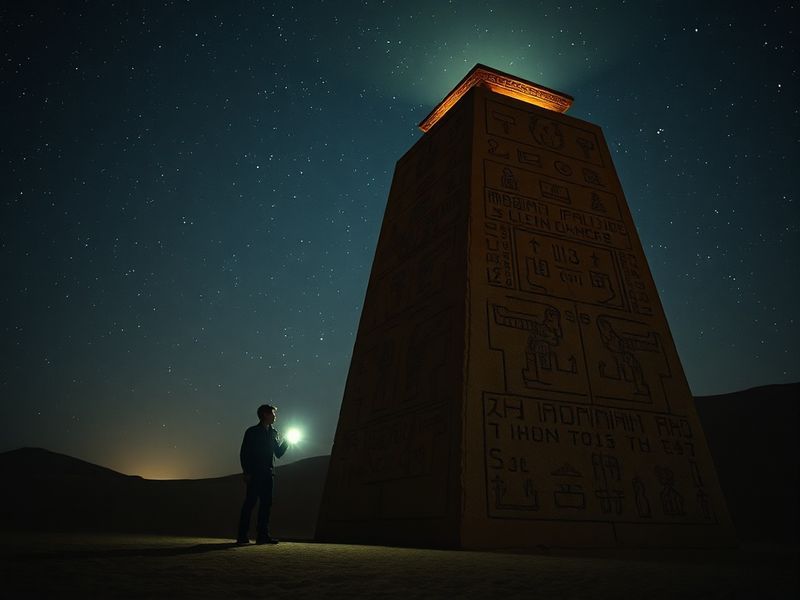
Did Aliens Visit Earth in Ancient Times? The Truth Behind the Theory
“`html
The Ancient Aliens Hypothesis: Myth, History, or Hidden Truth?
The idea that extraterrestrial beings visited Earth in ancient times has captivated imaginations for decades. Popularized by television shows and speculative documentaries, the ancient aliens hypothesis suggests that advanced civilizations from other planets interacted with early humans, leaving behind artifacts, knowledge, and even genetic imprints. While mainstream science dismisses many claims as pseudoscience, the theory persists in alternative circles, blending history, archaeology, and cosmic speculation.
What fuels this enduring fascination? Partly, it’s the mystery of unexplained ancient structures. Sites like the pyramids of Giza, Stonehenge, and the Nazca Lines defy conventional understanding of ancient engineering. Their precision and scale seem to suggest technologies beyond the capabilities of their supposed builders. Could these monuments be evidence of lost human ingenuity—or something more?
Another layer of the debate involves ancient texts and oral traditions. Cultures across the globe, from the Sumerians to the Maya, describe encounters with celestial beings. The Mahabharata, an ancient Indian epic, references flying machines called Vimanas. The Bible’s Book of Ezekiel features a vivid account of a “wheel within a wheel” in the sky, often interpreted as a spacecraft. Are these merely metaphors, or do they hint at forgotten truths?
The Evidence: What Proponents Point To
Advocates of the ancient aliens theory compile a variety of artifacts, texts, and geological anomalies to support their claims. Some of the most frequently cited examples include:
- Ancient Astronauts in Art and Iconography: Petroglyphs, cave paintings, and carvings worldwide depict humanoid figures with helmets, sometimes surrounded by celestial objects. The 1961 discovery of the Palpa Lines in Peru, massive geoglyphs that resemble astronauts, adds to the intrigue.
- Out-of-Place Artifacts: Objects like the Antikythera Mechanism, an ancient Greek “computer” used to predict astronomical events, challenge assumptions about ancient technological limits. Similarly, the Baghdad Battery raises questions about early electrical experiments.
- Megalithic Structures: The precision of structures like the Great Pyramid or the Puma Punku ruins in Bolivia—featuring precisely cut stones with interlocking joints—has led some to speculate about advanced construction methods, possibly involving non-human assistance.
- Ancient Texts and Myths: The Popol Vuh, the sacred book of the Maya, describes the creation of humans by gods who descended from the sky. The Epic of Gilgamesh mentions a “sky boat” used by the gods. These narratives often align with descriptions of extraterrestrial visitation.
Yet, for every piece of evidence, skeptics offer counterarguments. The Antikythera Mechanism, for example, can be explained within the context of Hellenistic science. The precision of megalithic structures, while impressive, may stem from incremental innovation rather than alien intervention. Critics argue that ancient texts are allegorical, using celestial imagery to convey moral or theological ideas rather than literal events.
Skepticism and Scientific Perspective
Mainstream archaeologists and historians overwhelmingly reject the ancient aliens hypothesis as a fringe theory lacking empirical support. The scientific community emphasizes that extraordinary claims require extraordinary evidence—and so far, none has been found. The burden of proof lies with those who propose that aliens visited Earth millennia ago.
Dr. Kenneth Feder, professor of archaeology at Central Connecticut State University, argues that the ancient aliens narrative often stems from a misunderstanding of human capabilities. “Ancient people were incredibly innovative,” he notes. “They built structures that have endured for thousands of years using only the tools and knowledge available to them.” He points to examples like the Roman aqueducts or the Inca road system as evidence of human ingenuity without the need for extraterrestrial explanations.
Another challenge to the hypothesis is the lack of physical proof. If advanced beings visited Earth, one would expect to find more than just suggestive art or enigmatic structures. Where are the tools, the machinery, or even the biological traces? The absence of such evidence is a significant hurdle for the theory’s credibility.
Skeptics also highlight the cultural bias in interpreting ancient texts. Modern minds, steeped in science fiction, may project contemporary ideas onto ancient narratives. What was once a myth or a metaphorical story becomes, in the hands of enthusiasts, a literal account of alien contact.
The Broader Implications: Why the Theory Endures
Despite the skepticism, the ancient aliens hypothesis persists because it speaks to deeper human concerns and aspirations. It challenges the notion that humanity is alone in the universe and suggests that we may have cosmic neighbors who played a role in our past. This idea resonates in an era where space exploration and the search for extraterrestrial life dominate scientific discourse.
The theory also reflects a broader cultural fascination with the unknown. In an age of instant information and digital connectivity, mysteries like the origin of the pyramids or the purpose of the Nazca Lines tap into a primal curiosity. They invite us to question the limits of our knowledge and imagine possibilities beyond the accepted narrative.
Moreover, the ancient aliens hypothesis intersects with other fringe theories, such as the idea of lost civilizations or advanced prehistoric cultures. This blending of ideas creates a rich tapestry of speculation that appeals to those who feel constrained by mainstream history. For some, it’s not just about aliens—it’s about rewriting history itself.
There’s also a psychological dimension. The concept of ancient astronauts offers a sense of connection to something greater than ourselves. It suggests that we are not the first intelligent beings to inhabit Earth, and perhaps not the last. This idea can be comforting in a world often marked by division and uncertainty.
Conclusion: Myth, Metaphor, or Missing Truth?
The ancient aliens hypothesis remains a compelling but unproven theory. While it offers a tantalizing narrative that blends history, archaeology, and cosmic speculation, it lacks the rigorous evidence required to be taken seriously by the scientific community. Yet, its endurance speaks to humanity’s enduring fascination with the unknown and our desire to find meaning in the mysteries of the past.
Perhaps the truth lies somewhere in between. Ancient humans may have possessed knowledge and skills that seem almost otherworldly to us today. Or maybe, just maybe, they did encounter beings from beyond the stars. Until definitive proof emerges, the debate will continue—fueled by curiosity, skepticism, and the eternal human quest for answers.
For now, the ancient aliens hypothesis remains a fascinating thought experiment, a blend of myth, history, and speculation that challenges us to look at the past—and the future—with fresh eyes.
Explore more about ancient mysteries and fringe theories by visiting our Analysis and Science categories on Dave’s Locker.