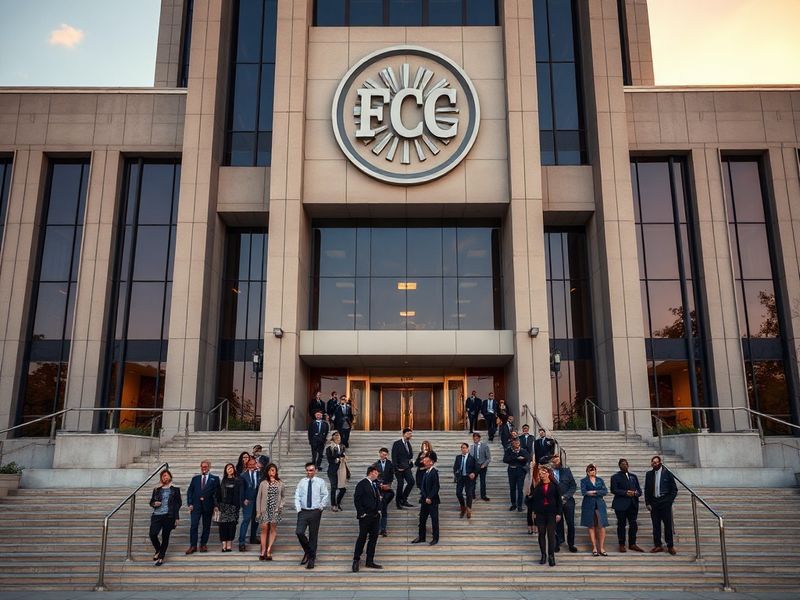
Understanding the FCC: Its Role, Challenges, and Global Impact
“`html
The Origins and Evolution of the FCC
The Federal Communications Commission (FCC) stands as one of the United States’ most influential regulatory bodies, shaping the nation’s media and communications landscape since its inception in 1934. Born from the Communications Act of 1934, the FCC replaced the earlier Federal Radio Commission, expanding its mandate to oversee not just radio but all interstate and international communications via wire, satellite, cable, and television.
Its creation was driven by the rapid expansion of broadcast technology in the early 20th century. As radio waves became crowded and interference grew rampant, Congress recognized the need for centralized oversight. The FCC’s early years were marked by a focus on spectrum allocation, ensuring that broadcasters could operate without disrupting one another. This was particularly crucial as television emerged as a dominant medium in the mid-20th century, demanding even stricter regulations to manage limited airwaves.
Over time, the FCC’s role evolved beyond mere technical management. It became a guardian of public interest, tasked with preventing monopolies, promoting competition, and ensuring universal access to communication services. The 1996 Telecommunications Act was a watershed moment, modernizing the FCC’s authority to include the internet and digital technologies—a shift that would redefine its responsibilities in the 21st century.
Core Functions: What the FCC Actually Does
The FCC’s responsibilities are vast and often misunderstood. At its core, the agency enforces laws that govern how communication services operate, ensuring they serve the public good. Its authority spans several critical areas:
- Broadcast Regulation: The FCC licenses and regulates radio and television stations, enforcing rules on content, ownership, and decency. While it does not censor content directly, it penalizes broadcasters for violations of federal standards.
- Wireless Communications: The FCC manages the electromagnetic spectrum, auctioning bandwidth to mobile carriers, broadcasters, and other users. This includes overseeing 5G deployment, which has become a geopolitical battleground in recent years.
- Internet and Broadband: Under Title II of the Communications Act, the FCC regulates internet service providers (ISPs), ensuring net neutrality principles—though this authority has shifted with changing administrations.
- Universal Service: The FCC administers programs like the Universal Service Fund, which subsidizes broadband access in rural and underserved areas, aiming to bridge the digital divide.
- Consumer Protection: It enforces rules against fraudulent practices, such as cramming (unauthorized charges on phone bills) and slamming (switching a consumer’s phone service without consent).
The FCC’s reach extends globally as well. It collaborates with international bodies like the International Telecommunication Union (ITU) to coordinate satellite orbits, undersea cables, and cross-border communications. This global perspective is essential in an era where digital connectivity transcends national borders.
The FCC in the Digital Age: Challenges and Controversies
The digital revolution has thrust the FCC into uncharted territory. The rise of streaming services, social media, and the internet of things (IoT) has blurred the lines between traditional broadcast media and digital platforms. This has sparked intense debates over the FCC’s role in regulating online content, protecting privacy, and fostering innovation.
One of the most contentious issues is net neutrality. The principle, which bars ISPs from throttling or prioritizing certain online traffic, has been a flashpoint in U.S. politics. Under the Obama administration, the FCC classified broadband as a Title II service, enshrining net neutrality protections. The Trump administration reversed this, reclassifying broadband as a Title I information service, effectively deregulating it. The Biden administration has since pushed to restore stronger rules, reflecting the partisan divide over internet governance.
Another challenge is the FCC’s struggle to keep pace with technological change. The shift from 4G to 5G networks requires not just spectrum allocation but also infrastructure upgrades, including small cell towers and fiber-optic cables. Local governments and telecom giants often clash over permitting and zoning, while the FCC seeks to streamline regulations to accelerate deployment.
The agency also grapples with the rise of misinformation and hate speech online. While the FCC does not regulate social media platforms directly, its decisions on broadcast licenses and indecency standards indirectly influence how digital content is treated. For example, the FCC’s repeal of the fairness doctrine in 1987—long before the internet era—has been cited as a precursor to today’s polarized media landscape.
Global Comparisons: How Other Countries Regulate Communications
The FCC’s model is uniquely American, but it shares similarities—and differences—with regulatory bodies worldwide. A comparison with other nations reveals how cultural priorities shape communication policies.
- United Kingdom: Ofcom
Ofcom, the UK’s communications regulator, operates with a broader remit than the FCC, overseeing television, radio, telecommunications, and postal services. Unlike the FCC, Ofcom has explicit powers to enforce content standards, including fines for breaches of broadcasting codes. Its approach is more centralized, reflecting the UK’s smaller geographic size and stronger tradition of public service broadcasting. - Germany: Bundesnetzagentur
Germany’s Federal Network Agency (Bundesnetzagentur) focuses on competition and infrastructure, particularly in energy and telecommunications. Its approach to net neutrality is stricter than the FCC’s, with rules that prohibit zero-rating (the practice of exempting certain apps or services from data caps). This reflects Germany’s emphasis on consumer protection and digital sovereignty. - China: Ministry of Industry and Information Technology (MIIT)
China’s MIIT wields immense power, controlling not just telecommunications but also the internet’s backbone. Unlike the FCC, MIIT enforces strict censorship through the “Great Firewall,” blocking foreign platforms like Google and Facebook. This centralized control contrasts sharply with the FCC’s decentralized, market-driven model. - Japan: Ministry of Internal Affairs and Communications (MIC)
Japan’s MIC balances innovation with social harmony. It has pioneered regulations for 5G and IoT, while also promoting “Society 5.0,” a vision of a human-centric digital society. The MIC’s approach is collaborative, involving industry stakeholders in policymaking—a stark contrast to the FCC’s sometimes adversarial relationship with tech giants.
These comparisons highlight a fundamental divide: some countries prioritize market competition, while others emphasize state control or social cohesion. The FCC’s challenge is to navigate these global trends while addressing domestic pressures, from rural broadband access to the influence of Big Tech.
Looking Ahead: The FCC’s Role in Shaping the Future
The FCC’s decisions today will reverberate for decades. As artificial intelligence, virtual reality, and quantum computing emerge, the agency must adapt its regulatory framework to ensure these technologies serve the public interest. Key priorities include:
- Closing the Digital Divide: Expanding broadband access remains a critical goal, particularly in rural and low-income communities. The FCC’s Affordable Connectivity Program, which provides subsidies for internet service, is a step in this direction, but funding and political will remain hurdles.
- Cybersecurity and Privacy: With data breaches and online scams proliferating, the FCC is increasingly focused on protecting consumers. It has proposed rules to require ISPs to report breaches and strengthen consumer privacy protections—a response to growing public concern over digital surveillance.
- Emerging Technologies: The FCC is exploring how to regulate satellite internet services like SpaceX’s Starlink and Amazon’s Project Kuiper. These ventures promise global connectivity but also raise questions about spectrum management and competition.
The FCC’s work is far from glamorous, but its impact is undeniable. From ensuring that children’s television programs meet educational standards to preventing monopolies in the broadband industry, the agency shapes how Americans—and, by extension, global citizens—experience the digital world. Its ability to balance innovation with regulation will determine whether the future of communication is one of opportunity or inequality.
As technology continues to evolve, so too will the FCC’s role. Whether through the rollout of 6G networks, the regulation of AI-generated content, or the oversight of next-generation wireless devices, the agency will remain at the heart of the conversation about how we connect, communicate, and consume information in the 21st century.