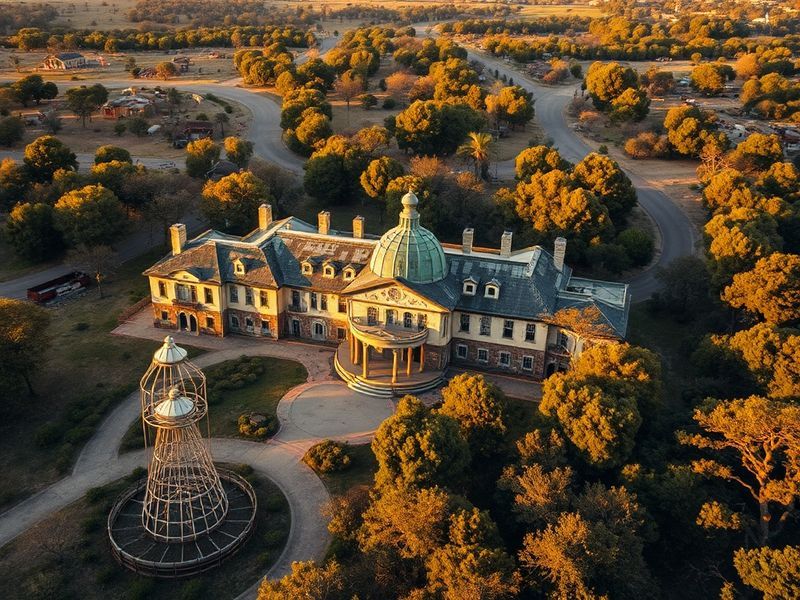
Nestled in the rolling hills of Santa Ynez Valley, California, Neverland Ranch was more than just a property—it was a physical manifestation of Michael Jackson’s imagination, ambition, and contradictions. Purchased in 1988 for $19.5 million, the 2,700-acre estate became synonymous with the King of Pop’s lavish lifestyle and his penchant for creating a world that mirrored his music videos.
The ranch, named after the fictional island in Peter Pan where children never grow up, embodied Jackson’s desire to preserve innocence and joy. It featured a private zoo, amusement park rides, a movie theater, and a four-story, 5,000-square-foot mansion. For Jackson, Neverland was both a retreat and a playground, a place where he could escape the relentless scrutiny of fame while indulging his love for fantasy and entertainment.
The Rise and Fall of a Pop Icon’s Retreat
Neverland Ranch’s early years were marked by opulence and excess. Jackson transformed the property into a self-contained universe, complete with a Ferris wheel, a carousel, and a menagerie of animals, including llamas, elephants, and tigers. The ranch hosted children’s parties, complete with carnival games and treats, reflecting Jackson’s commitment to making others happy—a trait that would later become central to his public image.
However, the estate’s legacy is as complex as the man who created it. By the late 1990s and early 2000s, Neverland became entangled in the controversies that plagued Jackson’s life. The ranch was a focal point during his 2005 trial on child molestation charges, where prosecutors scrutinized his relationships with young boys who visited the property. Though Jackson was acquitted, the allegations cast a long shadow over Neverland, transforming it from a symbol of joy into one of controversy.
The financial strain of Jackson’s legal battles and his declining health further complicated the ranch’s fate. In 2008, Jackson defaulted on a $24 million loan secured by Neverland, leading to its foreclosure. The property changed hands multiple times in the years that followed, with investors and developers eyeing its potential for redevelopment. Yet, despite its tumultuous history, Neverland remained a cultural touchstone, a testament to Jackson’s larger-than-life persona.
Key Moments in Neverland Ranch’s History
- 1988: Michael Jackson purchases the 2,700-acre property for $19.5 million.
- 1990s: Neverland is transformed into a private amusement park, complete with rides, a zoo, and a mansion.
- 2003-2005: The ranch becomes a focal point during Jackson’s child molestation trial.
- 2008: Jackson defaults on a $24 million loan, leading to the foreclosure of Neverland.
- 2015: The property sells for $22 million to billionaire Ron Burkle, who plans to redevelop it.
- 2017: Jackson’s estate retains control of Neverland, and the property is sold to a private investment group.
- 2019: The mansion is demolished, marking the end of an era for Neverland Ranch.
The Cultural and Symbolic Significance of Neverland
Neverland Ranch was more than just a home—it was a cultural artifact, a physical representation of Jackson’s artistry and his struggle to reconcile fame with privacy. The ranch’s design and purpose reflected Jackson’s obsession with childhood, escapism, and control. It was a place where he could curate an idealized version of the world, free from the constraints of reality. This duality—Jackson’s desire to both preserve and exploit innocence—became a defining theme in his life and career.
The ranch also highlighted the paradoxes of Jackson’s public persona. He was a global superstar who craved solitude, a humanitarian who faced accusations of impropriety, and a visionary who struggled with personal demons. Neverland encapsulated these contradictions, serving as both a sanctuary and a stage. It was where Jackson hosted celebrities, friends, and family, yet it also became a symbol of the isolation that often accompanies fame.
After Jackson’s death in 2009, Neverland’s significance evolved. It became a pilgrimage site for fans, a place where admirers could pay tribute to the artist’s legacy. The property’s eventual demolition in 2019 marked the end of an era, but it also underscored the impermanence of material symbols in the face of cultural memory. Jackson’s legacy, after all, was never confined to the walls of Neverland—it lived on in his music, his influence, and the emotions he evoked in millions around the world.
What’s Next for the Neverland Legacy?
Today, the site of Neverland Ranch is a quiet reminder of its storied past. While the mansion is gone, the land retains traces of its former glory. Developers have proposed various plans for the property, including a luxury resort or a museum dedicated to Jackson’s life and career. However, any redevelopment faces challenges, from zoning restrictions to the emotional weight of Jackson’s legacy.
The story of Neverland Ranch is ultimately a reflection of Michael Jackson’s life—grand, flawed, and deeply human. It was a place where dreams and nightmares coexisted, where joy and controversy often intersected. As the world continues to grapple with Jackson’s complicated legacy, Neverland remains a potent symbol of the dualities that defined his existence.
For fans and historians alike, the ranch’s story is a reminder that legacies are not static. They evolve with time, shaped by memory, interpretation, and the passage of years. Neverland Ranch may be gone, but its place in pop culture history is assured.
To explore more about the intersection of music and culture, visit Dave’s Locker Entertainment or dive into Culture for deeper analysis on how icons like Jackson shape our world.
Final Thoughts
Neverland Ranch was more than a home—it was a narrative, a cautionary tale, and a testament to the power of imagination. Michael Jackson’s vision for the property was ambitious, flawed, and deeply personal. While the physical estate may be gone, its legacy endures in the music, the memories, and the conversations it continues to inspire. As we reflect on Jackson’s life and career, Neverland serves as a poignant reminder of the complexities that lie beneath the surface of stardom.