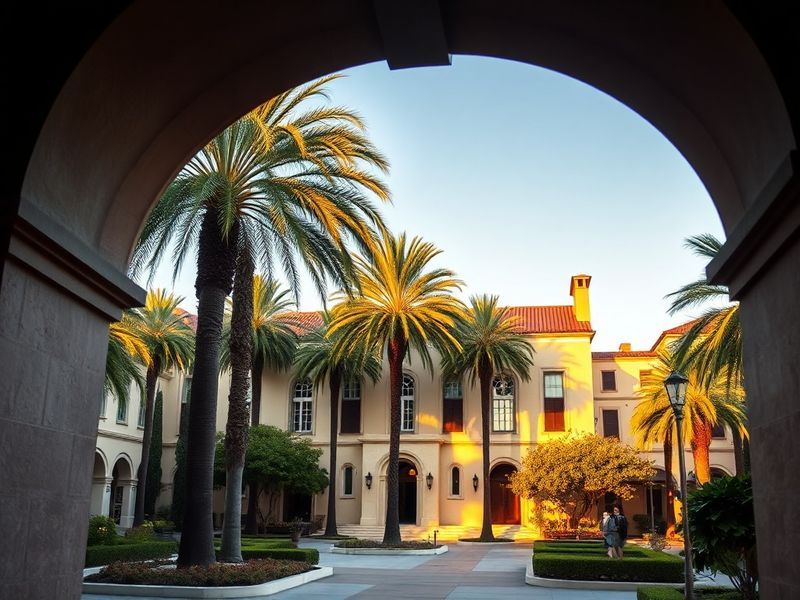
Nestled in Pasadena, California, the California Institute of Technology—commonly known as Caltech—has long stood as a beacon of scientific innovation and academic excellence. Since its founding in 1891, the institution has cultivated an environment where curiosity meets rigor, producing some of the most influential minds in science, engineering, and technology. With a student body of just over 2,000, Caltech punches far above its weight, frequently topping global rankings for research impact and academic quality.
Its compact size belies its outsized contributions to fields ranging from quantum physics to space exploration. Caltech’s Jet Propulsion Laboratory (JPL), a federally funded research and development center, has become synonymous with NASA missions, including the Mars rovers and Voyager probes. This symbiotic relationship between academia and cutting-edge research has cemented Caltech’s reputation as a place where ideas don’t just take flight—they redefine the boundaries of what’s possible.
An Unwavering Commitment to Discovery
At the heart of Caltech’s mission is an unrelenting pursuit of discovery. The institute operates on the principle that fundamental research—even when its immediate applications aren’t clear—can lead to transformative breakthroughs. This philosophy is evident in its interdisciplinary approach, where physicists, biologists, and engineers collaborate to tackle some of science’s most complex challenges.
Caltech’s Division of Physics, Mathematics, and Astronomy, for example, has been instrumental in advancing our understanding of gravitational waves, dark matter, and the origins of the universe. Faculty members and alumni have won over 40 Nobel Prizes, underscoring the institute’s role as a powerhouse of scientific achievement. Even in less high-profile fields, such as geology or chemistry, Caltech researchers consistently publish groundbreaking work that reshapes academic and industrial landscapes.
The undergraduate experience at Caltech is designed to mirror this culture of inquiry. Students are not just passive learners; they are active participants in research from their first year. The institute’s Summer Undergraduate Research Fellowships (SURF) program places undergraduates in labs across campus, where they work alongside faculty on projects that often lead to published papers. This hands-on approach ensures that Caltech graduates are not only well-versed in theory but also skilled in the practical application of scientific methods.
A Culture of Collaboration and Intensity
Caltech’s small size fosters an unusually tight-knit community where collaboration is the norm. Unlike larger universities where departments operate in silos, Caltech encourages cross-disciplinary partnerships. The Tianqiao and Chrissy Chen Institute for Neuroscience, for instance, brings together neuroscientists, engineers, and computer scientists to explore the mysteries of the brain. Similarly, the Resnick Sustainability Institute focuses on clean energy solutions, merging chemistry, physics, and policy to address global challenges.
This collaborative spirit extends to the student body. Housing is guaranteed for all four years, and dormitories are designed to encourage interaction. The house system, a Caltech tradition, assigns students to one of eight residential houses, each with its own culture and traditions. These houses serve as social hubs, academic support networks, and venues for intellectual debate. The result is a community where students form lifelong bonds and where the lines between academic and social life often blur in pursuit of shared goals.
Yet, this closeness comes with a trade-off: the academic workload is notoriously demanding. Caltech’s “learn by doing” ethos means that students are expected to dedicate significant time to their studies and research. The institute’s notoriously rigorous core curriculum, which includes advanced mathematics, physics, and chemistry, is designed to push students to their limits. For many, the experience is as rewarding as it is challenging, fostering resilience and a deep appreciation for the scientific process.
Beyond the Lab: Caltech’s Impact on Industry and Society
Caltech’s influence extends far beyond the confines of its campus. The institute has played a pivotal role in shaping entire industries, from aerospace to biotechnology. A prime example is the work of alumni and faculty in the development of the silicon chip, which revolutionized computing. Companies like Intel and NVIDIA were co-founded by Caltech graduates, and the institute continues to be a pipeline for tech innovation. Its entrepreneurship ecosystem, supported by programs like the Caltech Office of Technology Transfer, helps turn academic research into marketable solutions.
In the realm of sustainability, Caltech’s research has led to advancements in solar energy, carbon capture, and water purification. The institute’s scientists have pioneered new materials for solar panels that are more efficient and affordable, while its engineers have developed technologies to monitor and mitigate climate change. These contributions are not merely academic; they are actively deployed in real-world settings, demonstrating Caltech’s commitment to addressing global challenges.
Caltech also plays a critical role in shaping public policy. Faculty members frequently advise government agencies, including NASA, the National Science Foundation, and the Department of Energy, on matters ranging from space exploration to energy policy. The institute’s proximity to Silicon Beach and the broader tech ecosystem in Southern California further amplifies its influence, providing a bridge between cutting-edge research and commercial application.
Life at Caltech: More Than Just a Degree
While Caltech is renowned for its academic rigor, life on campus is far from one-dimensional. The institute’s location in Pasadena offers a vibrant cultural scene, with access to museums, music venues, and outdoor activities in the nearby San Gabriel Mountains. Students often balance their studies with hobbies like rock climbing, robotics competitions, or even composing music.
The Caltech Y, a student-run organization, offers over 100 clubs and organizations, from the Robotics Team to the Caltech Shakespeare Company. These groups provide opportunities for students to explore interests outside their majors, fostering a well-rounded educational experience. The institute also hosts numerous public lectures and events, bringing in speakers from fields as diverse as astrophysics and philosophy, ensuring that intellectual curiosity isn’t confined to the lab.
For those interested in pursuing advanced studies, Caltech’s graduate programs are equally prestigious. The institute is home to some of the most competitive PhD programs in the world, particularly in physics, chemistry, and engineering. Graduate students benefit from close mentorship by faculty members who are leaders in their fields, as well as access to state-of-the-art facilities, such as the Caltech Center for Inclusion and Diversity and the Kavli Nanoscience Institute.
Key Takeaways for Prospective Students
- Research Opportunities: Undergraduates can participate in groundbreaking research early in their academic careers, often leading to published work.
- Interdisciplinary Collaboration: Caltech encourages partnerships across departments, providing a holistic approach to problem-solving.
- Entrepreneurship: The institute’s strong ties to industry and venture capital make it an ideal place to turn ideas into startups.
- Community: Despite its intensity, Caltech fosters a supportive and collaborative environment where students form lasting bonds.
Caltech vs. Other Elite Institutions
While Caltech shares similarities with other top-tier institutions like MIT or Stanford, it distinguishes itself through its singular focus on science and engineering. Unlike larger universities, Caltech’s small size allows for greater personal attention and mentorship. Its location in Pasadena also provides a more relaxed, suburban setting compared to the urban environments of schools like Columbia or NYU. However, this comes with fewer distractions from industry, as Silicon Valley’s tech giants are a short drive away.
Another key difference is Caltech’s emphasis on undergraduate research. While many elite schools prioritize graduate-level work, Caltech ensures that even freshmen have opportunities to contribute to high-level research. This early exposure to the scientific process is a defining feature of a Caltech education.
Looking Ahead: The Future of Caltech
As Caltech approaches its 140th anniversary, the institute shows no signs of slowing down. Its strategic plan for the coming decade emphasizes three core areas: sustainability, quantum science, and biological engineering. These fields are poised to shape the next century of scientific discovery, and Caltech is positioning itself at the forefront.
The institute’s recent investments in quantum computing, for example, reflect its commitment to staying ahead of technological trends. The new Center for Quantum Science and Engineering will bring together physicists, computer scientists, and engineers to develop quantum technologies that could revolutionize industries from cryptography to drug discovery. Similarly, the Resnick Sustainability Institute’s expansion into new research areas, such as artificial photosynthesis, underscores Caltech’s role in addressing climate change.
Caltech’s future also hinges on its ability to attract and retain top talent. The institute has launched initiatives to increase diversity among its faculty and student body, recognizing that a broader range of perspectives is essential for tackling global challenges. Programs like the Caltech Equity and Title IX Office work to create an inclusive environment where all individuals can thrive.
For alumni, Caltech remains a lifelong connection. The institute’s strong network of supporters ensures that graduates have access to mentorship, funding, and collaboration opportunities throughout their careers. Whether through the Caltech Alumni Association or the institute’s annual entrepreneurship competitions, the Caltech community continues to support innovation long after students leave campus.
Why Caltech Stands Out
In a world where universities are often judged by their size or endowment, Caltech’s success is a testament to the power of focus and excellence. Its ability to produce groundbreaking research, foster interdisciplinary collaboration, and cultivate the next generation of scientific leaders sets it apart. For those who are drawn to the pursuit of knowledge and the thrill of discovery, Caltech offers an unparalleled environment.
The institute’s motto, “The truth shall make you free,” encapsulates its mission. At Caltech, freedom isn’t just a philosophical ideal; it’s a practical reality. Students and faculty are encouraged to question, explore, and innovate without the constraints of convention. This culture of intellectual freedom is what has allowed Caltech to remain at the cutting edge of science for over a century—and it’s what will drive its future success.