How Weather Forecasting Went from Ancient Omens to AI Precision
“`html
Weather Forecasting: From Ancient Omens to AI Predictions
The sky has always been a canvas for human curiosity. Long before satellites and supercomputers, ancient civilizations read clouds, winds, and animal behavior to predict tomorrow’s weather. Today, forecasting blends centuries-old observations with cutting-edge technology, transforming how we prepare for everything from sunny afternoons to life-threatening storms. Understanding this evolution offers more than just practical insights—it reveals how deeply weather shapes economies, cultures, and daily decisions.
The stakes have never been higher. Extreme weather events cost the U.S. alone over $150 billion annually, while accurate forecasts save lives and billions in agricultural losses. Yet even with advanced tools, challenges persist—from the unpredictability of climate change to the limits of long-range models. This is the story of how weather forecasting grew from folklore to a science that now underpins global infrastructure.
The Evolution of Forecasting: Tools That Changed the Game
The shift from superstition to science began in earnest in the 17th century. Galileo’s thermometer and Torricelli’s barometer laid the groundwork for measuring atmospheric pressure and temperature. By the 19th century, the telegraph enabled real-time data sharing, giving birth to the first national weather services. The 20th century brought radar and satellites, turning forecasting from educated guesses into a data-driven discipline.
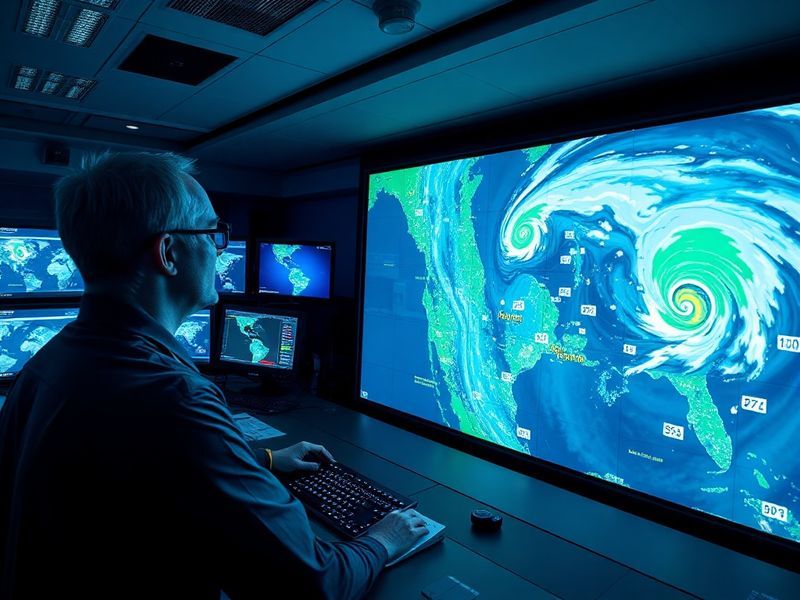
Today’s tools are staggering in their precision. Geostationary satellites like NOAA’s GOES-16 scan the Earth every 30 seconds, while numerical weather prediction models divide the atmosphere into grids smaller than a city block. The European Centre for Medium-Range Weather Forecasts (ECMWF) runs simulations on some of the world’s most powerful supercomputers, crunching trillions of data points to project conditions up to 15 days ahead.
Yet even these advancements have limits. Chaos theory reminds us that tiny errors in initial data—like a misplaced wind measurement—can spiral into wildly different outcomes over time. This “butterfly effect” is why forecasts beyond 10 days often rely on statistical trends rather than deterministic models.
Key Milestones in Weather Forecasting History
- 1849: The Smithsonian Institution begins collecting weather data via telegraph, creating the first national network.
- 1922: Lewis Fry Richardson publishes a paper outlining numerical weather prediction, though manual calculations make it impractical at the time.
- 1950: The first computer-generated forecast runs on ENIAC, marking the dawn of modern meteorology.
- 1960: TIROS-1, the first weather satellite, launches, revolutionizing global observation.
- 2023: AI models like Google’s GraphCast reduce forecast errors by up to 50% for certain variables.
AI and the Future: Can Machines Outsmart the Sky?
Artificial intelligence is reshaping forecasting in ways unimaginable a decade ago. Traditional models like the Global Forecast System (GFS) and ECMWF rely on physics-based equations, but AI thrives on pattern recognition. By training on decades of historical weather data, neural networks can now predict localized events—such as afternoon thunderstorms—with remarkable accuracy.
Companies like DeepMind and NVIDIA are pushing boundaries further. Their AI systems analyze satellite imagery in real time, identifying developing storms before radar picks them up. In 2023, DeepMind’s GraphCast outperformed ECMWF’s high-resolution model in predicting extreme weather events up to 10 days in advance—for certain regions.
But AI isn’t a silver bullet. It struggles with rare or unprecedented events, like the 2021 Pacific Northwest heat dome, which defied historical precedents. Skeptics argue that AI’s strength—pattern recognition—can also reinforce biases if trained on flawed data. The future likely lies in hybrid models, combining AI’s speed with physics-based simulations for the most reliable forecasts.
Beyond the Forecast: Why Accuracy Matters
Weather forecasting isn’t just about knowing whether to carry an umbrella. It’s a cornerstone of economic stability and public safety. Farmers rely on seasonal outlooks to decide planting schedules; airlines adjust flight paths to avoid turbulence; energy companies forecast demand to balance power grids. In 2022, the U.S. Department of Energy estimated that improved forecasts could save the power sector $3 billion annually by optimizing renewable energy integration.
The stakes are even higher in vulnerable regions. Small island nations, for instance, depend on cyclone predictions to evacuate communities and protect infrastructure. Yet many lack access to high-resolution models, highlighting a global disparity in forecasting resources. Initiatives like the World Meteorological Organization’s Global Basic Observing Network aim to bridge this gap, ensuring even developing nations benefit from life-saving data.
Climate change is complicating this equation. Warmer air holds more moisture, intensifying rainfall and flooding. Warmer oceans fuel stronger hurricanes. Traditional forecasting methods, calibrated on historical data, may struggle to adapt. This is where AI’s adaptability becomes critical—training models on projected future climates rather than past patterns.
How Forecasting Impacts Daily Life
- Health: Heat advisories reduce hospitalizations during extreme temperatures; pollen forecasts help allergy sufferers manage symptoms.
- Transportation: Airlines save fuel by avoiding turbulent routes; shipping companies reroute cargo ships to dodge storms.
- Retail: Stores stock up on ice melt or sunscreen based on seasonal outlooks, reducing waste and lost sales.
- Insurance: Accurate flood predictions allow insurers to price policies fairly and avoid massive payouts after disasters.
Challenges and Ethical Considerations
Despite its advancements, weather forecasting faces persistent challenges. Data gaps persist in remote areas, from the Sahara to the South Pacific, where ground stations are sparse. Even in data-rich regions, model biases can skew results. For example, ECMWF tends to underestimate winter storm intensity in the northeastern U.S., while GFS often overestimates precipitation in the Midwest.
Ethical dilemmas also arise. Should forecasts prioritize accuracy over speed? How do we communicate uncertainty to the public without causing panic or complacency? The rise of AI introduces new questions: Who owns the data used to train models? Could proprietary algorithms create monopolies in weather intelligence?
Public trust remains fragile. A 2022 study found that 63% of Americans check weather apps daily, yet fewer than half believe forecasts beyond three days. This skepticism stems from past failures—like the 2013 Boston snowstorm that was underpredicted, or the 2021 European heatwave that caught officials off guard. Bridging this gap requires transparency, education, and perhaps most importantly, humility in acknowledging forecasting’s inherent uncertainties.
For now, the best forecasts combine the best of old and new: the rigor of physics-based models, the adaptability of AI, and the wisdom of experienced meteorologists who interpret nuanced data. The goal isn’t perfection—it’s progress. Each improvement, no matter how small, translates into lives saved, resources preserved, and communities better prepared for whatever the sky delivers next.
As climate change accelerates, the need for reliable forecasting will only grow. The tools we use today—satellites, supercomputers, AI—are just the beginning. The next frontier may lie in quantum computing or even crowdsourced data from smartphones. One thing is certain: the sky will continue to command our attention, and our ability to understand it will define how well we weather the storms ahead.
For those interested in the intersection of science and technology behind these advancements, explore our Technology and Science sections for deeper analysis and updates on breakthroughs driving modern meteorology.