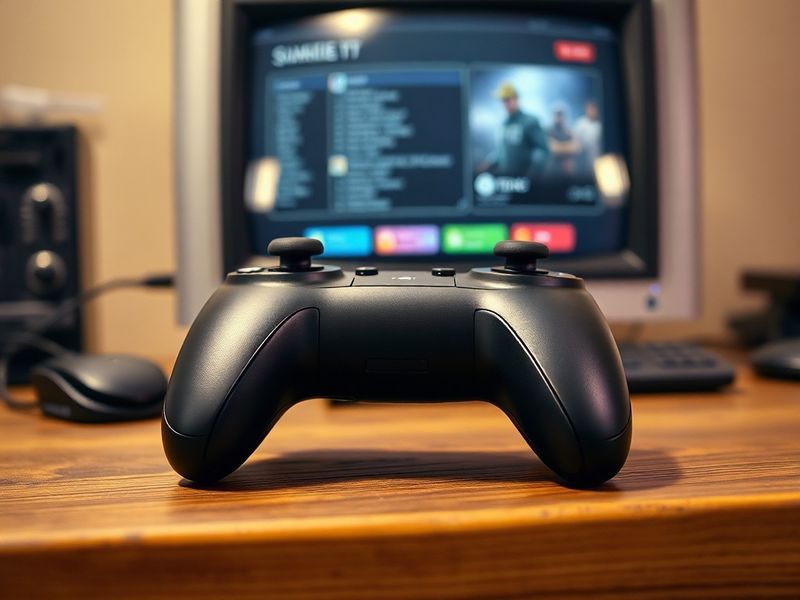
Steam Controller: The Rise and Fall of Valve’s Gaming Experiment
“`html
Steam Controller: Valve’s Ambitious but Short-Lived Gaming Innovation
Released in 2015 as part of Valve’s push to redefine PC gaming, the Steam Controller was a bold experiment in input devices. Designed to bridge the gap between console-style precision and PC flexibility, it promised a new way to play. Yet despite its innovative features, the controller failed to achieve lasting success. This is the story of its rise, its unique technology, and the reasons behind its ultimate discontinuation.
The Vision Behind Valve’s Unconventional Controller
Valve’s decision to create the Steam Controller stemmed from a clear frustration: traditional controllers were ill-suited for many PC games. While keyboard and mouse offered precision, they lacked the tactile feedback and ergonomics of a controller. Mouse and keyboard also struggled to translate well to certain genres, particularly those designed with console players in mind.
The Steam Controller aimed to solve this by offering high-precision trackpads that mimicked mouse movement with adjustable sensitivity. Unlike traditional analog sticks, these trackpads allowed for pixel-perfect cursor control, making them ideal for strategy games, shooters, and even emulation. Valve marketed the device as a way to “play your entire Steam library the way you want,” emphasizing versatility over genre limitations.
Another key feature was its customizable layout. Players could remap buttons, adjust dead zones, and even create multiple profiles for different games. This level of personalization was unprecedented in gaming hardware at the time. Valve also emphasized its open nature, encouraging modding and community-driven improvements through software updates.
A Closer Look at the Hardware and Software
The Steam Controller’s design was unconventional from the start. Instead of traditional analog sticks, it featured two capacitive touchpads with haptic feedback. These pads could simulate mouse movements or act as dual analog inputs, depending on the game. The left pad was typically used for movement, while the right controlled camera or actions, much like a traditional controller.
The controller also included a back panel with two additional buttons, offering more inputs without requiring awkward finger stretches. Its build quality was solid, with a comfortable grip and responsive triggers. Battery life was a concern for some, as the controller relied on a rechargeable lithium-ion battery that lasted roughly 40 hours per charge.
Software was where the Steam Controller truly shined. The Steam Input system allowed players to fine-tune their experience with extensive calibration tools. Players could adjust trackpad sensitivity, button mapping, and even create custom configurations for specific games. This software evolved over time, adding support for non-Steam games and improving compatibility with a growing library of titles.
Valve also released a companion app called Steam Link, which let users stream games from their PC to another device—including their Steam Controller. This extended the controller’s functionality beyond the living room, allowing for remote play on mobile devices or secondary monitors.
Why the Steam Controller Failed to Gain Traction
Despite its innovative features, the Steam Controller faced several significant challenges. The first was price. Launched at $59.99, it was more expensive than most third-party controllers and even some first-party options. Many gamers were unwilling to pay a premium for a device that promised flexibility but didn’t guarantee better performance in all games.
Another major hurdle was compatibility. While Valve worked hard to improve support, many games—particularly older or indie titles—lacked native controller support. Players often had to rely on community-made configurations, which were inconsistent. Even with Valve’s updates, some games simply didn’t translate well to a controller, leaving users frustrated.
Perhaps the biggest obstacle was simply the dominance of existing options. The Xbox 360 and PlayStation controllers had set a high standard for comfort and responsiveness. While the Steam Controller offered unique advantages, it didn’t feel as natural in the hands as a traditional controller. The haptic feedback, while impressive, took time to get used to and wasn’t universally loved.
Valve also faced competition from other innovative controllers like the Xbox Elite Series 2 and Razer’s Wolverine. These devices offered customization and high-end features without requiring players to relearn their entire setup. The Steam Controller, while ambitious, felt like a niche product in an increasingly crowded market.
The Legacy of the Steam Controller
Though the Steam Controller was discontinued in 2019, its influence persists in modern gaming hardware. Valve’s work on Steam Input and customizable controllers laid the groundwork for future innovations. Today, many third-party controllers incorporate touchpads, paddles, and customizable layouts inspired by Valve’s design philosophy.
The controller’s most enduring contribution may be its software. Steam Input continues to evolve, supporting a wide range of controllers beyond Valve’s own. The open nature of the system has allowed modders and developers to push the boundaries of what’s possible with gamepad input. Even non-Valve controllers now benefit from advanced configurations that were once exclusive to the Steam Controller.
Valve itself has moved on to other projects, including the Steam Deck. While the handheld gaming PC is a different beast entirely, it shares some DNA with the Steam Controller—particularly in its focus on versatility and user customization. The Steam Deck’s success suggests that Valve’s experimentation with input devices wasn’t entirely in vain.
Should You Still Consider a Steam Controller in 2024?
For most gamers, the Steam Controller is no longer a practical choice. Valve stopped selling it years ago, and official support has waned. However, used units are still available at a discount, making them an interesting option for enthusiasts or collectors. If you’re curious about its unique features, picking one up secondhand could be a fun experiment.
Before buying, consider whether you truly need the Steam Controller’s capabilities. If you primarily play games that work well with a traditional controller, an Xbox or PlayStation pad will likely serve you better. But if you’re drawn to its trackpads or customization options, it might still be worth trying—especially if you find a well-preserved used model.
For those interested in similar alternatives, the gaming accessories market offers several high-end controllers with customizable layouts. Brands like Razer, Scuf, and PowerA provide paddles, remappable buttons, and other features that cater to competitive and casual gamers alike. These options may not have the Steam Controller’s trackpads, but they offer a more traditional (and often more affordable) path to customization.