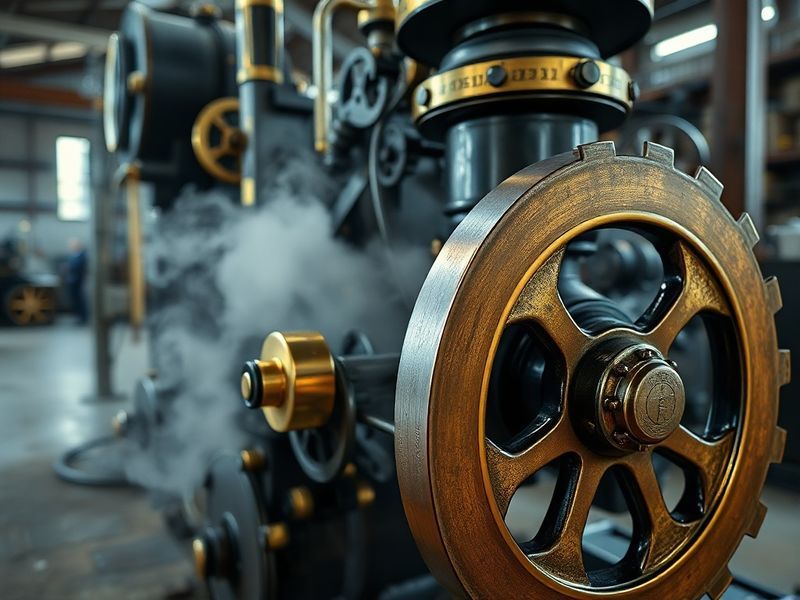
The Engine: Powering Progress Across Cultures and Centuries
The engine is more than a mechanical marvel—it is a symbol of human ingenuity, a force that has reshaped economies, and a silent architect of modern life. From the earliest steam engines that powered the Industrial Revolution to the high-efficiency turbines propelling today’s airliners, engines have been central to progress. Their evolution reflects broader shifts in science, industry, and society, making them a lens through which to view global development.
Across continents, engines have served distinct purposes shaped by geography, resources, and cultural priorities. In Europe, the steam engine became a catalyst for urbanization, while in Japan, compact combustion engines fueled the rise of automotive giants. Meanwhile, in North America, diesel engines revolutionized freight and agriculture. These regional adaptations highlight how a single concept can take on diverse forms, each tailored to local needs and aspirations.
The Birth of Power: How Engines Changed the World
The story of the engine begins in 1712 with Thomas Newcomen’s atmospheric engine, a clumsy but revolutionary device that harnessed steam to pump water from mines. Though inefficient by modern standards, it laid the foundation for James Watt’s 1769 design—an engine that could convert steam pressure into rotary motion. Watt’s innovation didn’t just improve efficiency; it redefined work itself, shifting labor from human and animal power to machine-driven productivity.
By the 19th century, engines powered factories, ships, and railways, enabling the rapid movement of goods and people. The expansion of rail networks in the United States and Europe, for instance, compressed distances and accelerated communication, fostering national unity and economic integration. In India, the introduction of steam locomotives during British colonial rule transformed trade routes, though often at a steep social cost.
These early engines were not merely technological achievements—they were political tools. They enabled empires to project power across vast territories and allowed emerging nations to assert industrial independence. The shift from waterwheels to steam marked the beginning of an era where energy became synonymous with sovereignty.
From Combustion to Conservation: The Engine’s Evolving Role
The 20th century brought explosive growth in engine technology, particularly with the internal combustion engine (ICE). Developed by figures like Nikolaus Otto and Karl Benz, the ICE became the beating heart of automobiles, airplanes, and industrial machinery. Its dominance was unchallenged for decades, but by the late 20th century, concerns about pollution and fossil fuel depletion began to reshape its future.
Today, the engine faces a new set of challenges and opportunities. Electric motors, once niche alternatives, now dominate conversations about sustainability. Countries like Norway and China have rapidly adopted electric vehicles (EVs), driven by both environmental policies and consumer demand. Meanwhile, in regions rich in oil, such as the Middle East, hybrid and hydrogen-powered engines are being explored as transitional technologies.
The transition is not uniform. In Europe, where urban density and stringent emissions laws favor EVs, automakers like Volkswagen and Renault are phasing out combustion engines entirely. In contrast, in parts of Africa and Southeast Asia, older engine designs remain in use due to affordability and infrastructure limitations. This disparity underscores how engines remain deeply embedded in local contexts, even as global trends push toward electrification.
Another frontier is the development of synthetic fuels and biofuels, which aim to extend the life of ICE technology while reducing carbon footprints. Companies in Brazil, for example, have long used ethanol derived from sugarcane to power vehicles, demonstrating that alternative energy sources can be both practical and profitable.
Engines in Culture: More Than Just Machinery
Beyond their technical functions, engines have permeated global culture, becoming symbols of speed, freedom, and rebellion. In American cinema, the roar of a V8 engine in a 1970s muscle car evokes a sense of unbridled individualism. In Japanese anime, futuristic engines power mecha robots, blending technology with fantasy. Even in music, engines inspire lyrics and rhythms—think of the revving guitars in rock anthems or the steady pulse of a train’s locomotive in folk ballads.
Engines also play a role in social movements. During the 20th century, labor strikes often targeted factories and mines where engines symbolized both exploitation and opportunity. In India, the 1974 railway strike became a turning point in workers’ rights, with engines serving as both tools and rallying points for collective action.
The cultural significance of engines extends to language. Phrases like “full throttle,” “idling,” and “running on empty” are metaphors for intensity, stagnation, and endurance. These idioms reveal how deeply engines have embedded themselves in the human psyche, transcending their mechanical origins.
The Future of the Engine: Innovation Meets Sustainability
As the world grapples with climate change, the future of the engine is a subject of intense debate. The most visible shift is toward electric propulsion, with companies like Tesla and BYD leading the charge. However, challenges remain, particularly around battery production, charging infrastructure, and the environmental cost of mining rare earth metals.
Another promising avenue is hydrogen fuel cell technology, which produces only water as a byproduct. Japan and South Korea are investing heavily in hydrogen-powered vehicles, while Germany has launched hydrogen trains to replace diesel on regional lines. Yet, the high cost of fuel cells and the lack of refueling stations pose significant hurdles.
For regions still reliant on older engine technologies, the path forward may involve incremental improvements. Turbocharging, cylinder deactivation, and advanced fuel injection systems can enhance efficiency without requiring a complete overhaul. In the automotive technology sector, startups are also exploring hybrid solutions that combine traditional engines with electric components, offering a bridge between the old and the new.
The engine’s legacy is one of adaptation. From steam to solar, from combustion to wireless charging, each iteration reflects humanity’s evolving relationship with energy. What remains constant is the engine’s role as a driver of change—not just in industry, but in how societies envision progress.
Conclusion: The Engine as a Mirror of Human Ambition
The engine is more than a device; it is a testament to human ambition and adaptability. It has powered revolutions, enabled globalization, and inspired art. Yet, as the world confronts climate change, the engine’s next chapter will demand not just innovation, but responsibility. Whether through electrification, alternative fuels, or entirely new paradigms, the challenge will be to ensure that the engine continues to serve humanity without compromising the planet.
Looking ahead, the engines of tomorrow may look nothing like those of today. But their purpose will remain the same: to turn energy into action, and ideas into reality.