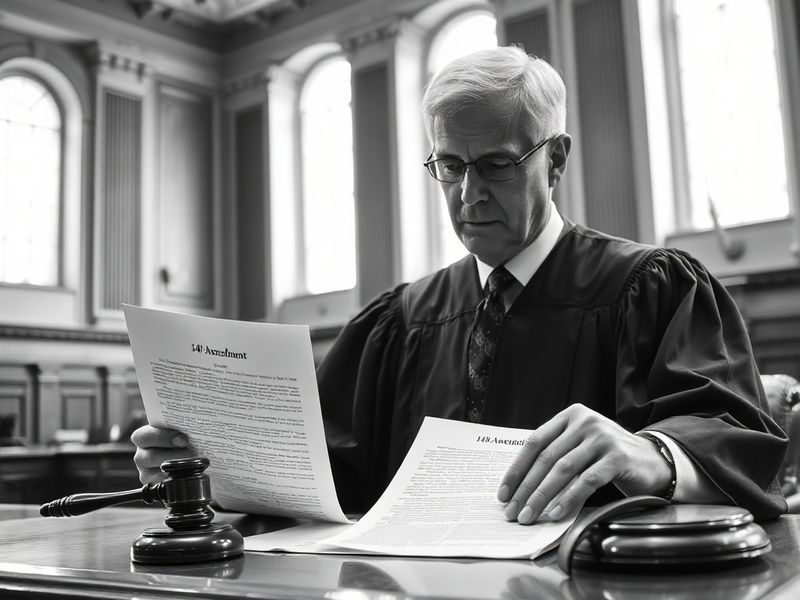
14th amendment
“`html
The 14th Amendment: A Constitutional Cornerstone and Its Modern Battles
First ratified in 1868, the 14th Amendment transformed American law by embedding equality and due process into the Constitution. Its clauses on citizenship, equal protection, and due process have become the legal foundation for civil rights movements, landmark Supreme Court rulings, and ongoing debates about justice in the United States.
The Historical Roots of the 14th Amendment
The 14th Amendment emerged from the ashes of the Civil War, a direct response to the failures of Reconstruction and the persistent oppression of formerly enslaved people. Drafted by the Radical Republicans in Congress, it sought to dismantle the Black Codes that restricted Black Americans’ rights in the South and to ensure federal protection of civil liberties against state infringement.
Its most consequential clauses—the Citizenship Clause, the Privileges or Immunities Clause, the Due Process Clause, and the Equal Protection Clause—were designed to reverse the Supreme Court’s decision in Dred Scott v. Sandford (1857), which had denied citizenship to Black Americans. The Equal Protection Clause, in particular, became a powerful tool for challenging segregation, discrimination, and systemic inequality, though its interpretation has evolved dramatically over time.
Key Provisions and Their Original Intent
- Citizenship Clause (Section 1): “All persons born or naturalized in the United States, and subject to the jurisdiction thereof, are citizens of the United States and of the state wherein they reside.” This clause overturned Dred Scott and established birthright citizenship, a principle still debated today in discussions about immigration and national identity.
- Due Process Clause (Section 1): “No state shall… deprive any person of life, liberty, or property, without due process of law.” This clause has been used to protect a wide range of rights, from fair trials to privacy, and has become a cornerstone of constitutional litigation.
- Equal Protection Clause (Section 1): “Nor shall any state… deny to any person within its jurisdiction the equal protection of the laws.” Though initially aimed at racial equality, this clause now underpins challenges to discrimination based on gender, sexual orientation, disability, and more.
- Enforcement Clause (Section 5): “The Congress shall have power to enforce, by appropriate legislation, the provisions of this article.” This provision gives Congress broad authority to pass laws ensuring the Amendment’s protections, a power that has been central to civil rights legislation like the Civil Rights Act of 1964 and the Voting Rights Act of 1965.
The Amendment’s Role in Shaping Civil Rights
The 14th Amendment’s legacy is most visible in the civil rights victories it enabled. In Brown v. Board of Education (1954), the Supreme Court relied on the Equal Protection Clause to declare racial segregation in public schools unconstitutional, overturning the “separate but equal” doctrine established in Plessy v. Ferguson (1896). This decision set the stage for the broader dismantling of Jim Crow laws and the expansion of voting rights.
Beyond racial equality, the Amendment has been invoked in cases involving reproductive rights, LGBTQ+ rights, and disability rights. In Roe v. Wade (1973), the Supreme Court cited the Due Process Clause to protect a woman’s right to choose, while in Obergefell v. Hodges (2015), it was used to legalize same-sex marriage nationwide. These rulings demonstrate the Amendment’s adaptability in addressing evolving notions of liberty and equality.
Landmark Cases That Redefined Its Scope
- Griswold v. Connecticut (1965): Established a constitutional right to privacy, which the Court found implicit in the Due Process Clause. This case paved the way for Roe v. Wade and later challenges to contraception bans.
- Loving v. Virginia (1967): Struck down state laws banning interracial marriage, affirming that the Equal Protection Clause prohibits racial discrimination in marital rights.
- Bolling v. Sharpe (1954): Applied the principles of Brown v. Board of Education to the District of Columbia, demonstrating that the Due Process Clause of the 5th Amendment could be interpreted similarly to the 14th Amendment’s Equal Protection Clause.
- United States v. Virginia (1996): Held that Virginia Military Institute’s male-only admissions policy violated the Equal Protection Clause, reinforcing the Amendment’s role in challenging gender discrimination.
Modern Battles and Controversies
Despite its transformative impact, the 14th Amendment remains a flashpoint in contemporary legal and political debates. Issues such as abortion rights, voting rights, immigration, and affirmative action have all hinged on interpretations of its clauses, often dividing courts and public opinion.
One of the most contentious modern applications is in the realm of abortion. The Supreme Court’s decision in Dobbs v. Jackson Women’s Health Organization (2022) overturned Roe v. Wade, arguing that the Constitution does not confer a right to abortion. This ruling sparked widespread outrage and renewed scrutiny of the Due Process Clause’s role in protecting unenumerated rights. Critics argue that the decision undermines the 14th Amendment’s promise of liberty, while supporters claim it restores the Amendment’s original intent by leaving such matters to the states.
Another contentious issue is birthright citizenship. Some legal scholars and politicians have argued that the Citizenship Clause should not apply to children of undocumented immigrants, despite the plain language of the Amendment and decades of legal precedent. This debate highlights broader tensions about immigration, national identity, and the scope of constitutional protections.
Challenges to Equal Protection
The Equal Protection Clause continues to be a battleground for disputes over affirmative action, voting rights, and police reform. In Students for Fair Admissions v. Harvard (2023), the Supreme Court ruled that race-conscious admissions programs at Harvard and the University of North Carolina violated the Equal Protection Clause, effectively ending affirmative action in college admissions. The decision has reignited debates about how to achieve racial equity in education and employment without explicitly considering race.
Similarly, challenges to voting rights laws—such as those restricting mail-in voting or gerrymandering districts—often invoke the Equal Protection Clause to argue that such measures disenfranchise minority voters. The Supreme Court’s 2013 decision in Shelby County v. Holder, which gutted key provisions of the Voting Rights Act, underscored the fragility of protections guaranteed by the 14th Amendment.
The Amendment’s Global Influence and Future Implications
The 14th Amendment’s principles have extended beyond U.S. borders, inspiring constitutional reforms and human rights movements worldwide. Countries from South Africa to India have cited its language and ideals in crafting their own constitutional protections for equality and due process. Its emphasis on universal rights has made it a touchstone for international law, particularly in the context of racial justice and discrimination.
Looking ahead, the 14th Amendment will likely remain at the center of legal and political struggles. Issues such as transgender rights, police brutality, and economic inequality all intersect with its provisions. For example, lawsuits challenging state laws that ban gender-affirming care for minors often rely on the Due Process Clause to argue that such bans violate parents’ rights to make medical decisions for their children. Similarly, activists are increasingly turning to the Equal Protection Clause to challenge systemic racism in policing and criminal justice.
The Amendment’s adaptability is both its strength and its vulnerability. While its broad language allows it to address new forms of discrimination, it also invites competing interpretations that can lead to judicial gridlock. The Supreme Court’s ideological divides, particularly on issues like abortion and affirmative action, suggest that the 14th Amendment will continue to be a site of intense legal and political conflict.
What’s Next for the 14th Amendment?
Several potential developments could reshape the Amendment’s role in American law:
- Congressional Action: Congress could pass new legislation to strengthen voting rights, address police reform, or expand protections for marginalized groups. However, partisan divisions and filibuster rules often stall such efforts.
- Supreme Court Rulings: Upcoming cases on issues like transgender rights, gun control, and environmental regulations may further define the limits of the 14th Amendment’s protections. The Court’s conservative supermajority could narrow its scope in some areas while expanding it in others.
- State-Level Reforms: States may take the lead in expanding protections where federal action stalls. For example, some states have already enshrined abortion rights in their constitutions, while others are pushing back against LGBTQ+ rights.
- Public Mobilization: Grassroots movements, such as those advocating for racial justice or immigrant rights, will continue to pressure lawmakers and courts to uphold the Amendment’s promises. The success of these movements often hinges on their ability to frame their struggles within the language of the Constitution.
Conclusion: A Living Document in Peril and Promise
The 14th Amendment stands as a testament to the enduring struggle for equality in America. Its clauses have been invoked to challenge injustice, expand liberty, and redefine the boundaries of constitutional rights. Yet, its legacy is not secure. As political divisions deepen and the Supreme Court’s rulings reshape its scope, the Amendment’s future hangs in the balance.
For those committed to justice, the 14th Amendment remains a vital tool—but also a reminder of the work left undone. Its promises are only as strong as the movements that demand their fulfillment. Whether through legislation, litigation, or public advocacy, the fight to realize the Amendment’s full