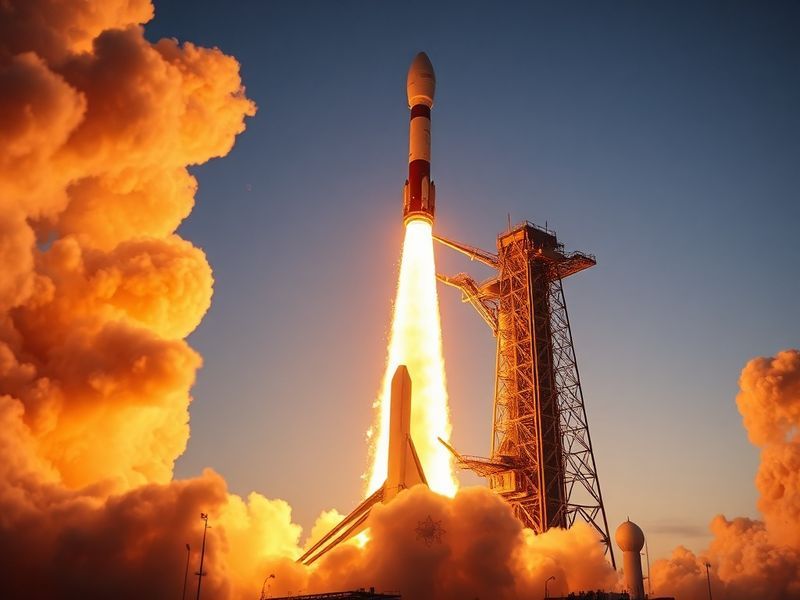
Falcon Heavy Launch: How SpaceX’s Rocket Changed Space Travel Forever
“`html
Falcon Heavy Launch: How SpaceX’s Rocket Redefines Space Travel
SpaceX’s Falcon Heavy has cemented its place in aerospace history not just as a technological marvel, but as a catalyst for the future of space exploration. When it roared into the Florida sky on its maiden voyage in February 2018, the rocket didn’t just carry a payload—it carried the aspirations of a new era in spaceflight. Nearly six years later, its impact continues to reverberate across industries, from satellite deployment to human missions to Mars.
The Falcon Heavy stands as the world’s most powerful operational rocket, capable of lifting nearly 64 metric tons into orbit—more than twice the payload of its closest competitor. Its success has forced competitors to rethink their strategies, inspired a generation of engineers, and proven that reusable rocketry could be the backbone of sustainable space travel. But beyond the headlines and record-breaking launches, the Falcon Heavy represents something deeper: a shift in how humanity views its relationship with the cosmos.
The Origins and Evolution of the Falcon Heavy
Elon Musk first teased the idea of a super-heavy lift vehicle in 2011, framing it as a stepping stone toward Mars colonization. At the time, skeptics questioned whether such a rocket was even necessary. NASA’s Space Launch System (SLS) was already in development, and traditional aerospace giants like Boeing and Lockheed Martin dominated the launch market. Yet SpaceX pursued a different path—one built on reusability, modularity, and relentless iteration.
The Falcon Heavy’s design leverages three Falcon 9 first-stage cores, strapped together to form a single, colossal launch system. This approach allowed SpaceX to minimize development costs by repurposing existing technology rather than starting from scratch. The result? A rocket that could deliver payloads to the Moon, Mars, or even beyond—all at a fraction of the cost of legacy systems.
Its first flight on February 6, 2018, was nothing short of cinematic. The rocket lifted off from Kennedy Space Center’s historic Launch Complex 39A—the same pad used for Apollo moon missions—amid a global audience. The payload was unconventional: Musk’s own Tesla Roadster, complete with a spacesuit-clad mannequin named “Starman” at the wheel. As the car drifted into deep space with David Bowie’s “Life on Mars?” playing on loop, the world watched in awe.
Key Milestones in the Falcon Heavy’s Journey
- 2011: Elon Musk publicly announces plans for the Falcon Heavy.
- 2017: SpaceX conducts a static fire test of the rocket’s center core.
- 2018: First successful launch, carrying Musk’s Tesla Roadster into a Mars-crossing orbit.
- 2019: First commercial mission ( Arabsat-6A ), demonstrating operational readiness.
- 2022: Launch of the USSF-44 mission for the U.S. Space Force, marking its first classified payload.
- 2023: First launch since 2019, carrying multiple payloads for the U.S. Department of Defense.
Why the Falcon Heavy Matters Beyond the Launchpad
The Falcon Heavy isn’t just a rocket—it’s a disruptor. Its existence has forced governments and corporations alike to recalibrate their space strategies. For NASA, it provided an alternative to the delayed and over-budget SLS program. For commercial satellite operators, it offered a cost-effective way to launch heavier payloads into geostationary orbit. And for aspiring spacefaring nations, it demonstrated that access to deep space was no longer the exclusive domain of superpowers.
One of its most understated contributions is economic. Traditional heavy-lift rockets cost hundreds of millions per launch. The Falcon Heavy, by contrast, advertises a price tag of around $90 million—less than a third of that. While launch costs fluctuate based on payload and mission complexity, the price differential has made high-mass missions feasible for organizations that previously couldn’t afford them.
The rocket has also played a pivotal role in national security. The U.S. Space Force has increasingly relied on SpaceX for rapid launches of critical satellites, including communications and reconnaissance platforms. The ability to deploy large payloads quickly—and at lower cost—has reshaped how the military thinks about space dominance.
The Road Ahead: What’s Next for the Falcon Heavy?
Despite its groundbreaking achievements, the Falcon Heavy faces both opportunities and challenges. On the one hand, SpaceX is shifting focus toward Starship, its next-generation, fully reusable launch system, which could eventually render the Falcon Heavy obsolete. On the other, the rocket remains the only operational super-heavy lift vehicle in the world—and demand for its services is growing.
Looking ahead, several missions could define the Falcon Heavy’s legacy. NASA’s upcoming Science missions, including potential Europa Clipper support, could leverage its heavy-lift capacity. Commercial ventures like lunar tourism and asteroid mining may also find a reliable partner in the Falcon Heavy, especially as private companies push the boundaries of off-world industry.
Yet challenges remain. The rocket’s infrequent launches—only six to date—raise questions about its long-term viability. SpaceX has prioritized Starship development, and without a steady cadence of missions, the Falcon Heavy risks becoming a niche player. Additionally, international competition is heating up. China’s Long March 9 and Russia’s Yenisei are in development, each aiming to challenge SpaceX’s dominance in heavy-lift rocketry.
What’s Ahead for Commercial Spaceflight?
The Falcon Heavy’s success has opened doors for an emerging ecosystem of space-based industries. Consider these developments:
- Lunar Gateway Assembly: NASA’s plans for a lunar orbital station may require multiple heavy-lift launches, where the Falcon Heavy could play a crucial role.
- Orbital Refueling: Advances in in-space refueling technology could allow the Falcon Heavy to launch fuel depots, extending mission ranges for smaller spacecraft.
- Deep Space Tourism: Companies like Space Adventures have proposed lunar flyby missions using the Falcon Heavy, offering private citizens a chance to see Earth from deep space.
- Military Innovation: The U.S. Department of Defense continues to explore responsive launch capabilities, where the Falcon Heavy could deploy constellations of satellites on short notice.
Conclusion: A Rocket That Changed the Trajectory of Spaceflight
The Falcon Heavy didn’t just launch a car into space—it launched a new chapter in human ambition. By proving that heavy-lift rocketry could be both powerful and affordable, SpaceX challenged the status quo and forced an entire industry to evolve. While its future may be intertwined with Starship, the Falcon Heavy’s legacy is already secure: it showed the world that space wasn’t just for governments and billionaires. It was for innovators, dreamers, and anyone willing to reach for the stars.
As we look toward the Moon, Mars, and beyond, the Falcon Heavy stands as a reminder that the most profound achievements often begin with a single, thunderous liftoff.