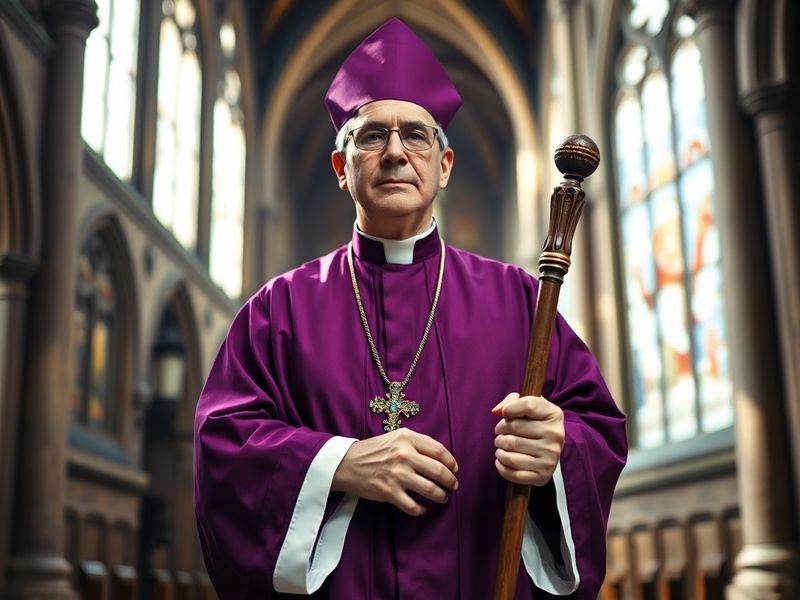
For over half a century, Bishop Richard Harries has stood at the intersection of faith and public life in Britain, earning respect across religious and secular divides. His career spans decades of theological scholarship, pastoral leadership, and advocacy for social justice. Few figures have shaped modern Anglican thought as profoundly as Harries, whose work has bridged the gap between traditional Christianity and contemporary ethical challenges.
Early Life and Spiritual Formation
Born in 1936 in Hampshire, England, Richard Harries grew up in a modest household where faith played a central role. His father was a schoolteacher, and his mother instilled in him a deep sense of Christian duty. From an early age, Harries felt drawn to the priesthood, a calling that would define his life’s work. After studying theology at Oxford University, he was ordained in 1961 and began his ministry in the Church of England.
His early years as a curate in London’s East End exposed him to the harsh realities of post-war urban poverty. This experience left a lasting impression, shaping his commitment to social justice—a theme that would recur throughout his career. By the 1970s, Harries had established himself as both a scholar and a pastor, earning a reputation for his thoughtful engagement with both scripture and contemporary society.
Theological Contributions and Public Influence
Harries’ theological work is marked by a rare combination of intellectual rigor and pastoral warmth. His writings—including books like The Re-enchantment of Morality and After the Evil: Christianity and Judaism in the Shadow of the Holocaust—explore how faith can remain relevant in an increasingly secular world. Unlike some traditionalists, Harries has never shied away from difficult questions, instead embracing dialogue with atheists, humanists, and those from other faith traditions.
One of his most notable contributions was his leadership in the Church of England during a period of rapid social change. As Bishop of Oxford from 1987 to 2006, he navigated complex debates over issues like same-sex relationships, women’s ordination, and the role of faith in public policy. His approach was one of measured reform, advocating for gradual change while maintaining theological integrity.
- Interfaith Dialogue: Harries has been a vocal advocate for interfaith understanding, particularly in relation to Judaism and Islam. His book God Outside the Box examines how different religious traditions can coexist without diluting their distinct beliefs.
- Ethics and Public Life: He has served on numerous government commissions, including the House of Lords, where he contributed to debates on bioethics, human rights, and social welfare.
- Art and Religion: A patron of the arts, Harries has written extensively on the relationship between spirituality and creativity, arguing that art can be a powerful medium for exploring faith.
A Legacy of Reconciliation and Reform
Beyond his theological writings, Harries is perhaps best known for his role in fostering reconciliation. In 1999, he helped establish the Council of Christians and Jews, an organization dedicated to combating antisemitism and promoting mutual understanding. His efforts in this area reflect a lifelong commitment to healing divisions, whether between faiths or within society itself.
Even after retiring as Bishop of Oxford in 2006, Harries has remained an influential voice. He has continued to write, lecture, and engage in public discourse, often addressing topics like climate change, economic inequality, and the ethical challenges of artificial intelligence. His latest book, The Image of God in the Human Person, re-examines the biblical concept of imago Dei in light of modern science and philosophy.
Harries’ influence extends beyond the Church of England. He has been a visiting professor at universities in the UK and abroad, and his work has been recognized with numerous honors, including a knighthood in 2003 for services to religion. Yet, for all his achievements, those who know him describe him as remarkably humble—a man who sees his role not as a leader of the faithful but as a servant of both God and humanity.
Reflections on a Life Well-Lived
As Richard Harries approaches his ninth decade, his legacy is one of thoughtful engagement with the world. He has shown that faith need not be a relic of the past but can be a living, evolving force that speaks to the concerns of each generation. His willingness to engage with doubt, his commitment to justice, and his belief in the power of dialogue offer a model for how religion can remain relevant in a pluralistic society.
For younger generations seeking to reconcile faith with modern challenges, Harries’ life provides both inspiration and a challenge. His work reminds us that theology is not just an academic exercise but a call to action—a call to build a more just, compassionate, and thoughtful world. In an era where religion is often polarizing, his voice stands out as a rare example of how faith can bridge divides rather than deepen them.
Whether through his sermons, his books, or his public service, Richard Harries has demonstrated that the role of a religious leader is not to retreat from the world but to engage with it—critically, compassionately, and courageously. In doing so, he has left an indelible mark on both the Church and the wider society.
For those interested in exploring similar themes, you may wish to read more about Culture or Education on Dave’s Locker.