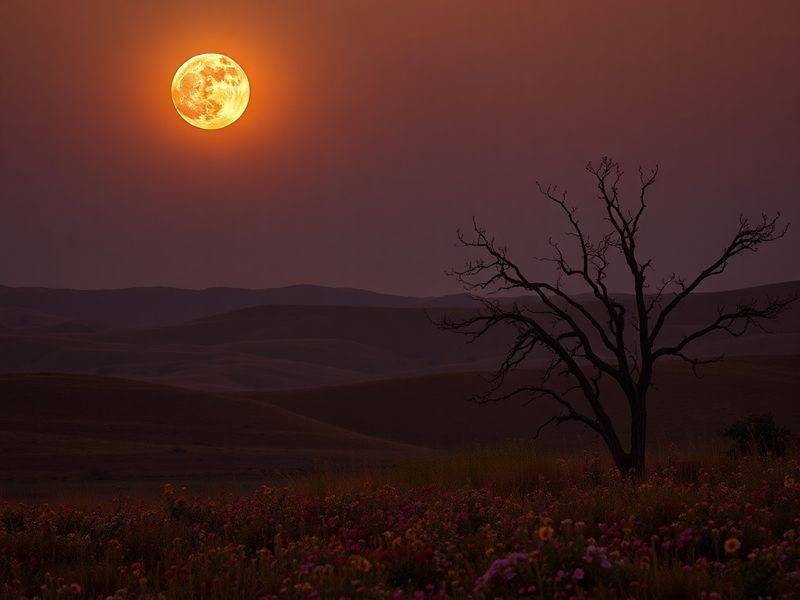
The Flower Moon Arrives: A Celestial Event Rooted in Tradition
The Flower Moon, the full moon of May, marks the height of spring’s bloom across the Northern Hemisphere. Named by Indigenous peoples of North America, this lunar phase coincides with the season when flowers burst into color across meadows and forests. Its arrival is both a natural spectacle and a reminder of humanity’s enduring connection to the rhythms of the Earth.
Unlike the more widely recognized Harvest Moon or Hunter’s Moon, the Flower Moon carries a quieter significance. It does not dominate agricultural calendars or hunting seasons but instead reflects the subtler transformations of spring. This year, the Flower Moon will reach peak fullness on May 23, visible in the night sky just as lilacs, peonies, and irises begin their seasonal display.
A Name Rooted in Indigenous Heritage
The term “Flower Moon” originates from the Algonquin tribes, who named each full moon to track the passage of time. Their lunar calendar served as a guide for planting, fishing, and gathering. For these communities, the May moon signaled the optimal time to cultivate crops and collect medicinal herbs. The name reflects not just botanical abundance but also the practical wisdom of those who lived in close harmony with nature.
Other Indigenous groups gave the May full moon different names, each tied to regional ecosystems. The Dakota people called it the “Moon When Leaves Are Green,” while the Ojibwe referred to it as “Zaagibagaa-giizis,” or “Budding Moon.” These variations highlight how lunar cycles were observed differently across North America, long before European colonization reshaped cultural traditions.
The Flower Moon Beyond North America: Global Interpretations
While the Flower Moon is most commonly associated with Native American traditions, similar celebrations of spring’s peak appear worldwide. In Asia, particularly in China and Japan, the full moon of May aligns with the festival of Baihui in Taoist tradition, a time to honor deities of agriculture and fertility. Lanterns are hung in temples, and families gather to share mooncakes, though these festivities occur in autumn under the Harvest Moon in the lunar calendar.
In Europe, ancient Celtic festivals marked the Flower Moon with bonfires and floral offerings. The Roman goddess Flora, deity of blossoms and spring, was honored during this season with games and rituals. These traditions persisted even after Christianization, blending into traditions like May Day celebrations, where flowers and greenery remain central.
For some cultures, the Flower Moon carries spiritual significance. In Hinduism, the full moon of Vaishakha (April-May) is celebrated as Buddha Purnima, commemorating the birth, enlightenment, and death of Siddhartha Gautama. While not directly tied to flowers, the timing aligns with the blooming season in northern India, where temples are adorned with garlands and lotus flowers.
How to Observe the Flower Moon in 2024
Viewing the Flower Moon requires little more than clear skies and a willingness to look up. Unlike solar events, no special equipment is needed to witness its full glory. Here are a few ways to mark the occasion:
- Timing and Visibility: The Flower Moon will reach peak illumination on May 23 at 9:53 AM EDT (13:53 UTC), but it will appear full for about three days surrounding this time. It rises in the east at sunset and sets in the west at dawn, making it visible for most of the night.
- Photography Tips: For those capturing the moment, a tripod and a camera with manual settings will help. A low ISO (100-400) and a wide aperture (f/2.8–f/5.6) will preserve detail in the moon’s craters while avoiding overexposure.
- Cultural Rituals: Some communities gather to share stories, plant seeds, or create flower crowns as a nod to the moon’s namesake. Even a simple act, like arranging fresh blooms on a windowsill, connects observers to centuries-old traditions.
- Urban Stargazing: Light pollution can dampen the experience, but apps like SkyView or Star Walk can help locate the moon even in city environments. Parks or elevated areas often provide the best vantage points.
The Science Behind the Moon’s Bloom
From an astronomical perspective, the Flower Moon is no different from other full moons. It occurs when the Earth is positioned directly between the sun and the moon, fully illuminating its face. What makes it special is its timing within the seasonal cycle. The moon’s orbit is tilted by about 5 degrees relative to Earth’s, which is why not every full moon results in an eclipse.
Yet, the moon’s appearance can vary slightly due to atmospheric conditions. A “supermoon” occurs when the moon is at its closest point to Earth (perigee), making it appear up to 14% larger and 30% brighter. The Flower Moon of 2024 will not be a supermoon, but it remains a striking sight, especially when low on the horizon, where atmospheric distortion can create a warm, golden hue.
Meteorologists also note that the Flower Moon often coincides with increased atmospheric moisture, leading to clearer nights in many regions. This transparency enhances visibility, allowing observers to spot not just the moon but also planets like Jupiter and Saturn, which may appear nearby in the night sky.
Preserving the Tradition in Modern Times
As urbanization and digital culture reshape how we experience nature, the Flower Moon offers a chance to reconnect with Earth’s rhythms. For Indigenous communities, the naming of the moon remains a living tradition, passed down through generations. Efforts to revive and honor these names—such as those promoted by the National Museum of the American Indian—help preserve linguistic and cultural heritage.
In an era where artificial light obscures the night sky for many, events like the Flower Moon serve as a reminder of the cosmos’s enduring presence. Schools and environmental groups increasingly use such phenomena to teach astronomy, ecology, and cultural history, bridging science and tradition.
Whether observed alone or shared with others, the Flower Moon invites reflection on the cycles that govern both the natural world and human culture. It is a moment to pause, look up, and recognize the quiet beauty of a world in full bloom.