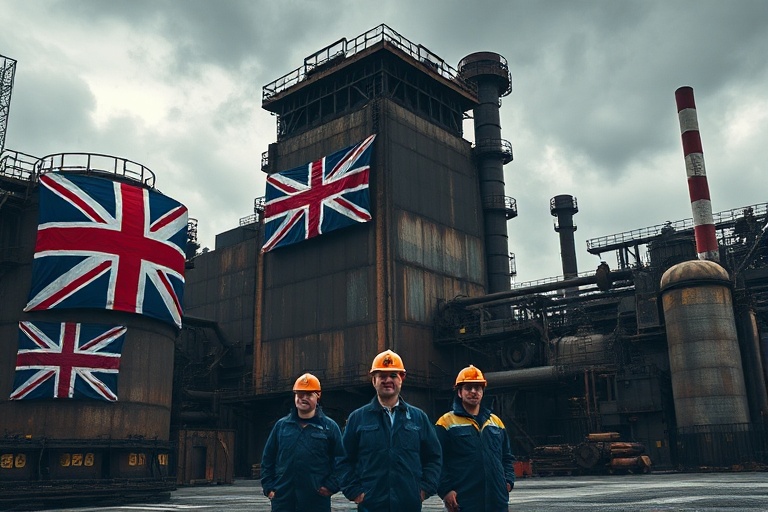
british steel nationalisation
In late 2023, the United Kingdom took a decisive step toward revitalising its steel industry by announcing plans to nationalise British Steel. The move, which involved a £100 million government loan followed by a full acquisition, marked a significant departure from decades of privatisation and market-driven industrial policy. For a sector that has faced relentless global competition and domestic challenges, this intervention raises critical questions about the future of British manufacturing, economic sovereignty, and industrial strategy.
The decision did not emerge in a vacuum. British Steel, once a cornerstone of the UK’s industrial heritage, has struggled to compete against state-subsidised competitors in China, India, and Europe. Years of financial instability culminated in a series of ownership changes, culminating in its purchase by the Chinese Jingye Group in 2020. While Jingye invested heavily, concerns persisted about long-term viability, job security, and strategic control over a critical supply chain asset.
The Background: A Sector in Decline
Britain’s steel industry has been in gradual decline for decades. In the 1970s, the UK produced over 20 million tonnes of steel annually. By 2023, that figure had fallen to under 7 million tonnes. The closure of iconic plants like Redcar in 2015 and the near-collapse of Tata Steel’s Port Talbot operations in 2021 highlighted the fragility of the sector. These closures eliminated thousands of jobs and left the country increasingly dependent on imported steel for construction, automotive, and defence industries.
A 2022 report by the House of Commons Business Committee warned that Britain risked losing its entire steelmaking capacity without urgent intervention. The report cited unfair trade practices, high energy costs, and insufficient investment as key factors. Against this backdrop, the government’s decision to nationalise British Steel was framed not as ideological preference, but as a pragmatic response to prevent further erosion of industrial capability.
Critics, however, argue that nationalisation alone will not solve the structural issues plaguing the sector. They point to the historical failures of state-owned enterprises in the UK, such as British Leyland, and question whether government ownership can deliver the innovation and efficiency needed to compete globally.
Why Nationalise Now? Strategic and Economic Justifications
The government’s case for nationalisation rested on three main pillars: national security, economic resilience, and the transition to green steel production. Steel remains essential for defence, infrastructure, and energy projects—including wind turbines and nuclear reactors. A 2023 report from the Royal United Services Institute (RUSI) emphasised that reliance on foreign steel posed risks to supply chain continuity in times of geopolitical tension.
Energy costs have also been a critical factor. British Steel’s Scunthorpe plant, the company’s largest site, consumes vast amounts of electricity. With the UK’s energy prices among the highest in Europe, maintaining competitiveness has been difficult. The government’s net-zero agenda further complicates this equation. To meet 2050 carbon targets, the steel sector must adopt hydrogen-based or carbon capture technologies—processes that require substantial public investment and coordination.
In announcing the takeover, Business Secretary Kemi Badenoch stated, “This is not about ideology—it’s about ensuring we have the industrial capacity to support our economy and protect our national interest.” The government pledged to invest £500 million over five years to modernise infrastructure and transition to low-carbon steelmaking at Scunthorpe.
- National security: Domestic steel production ensures supply chain resilience for defence and critical infrastructure.
- Green transition: Public ownership allows coordinated investment in hydrogen-based or electric arc furnace technologies.
- Job protection: Direct control over operations can stabilise employment in regions like Lincolnshire and North Yorkshire.
- Strategic assets: Scunthorpe remains one of the few remaining integrated steelworks in the UK, capable of producing high-quality steel from raw materials.
Challenges and Criticisms: Can the State Run a Steel Mill?
Despite the strategic rationale, significant challenges lie ahead. Public ownership does not automatically guarantee efficiency or innovation. The UK’s track record with nationalised industries is mixed. British Rail, for instance, became synonymous with inefficiency before privatisation, while the Royal Mail required later government intervention to stabilise its pension fund.
Opposition parties and business groups have raised concerns about political interference, bureaucratic inefficiency, and the risk of underfunding. The British Chambers of Commerce warned that government ownership could distort market signals and delay necessary restructuring. “Industries need to adapt or die,” said a spokesperson. “While support is welcome, it must not shield companies from the realities of global competition.”
Another concern is the cost to taxpayers. The initial £100 million loan was just the beginning. Analysts estimate the full cost of modernisation and restructuring could exceed £2 billion over a decade. With public finances under strain, critics argue that these funds could be better allocated to R&D or green energy infrastructure rather than propping up a single company.
There are also questions about leadership and governance. Unlike private firms, state-owned enterprises often face challenges in attracting top-tier management and maintaining accountability. The government has promised an independent board, but sceptics question whether political appointments could undermine operational independence.
Global Context: A Trend Toward Industrial Statecraft
While the UK’s move may seem unusual in an era of deregulation, it reflects a broader global trend. The United States, under the Inflation Reduction Act, is pouring billions into domestic semiconductor and clean energy manufacturing. The European Union has similarly approved state aid for green steel initiatives in Germany and Sweden. Even traditionally free-market economies like Japan and South Korea have used industrial policy to protect strategic sectors.
In this context, British Steel’s nationalisation can be seen as part of a wider reassertion of industrial policy—not as a retreat from globalisation, but as an adaptation to its risks. The shift reflects growing recognition that certain industries are too vital to be left entirely to market forces, especially in the face of climate urgency and geopolitical instability.
Yet, the UK’s approach remains cautious. Unlike France or Germany, where state involvement in industry is more entrenched, Britain’s industrial policy has historically favoured private ownership with targeted support. The British Steel case, therefore, represents a pragmatic middle path—one that acknowledges market failure without embracing full-scale dirigisme.
As the government finalises its ownership transfer and begins the long process of modernisation, the success or failure of this experiment will be closely watched. If it stabilises jobs, reduces carbon emissions, and secures supply chains, it could pave the way for similar interventions in other sectors. If it leads to inefficiency, cost overruns, or technological stagnation, it may reinforce the view that state ownership belongs in the past.
Conclusion: A New Chapter or a Temporary Fix?
British Steel’s nationalisation is neither a miracle cure nor a reckless gamble—it is a calculated risk in a high-stakes environment. The steel industry’s future will depend not only on government investment, but on global demand, energy prices, and technological breakthroughs. What is clear is that the UK can no longer afford to take its industrial base for granted.
For workers in Scunthorpe and communities that have relied on steel for generations, the decision offers hope. For policymakers, it demands humility and long-term vision. And for the rest of us, it serves as a reminder that the invisible hand of the market is not always sufficient to build a resilient economy.
As the government prepares to unveil its five-year plan for British Steel, one thing is certain: this is more than a corporate rescue—it is a test of whether Britain can still make things, and whether it still believes in doing so.
To learn more about the UK’s industrial policy and its impact on regional economies, visit our Economy section. For analysis on global manufacturing trends, see our Business category.