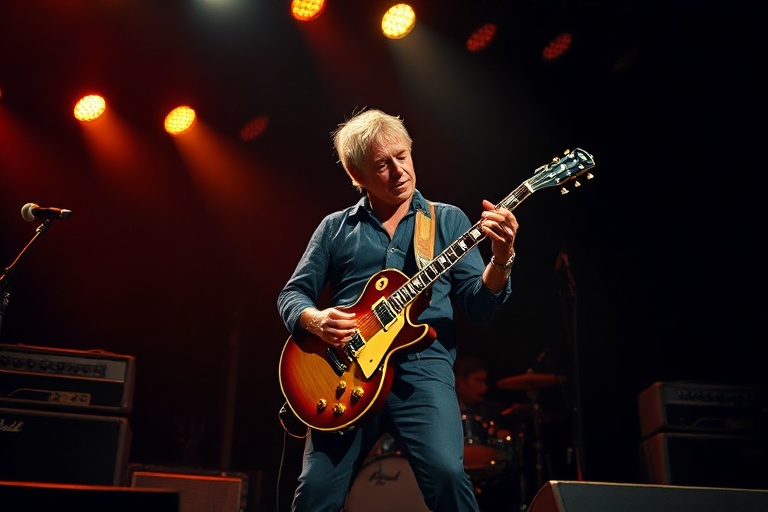
Few names in rock and blues history carry the weight and respect of Eric Clapton. Born in Ripley, Surrey, in 1945, Clapton’s journey from a young guitar enthusiast to a global icon spans more than six decades. His career has been marked by innovation, reinvention, and an uncompromising dedication to the craft of music. From his early days with The Yardbirds to his groundbreaking work with Cream and beyond, Clapton has continually redefined what it means to be a guitarist and a musician.
What sets Clapton apart is not just his technical brilliance but his ability to convey deep emotion through his playing. Whether bending a string with soulful precision or crafting a solo that lingers in the mind, his influence is woven into the fabric of modern music. This article explores the milestones, the music, and the man behind the legend.
The Early Years: A Prodigy’s Ascent
Clapton discovered the guitar at 13, inspired by blues records from American artists like Muddy Waters and B.B. King. Unlike many of his peers, he immersed himself in the recordings, studying every note. By 16, he was performing in local pubs, though his early bands—such as The Yardbirds—were often short-lived. His real breakthrough came when he joined John Mayall & the Bluesbreakers in 1965. It was there that his reputation as “Slowhand” began to grow, thanks to his fiery solos and a stage presence that commanded attention.
His time with Cream in 1966 solidified his status as a guitar legend. The band’s improvisational style allowed Clapton to showcase his virtuosity, particularly on tracks like “Crossroads” and “Sunshine of Your Love.” Yet, despite his success, he left Cream in 1968, seeking a new direction. This restlessness would become a defining trait of his career, pushing him to explore different genres and collaborations.
Musical Reinvention: From Blues to Crossroads of Genre
Clapton’s discography reads like a roadmap of musical evolution. After Cream, he formed Blind Faith, then Delaney & Bonnie and Friends, before embarking on a solo career in 1970. His self-titled debut album featured the iconic “After Midnight,” produced by Delaney Bramlett, which showcased a smoother, more polished sound. Yet, it was Layla and Other Assorted Love Songs, recorded with Derek and the Dominos in 1970, that cemented his legacy. The album’s title track, “Layla,” remains one of the most powerful love songs ever written, fueled by Duane Allman’s slide guitar and Clapton’s searing solos.
Throughout the 1970s, Clapton experimented with blues, rock, and even reggae. His 1974 album 461 Ocean Boulevard introduced a reggae-infused version of “I Shot the Sheriff,” bringing him mainstream success. This era also marked his struggles with addiction, a battle that would resurface throughout his life but never derail his artistic output. By the 1980s, he embraced pop sensibilities on albums like Behind the Sun, though purists often criticized these deviations. Yet, Clapton’s willingness to evolve kept him relevant across generations.
Collaborations That Shaped a Generation
Clapton’s career is also defined by his collaborations with other legends. His work with George Harrison on The Concert for Bangladesh in 1971 highlighted his versatility, while his friendship with B.B. King led to a blues summit on the 1985 album Behind the Sun. In the 1990s, he reunited with old friends for the Unplugged sessions, which won six Grammy Awards and redefined his acoustic approach. These partnerships underscore his role not just as a guitarist, but as a unifier of musical voices.
The Man Behind the Guitar: Personal Struggles and Triumphs
Clapton’s personal life has often mirrored the turbulence of his professional journey. His relationships with Pattie Boyd—first married to George Harrison—and later with model Melia McEnery have been well-documented. His battles with heroin and alcohol addiction in the 1970s and 1980s are part of his story, though he has spoken openly about overcoming them. In 1998, he founded the Crossroads Centre in Antigua, a rehab facility for substance abuse, reflecting his commitment to helping others.
Despite these struggles, Clapton’s resilience is evident in his music. His 2001 album Reptile and the 2006 live release Live in San Diego proved he could still deliver performances that rivaled his youth. Even in his seventh decade, he continues to tour, proving that passion and discipline can defy time.
A Legacy That Endures
Clapton’s impact on music is immeasurable. He is one of only three artists inducted into the Rock & Roll Hall of Fame three times—once as a solo artist, once with Cream, and once with Yardbirds. His influence extends beyond rock and blues; his solos have inspired generations of musicians, from Slash to John Mayer. Yet, Clapton remains grounded, often citing his love for blues as his guiding force.
What makes Clapton’s legacy enduring is not just his technical skill, but his authenticity. He has never chased trends for the sake of fame. Instead, he has followed his instincts, whether recording a blues standard, collaborating with a pop artist, or performing a stripped-down acoustic set. His 2021 album The Lady in the Balcony: Live in Montreal is a testament to this consistency, featuring his signature phrasing and emotional depth.
For those who follow his career, Clapton’s story is one of perseverance, reinvention, and quiet brilliance. He has seen the highs of superstardom and the lows of personal loss, yet his music remains a constant—an emotional anchor for millions. As he enters his eighth decade, his relevance shows no signs of fading.
Essential Eric Clapton Tracks to Explore
For newcomers or longtime fans, these tracks offer a snapshot of Clapton’s range:
- “Layla” (Derek and the Dominos, 1970) – The ultimate guitar anthem, blending raw emotion with technical mastery.
- “Crossroads” (Cream, 1968) – A live staple that showcases Clapton’s improvisational genius.
- “Tears in Heaven” (1992) – A heartbreaking ballad born from personal tragedy, highlighting his songwriting depth.
- “Badge” (Cream, 1969) – A collaborative gem with George Harrison, featuring one of Clapton’s most memorable solos.
- “Sunshine of Your Love” (Cream, 1967) – A psychedelic blues-rock classic that defined a generation.
Eric Clapton’s career is a reminder that true artistry is not about staying the same, but about evolving while staying true to oneself. Whether you’re a die-hard fan or a casual listener, his music offers something to discover—and rediscover—with every listen.
For more on legendary guitarists and their impact, explore our Music News section. To dive deeper into the evolution of rock and blues, visit our Culture category.