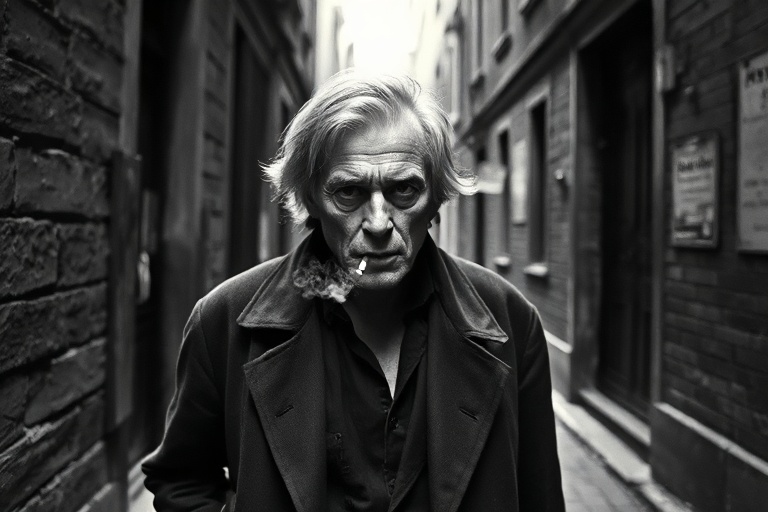
Klaus Kinski remains one of cinema’s most polarizing yet unforgettable figures. His performances were electric, his persona volatile, and his collaborations with director Werner Herzog legendary—both for their brilliance and their explosive conflicts. Beyond the screen, Kinski crafted an identity that merged artistic genius with unbridled eccentricity, leaving an indelible mark on global cinema.
Born Klaus Günter Karl Nakszyński in 1926 in Danzig (now Gdańsk, Poland), Kinski’s early life was marked by hardship. His mother was a nurse, his father a pharmacist, and their strict household fueled his rebellious spirit. By his late teens, he fled to Berlin, where he survived through odd jobs before discovering theater. His stage presence was magnetic, drawing comparisons to the great classical actors of his time. Yet it was film that would cement his legacy, particularly through his work with Herzog in the 1970s and 1980s.
The Herzog-Kinski Collaboration: A Relationship Like No Other
The partnership between Kinski and Werner Herzog is the stuff of cinematic lore. Their five films together—Aguirre, the Wrath of God (1972), Nosferatu the Vampyre (1979), Woyzeck (1979), Fitzcarraldo (1982), and Cobra Verde (1987)—are masterpieces of New German Cinema. Their dynamic was intense, often descending into screaming matches on set. Herzog has recounted how Kinski once threatened to leave mid-shoot, only to return after being paid more. Yet this volatile relationship produced some of the most visually stunning and thematically profound films of the 20th century.
Their films often explored themes of obsession, madness, and the sublime futility of human endeavor. Kinski’s performances were raw, his physicality unmatched, and his voice—a deep, guttural growl—became synonymous with characters teetering on the edge of sanity. In Aguirre, he played a conquistador descending into madness in the Amazon; in Nosferatu, he embodied the vampire as a tragic, almost poetic figure. Herzog once said of Kinski, “He was a volcano, and I was the man who stood too close.”
Kinski’s Global Influence: Beyond Germany
While Kinski is often associated with German cinema, his influence extended far beyond Europe. In Italy, he worked with directors like Luchino Visconti in Death in Venice (1971), where his portrayal of a tormented composer opposite Björn Andrésen’s Tadzio became iconic. The film won the Grand Prix at Cannes and solidified Kinski’s reputation as an actor capable of conveying profound psychological depth.
In the United States, Kinski remained a cult figure. His collaborations with American directors were fewer but no less impactful. He appeared in films like The Great Gatsby (1974) and Venom (1981), though these roles often played second fiddle to his European work. Nevertheless, American audiences who discovered Aguirre or Nosferatu were left in awe of his intensity. His ability to command the screen with little more than a glare or a whispered line made him a favorite among cinephiles worldwide.
Kinski’s global appeal lay in his universality. Whether playing a mad explorer, a vampire, or a doomed aristocrat, he embodied a kind of primal, almost mythic energy. His performances transcended language barriers, making him a figure of fascination in Japan, Latin America, and beyond. Even today, his influence can be seen in actors who prioritize raw emotional truth over technical precision.
The Man Behind the Myth: Kinski’s Personal Life and Philosophy
Kinski was as complex off-screen as he was on it. He authored several books, including his controversial autobiography I Must Say These Things to You (1975), in which he laid bare his violent temper, his struggles with depression, and his uncompromising views on art and life. He saw himself as a tormented genius, a man destined to suffer for his craft. His relationships with women were tumultuous, marked by multiple marriages and allegations of abuse. Yet he also had a softer side, nurturing his daughter Pola Kinski, who would later become an actress herself.
Kinski’s philosophy was one of extremes. He believed in art as a form of spiritual warfare, a battle against mediocrity and comfort. “I am not an actor,” he once declared. “I am a force of nature.” This self-mythologizing extended to his public persona. He was known for his temper tantrums, his refusal to suffer fools, and his disdain for the trappings of Hollywood. In an era where actors were increasingly polished and professional, Kinski was deliberately unpolished, a relic of a bygone era of theatrical excess.
Legacy and Modern Echoes
Kinski’s death in 1991 at the age of 65 marked the end of an era. Yet his legacy endures. Directors like Werner Herzog, David Lynch, and even modern auteurs like Ari Aster cite Kinski as an influence. His performances remain studied in acting schools, and his films continue to be rediscovered by new generations. In 2015, the documentary Kinski, The Image of an Actor offered fresh insights into his life, using never-before-seen footage and interviews to paint a more nuanced portrait of the man behind the myth.
Today, Kinski’s films are available on streaming platforms, ensuring his work reaches wider audiences than ever before. His influence can also be seen in the rise of antiheroes in cinema, characters who are flawed, violent, and deeply human. In a film landscape often dominated by CGI and formulaic storytelling, Kinski’s raw, unfiltered performances feel more vital than ever.
For those new to his work, diving into Kinski’s filmography can be a revelatory experience. Start with Aguirre, the Wrath of God for its breathtaking landscapes and Kinski’s mesmerizing performance, or Nosferatu for a vampiric portrayal that’s as poetic as it is chilling. Each film offers a glimpse into a singular talent, one that refused to conform to expectations.
As cinema continues to evolve, Kinski’s place in its pantheon is secure. He was more than an actor; he was a force of nature, a man who lived—and acted—with unparalleled intensity. In an industry that often prioritizes safety over risk, Kinski’s fearlessness is a reminder of what cinema can achieve when it dares to push boundaries.
Kinski’s life and career are a testament to the power of art to challenge, provoke, and inspire. He was a man who burned bright and fast, leaving behind a body of work that continues to captivate and unsettle. In the words of Werner Herzog, “Kinski was not a man. He was a hurricane.” And hurricanes, as we know, leave their mark on the landscape long after they’ve passed.